15 October 1987 – 15 October 2026: 39 Years After His Assassination
By Franck Essi
“We have chosen to risk taking new paths in the pursuit of a better life.”
Thomas Sankara, address to the United Nations General Assembly, New York, 4 October 1984.
In just four years in power, Thomas Sankara set out to transform the state, the economy and society. His speeches and actions reveal a political vision rooted in sovereignty, popular participation, social justice, women’s emancipation and the accountability of leaders. Revisiting his words helps us understand this ambition, while also examining the methods he employed, the results he achieved and the contradictions of his experience.
On 15 October 1987, Thomas Sankara, President of Burkina Faso, was assassinated in Ouagadougou alongside twelve of his comrades. He was only 37 years old. Having come to power on 4 August 1983, he had launched a revolution intended to profoundly transform his country and contribute to the emancipation of African peoples.
Thirty-nine years after his death, his name continues to symbolise, for many, the struggle against imperialism, integrity in leadership, African sovereignty and women’s emancipation.
But beyond the images, slogans and tributes, what do we really know about his political thought and vision? What did he want to change? What kind of society did he seek to build? How did he understand power, development, and the responsibilities of leaders and citizens?
To understand Sankara, we must first recognise the coherence of his political project. He believed that political independence meant little if peoples remained economically dependent, if wealth continued to benefit a privileged minority, and if relations of domination persisted within society. Transformation therefore had to address institutions, the economy, social relations, individual behaviour and relationships with the outside world simultaneously.
This vision was rooted in African anti-imperialist revolutionary traditions and strongly influenced by Marxist analyses of class relations and exploitation. It was notably articulated in the Political Orientation Speech of 2 October 1983, a collective programme of the National Council of the Revolution (CNR), presented and delivered by Sankara.
Returning to his words does not mean treating him as a providential leader or a model to be mechanically reproduced. It means discovering his ideas, appreciating their significance, examining their limitations and reflecting on what they can still teach us today.
For the great figures of our history should not merely be celebrated. They should also be studied, understood, discussed and critically examined.
The following quotations offer an introduction to eight essential dimensions of Sankara’s political thought and vision. They do not encompass his entire intellectual legacy or the full experience of the Burkinabè revolution. They are intended as a starting point and an invitation to explore further.
I – SANKARA ON TRANSFORMING SOCIETY, NOT MERELY CHANGING ITS LEADERS
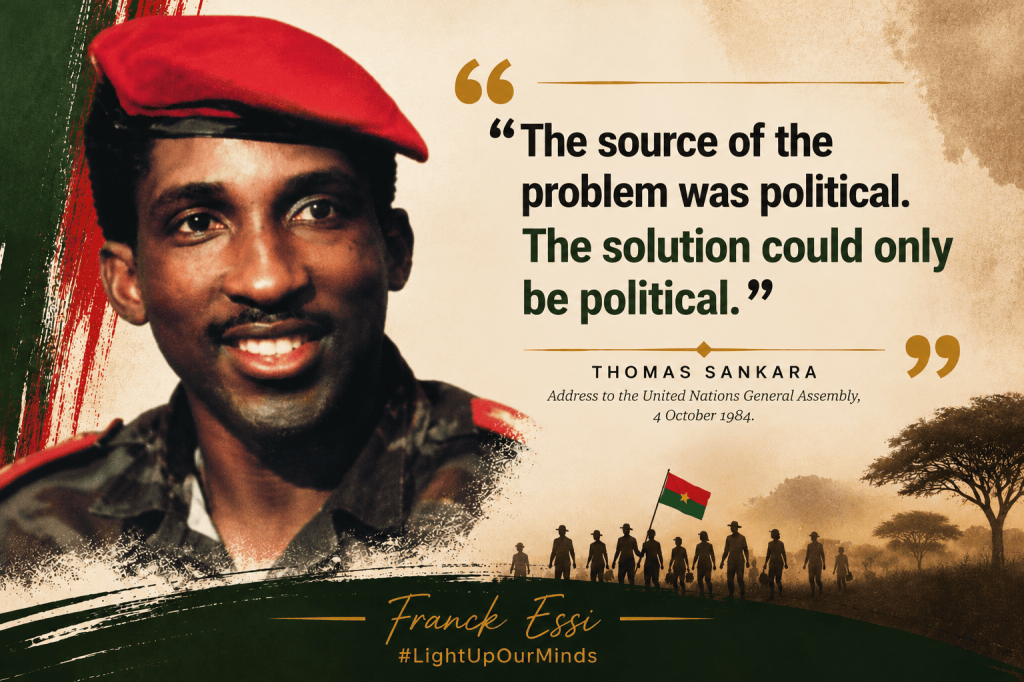
“The source of the problem was political. The solution could only be political.”
Thomas Sankara, address to the United Nations General Assembly, 4 October 1984.
“In essence, neocolonial society and colonial society do not differ in any way.”
Thomas Sankara, Political Orientation Speech, 2 October 1983.
These statements reveal one of the foundations of Sankara’s political thought. For him, the difficulties facing ordinary people were not simply the result of insufficient resources, skills or technical means. They were also rooted in political choices, power relations and a social order that preserved the privileges of a minority.
His analysis was grounded in a critique of neocolonialism, a situation in which a country is formally independent but remains subject to economic, political or cultural domination. Formal independence was therefore insufficient to guarantee the genuine freedom of a people.
National leaders could replace colonial administrators without transforming the mechanisms of domination, economic structures or relationships between rulers and citizens.
This is why Sankara advocated a democratic and popular revolution. In the political language of his time, this meant a profound transformation of power relations, intended to transfer authority from groups considered dominant to the working and popular classes. His project was therefore grounded in an understanding of society shaped by social classes, exploitation and conflicts of interest.
He did not simply want to replace those at the top of the state. He sought to transform institutions, public administration, the economy and social relations.
Changing leaders does not necessarily mean changing the system. Genuine political transformation must also address the rules, institutions, practices and mechanisms that produce injustice. Otherwise, new leaders risk reproducing the very problems they promised to overcome.
II – SANKARA ON ORGANISING THE PEOPLE SO THEY CAN GENUINELY EXERCISE POWER
“The objective of this revolution is to enable the people to assume power.”
Thomas Sankara, Political Orientation Speech, 2 October 1983.
“The democratic character of this revolution requires us to decentralise and deconcentrate administrative power in order to bring the administration closer to the people and make public affairs a matter of concern to everyone.”
Thomas Sankara, Political Orientation Speech, 2 October 1983.
These words demonstrate the central place Sankara wanted ordinary citizens to occupy in political life. For him, people should not merely support their leaders, attend demonstrations or applaud decisions made in their name. They should organise themselves, participate in public affairs and contribute directly to transforming their living conditions.
The Committees for the Defence of the Revolution (CDRs), established in neighbourhoods, villages, public institutions and workplaces, were central to this ambition.
The idea was to make popular organisation a means of political participation, collective mobilisation and implementation of reforms. The people were not supposed to remain passive beneficiaries of public policies. They were also expected to become active agents of change.
Yet this approach raised a fundamental question: how can organisations created in the name of the people be kept genuinely accountable to them?
The experience of the CDRs revealed the limitations of this ambition. Alongside their mobilisation and development activities, some committees became associated with abuses of power, coercive practices and restrictions on individual freedoms.
Mobilising citizens is therefore not enough to guarantee their sovereignty. They must also be free to organise, debate, choose their representatives, hold leaders accountable and challenge their decisions.
A genuinely sovereign people is not merely a people that can be mobilised. It is also a people that can challenge those who govern in its name.
III – SANKARA ON BUILDING GENUINE POLITICAL AND ECONOMIC SOVEREIGNTY
“We swear, we proclaim, that from now on, nothing will be done in Burkina Faso without the participation of the Burkinabè people. Nothing that has not first been decided and developed by us.”
Thomas Sankara, address to the United Nations General Assembly, 4 October 1984.
“Produce in Africa, process in Africa and consume in Africa.”
Thomas Sankara, speech on debt at the Organisation of African Unity summit, Addis Ababa, 29 July 1987.
In Sankara’s political thought, sovereignty was not limited to having a flag, a national anthem, an African government or international recognition.
It required peoples to possess the actual capacity to determine their priorities, formulate their policies and mobilise the resources necessary to implement them.
This explains the importance he attached to domestic production, agriculture, processing raw materials, local consumption and skills development.
It was not enough to denounce external dependencies. The capacities needed to overcome them had to be built.
This was the thinking behind the revolutionary government’s promotion of products made in Burkina Faso, the use of locally produced textiles and initiatives aimed at developing agricultural production and rural infrastructure.
The renaming of Upper Volta as Burkina Faso on 4 August 1984 also reflected the determination to assert a new political and national identity.
But sovereignty was not meant to remain symbolic. It had to be reflected in the organisation of the economy and improvements in people’s living conditions.
This ambition raises a question that remains relevant today: how do we build sovereignty that goes beyond denouncing foreign domination and translates into a genuine capacity to produce, decide and act?
Sovereignty is built through education, work, skills, production, control over resources and strong institutions. Sovereignty that does not progressively strengthen national capacities and improve living conditions risks remaining little more than a declaration.
IV – SANKARA ON OVERCOMING DEPENDENCY AND TRANSFORMING INTERNATIONAL RELATIONS
“Of course, we welcome aid that helps us do without aid.”
Thomas Sankara, address to the United Nations General Assembly, 4 October 1984.
“We cannot repay the debt because we do not have the means to pay. We cannot repay the debt because we are not responsible for the debt.”
Thomas Sankara, speech on debt, Addis Ababa, 29 July 1987.
These two statements express his criticism of the economic dependence of African countries on their external partners.
Sankara did not reject every form of international cooperation. Rather, he challenged assistance that, instead of strengthening recipient countries’ capacities, contributed to keeping them permanently dependent.
For him, genuinely useful aid should progressively enable people and institutions to meet their needs through their own efforts and resources.
His criticism of debt followed the same reasoning. He believed African indebtedness could not be analysed solely as a matter of repayment. It was also necessary to examine the history of international economic relations, the circumstances in which debts had been contracted and their consequences for ordinary people.
In his July 1987 address to African leaders, he denounced debt arrangements that placed the burden of decisions made under profoundly unequal conditions on African populations. He also called on African states to adopt a collective position towards their creditors.
His argument does not mean that every debt is illegitimate or every loan constitutes a threat to sovereignty. Rather, it invites us to question how resources are mobilised, how they are used and who ultimately benefits from them.
Cooperation should be assessed by the capacities it helps develop. Borrowing should be evaluated according to its usefulness, transparency, sustainability and the results it delivers.
Sovereignty requires as much responsibility in managing our own resources as it does awareness of external relations of domination. It would be contradictory to denounce dependency while perpetuating, through our own choices and governance practices, the conditions that sustain it.
V – SANKARA ON WOMEN’S LIBERATION AS A CONDITION FOR SOCIAL EMANCIPATION
“Comrades, there can be no genuine social revolution unless women are liberated.”
Thomas Sankara, International Women’s Day speech, 8 March 1987.
“Only struggle brings liberation, and we call upon all our sisters of every race to rise up and fight for their rights.”
Thomas Sankara, address to the United Nations General Assembly, 4 October 1984.
The importance Sankara attached to women’s emancipation remains one of the most significant dimensions of his political thought.
He believed national liberation could not be complete while women continued to experience domination within the family, at work and in public life.
A society did not automatically become just because it had gained independence, replaced its leaders or embarked on economic transformation. It also had to challenge discrimination, inequality and the attitudes that kept part of its population in a subordinate position.
For Sankara, women’s rights were not a secondary issue to be addressed after the major political and economic struggles. They were an integral part of the transformation project itself.
This conviction inspired several initiatives, including appointing women to public responsibilities, denouncing forced marriage and female genital mutilation, and raising awareness of discrimination and unequal relations between men and women.
His speech of 8 March 1987 presented women’s emancipation not only as a question of rights but also as a transformation of social relations and mindsets.
What I find particularly important about this approach is that it forces us to examine the contradictions that may exist between our public commitments and our private behaviour.
We may denounce political domination while reproducing relations of domination within our families. We may defend social justice while tolerating discrimination within our organisations. We may demand collective freedom without fully recognising the freedom of those around us.
No society can claim to be genuinely free, just and developed if a significant part of its population continues to be denied equal rights, opportunities and recognition.
Women’s emancipation must therefore be reflected in laws, institutions, education, working arrangements, family responsibilities and everyday behaviour.
VI – SANKARA ON PUTTING THE STATE AND DEVELOPMENT AT THE SERVICE OF THE PEOPLE
“Our economic ambition is to ensure that the mind and hands of every Burkinabè can at least enable them to create and produce enough to secure two meals a day and drinking water.”
Thomas Sankara, address to the United Nations General Assembly, 4 October 1984.
“Reject mere survival, ease the pressures, free our countryside from medieval stagnation or decline, democratise our society, and open minds to a world of collective responsibility in which we dare to invent the future.”
Thomas Sankara, address to the United Nations General Assembly, 4 October 1984.
These words reveal what Sankara believed development should ultimately achieve: concrete improvements in people’s living conditions and stronger capacities to shape their own future.
Development should not be reduced to aggregate economic performance, announced projects or completed infrastructure. It should enable people to escape deprivation, meet their basic needs and develop their potential.
This understanding inspired several initiatives between 1983 and 1987 in healthcare, education, agriculture, water supply and community infrastructure.
One of the best-documented examples is Operation Vaccination Commando, launched in November 1984 against measles, yellow fever and meningitis.
According to a UNICEF report published in 1985, the national campaign vaccinated approximately 2.6 million children in fifteen days. It reportedly achieved coverage of 94% among children under fourteen for measles and 90% for yellow fever. The campaign brought together public services, local communities and international partners.
This example illustrates several dimensions of Sankara’s political approach: identifying a priority need, mobilising people, organising public action and seeking tangible results within a short period.
It also demonstrates that strengthening domestic capacities did not necessarily rule out cooperation with external partners.
Other initiatives involved housing construction, water reservoirs, rural infrastructure and reforestation. Their scope and achievements must nevertheless be assessed individually, distinguishing stated objectives, actual accomplishments and long-term sustainability.
Indeed, it is not enough to judge a policy solely by the ambitions it announces. We must also examine the resources used, the results achieved, how those results are distributed and whether they can be sustained.
A state that serves its people must be able to demonstrate what collective resources have actually changed in citizens’ lives.
This requirement remains particularly relevant to our countries. What is the value of our public programmes if people continue to lack drinking water, accessible healthcare, functioning schools and economic opportunities? And how can we sustainably improve these services without measuring results, identifying shortcomings and correcting what does not work?
VII – SANKARA ON LEADERSHIP BY EXAMPLE, WORK AND ORGANISATION AS COLLECTIVE RESPONSIBILITIES
“In economic management, we are learning to live simply, to accept and impose austerity upon ourselves so that we can accomplish great ambitions.”
Thomas Sankara, address to the United Nations General Assembly, 4 October 1984.
“What is saved will not go towards prestige spending. We no longer want that. What is saved will go towards development.”
Thomas Sankara, speech on debt, Addis Ababa, 29 July 1987.
Simplicity, integrity, hard work and discipline occupied an important place in Sankara’s understanding of political leadership.
He believed leaders could not ask people to make sacrifices while preserving their own privileges. They had to lead by example and demonstrate consistency between the values they advocated and their personal conduct.
This approach inspired measures to reduce certain prestige expenditures, promote more modest lifestyles among senior officials and emphasise the responsibilities of public servants.
But Sankara’s thinking went beyond the personal integrity of leaders.
Transformation also required, in his view, a capacity for collective organisation: mobilising people, setting priorities, assigning responsibilities, working with discipline and pursuing agreed objectives.
This helps explain the emphasis placed on community initiatives, popular mobilisation and collective effort in implementing the revolutionary project.
Yet it raises two essential questions.
The first concerns changing behaviour. How can we demand rigorous management from leaders if our organisations and citizens do not themselves demonstrate high standards, responsibility and consistency in their practices?
The second concerns the limits of discipline. How can we promote collective commitment without turning discipline into submission, mobilisation into coercion, and loyalty to a political project into obedience to its leaders?
I believe this distinction is fundamental. The discipline needed for an organisation to succeed should not be confused with prohibiting criticism or dissent. An effective organisation must be built on rules, responsibilities and shared commitments while retaining the capacity to debate, evaluate its performance and correct its mistakes.
The same applies to public institutions.
Leadership by example is necessary, but it cannot replace rules, oversight mechanisms and institutions.
A society should not depend solely on the virtue of its leaders. It must be organised to prevent, detect and sanction abuses, regardless of who holds power.
VIII – SANKARA ON PAN-AFRICANISM AND SOLIDARITY AMONG PEOPLES
“We want to be the heirs of all the revolutions of the world, of all the liberation struggles of the peoples of the Third World.”
Thomas Sankara, address to the United Nations General Assembly, 4 October 1984.
“Those who want to exploit Africa are the same people who exploit Europe. We have a common enemy.”
Thomas Sankara, speech on debt, Addis Ababa, 29 July 1987.
Sankara’s political thought extended far beyond Burkina Faso. It formed part of a broader vision of African emancipation and struggles against domination throughout the world.
His Pan-Africanism was not limited to affirming a shared identity or denouncing the colonial past. It had a practical political and economic dimension: strengthening solidarity among African states, increasing their collective bargaining power and developing joint responses to shared challenges.
His July 1987 speech on debt illustrates this ambition. He believed that an African country acting alone had limited leverage over its creditors. A collective position, however, could change the balance of power.
This approach was also rooted in an internationalist understanding of solidarity. Sankara distinguished foreign populations from the political and economic systems responsible for exploitation. He did not regard the peoples of Europe and Africa as naturally opposed to one another.
Instead, he sought to show that people living on different continents could share common interests and pursue common struggles against injustice.
This perspective invites us to move beyond an understanding of sovereignty based exclusively on confrontation between states or continents.
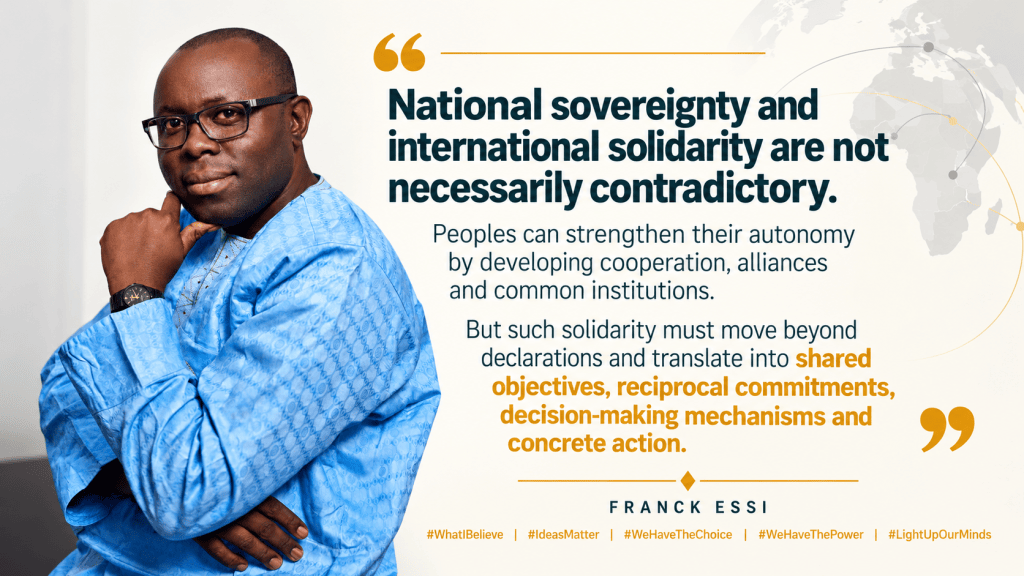
National sovereignty and international solidarity are not necessarily contradictory. Peoples can strengthen their autonomy by developing cooperation, alliances and common institutions.
But such solidarity must move beyond declarations and translate into shared objectives, reciprocal commitments, decision-making mechanisms and concrete action.
THE LIMITS AND CONTRADICTIONS OF SANKARA’S REVOLUTION: WHAT LESSONS FOR TRANSFORMING OUR SOCIETIES?
Understanding Sankara also requires examining the methods employed in the name of the revolution, the contradictions between its ambitions and certain practices of those in power, and the difficulties encountered in building lasting institutions.
The Sankarist revolution sought to empower the people, transform social relations and end privileges. Yet it was also carried out within a political system characterised by a strong concentration of authority, restrictions on political and trade union freedoms, and coercive measures against certain opponents.
The conflict with teachers is a particularly revealing episode.
In March 1984, following the arrest of leaders of the National Union of African Teachers of Upper Volta (SNEAHV), a strike was organised. The revolutionary government responded by dismissing large numbers of teachers who had participated.
The exact number of people affected has been disputed. A mission of the International Labour Organization (ILO) reported that another trade union organisation acknowledged 1,396 dismissals, while the SNEAHV put the figure at 2,600. Some teachers were subsequently reinstated.
This repression highlights a fundamental contradiction: a government seeking to mobilise workers to transform society can also repress their collective action when it challenges government decisions.
Tensions with trade unions, the practices of certain CDRs and the functioning of the People’s Revolutionary Tribunals also raised concerns about respect for civil liberties, judicial safeguards and mechanisms for holding those in power accountable.
These contradictions should neither erase the ambitions of the Sankarist project nor be concealed by admiration for its principal leader. Instead, they invite us to examine three essential questions.
The first concerns freedoms and methods of transformation. How can profound, sometimes urgent reforms be carried out while guaranteeing citizens the right to organise, criticise and protest? Can the desire to transform society rapidly justify restricting the very freedoms that transformation claims to defend?
The second concerns institutions and accountability mechanisms. How can we ensure that a transformation project does not depend primarily on the will, courage or integrity of one leader? How can organisations and institutions be built to prevent abuses, correct mistakes and ensure that those in authority genuinely account for their decisions?
The third concerns the sustainability of change. Why did a project with such significant ambitions prove vulnerable to internal conflicts and ruptures at the highest levels of power? What institutions, mechanisms for managing disagreements and forms of popular support might have helped preserve its achievements beyond its leading figures?
These questions are not unique to the Sankarist experience. They confront every organisation and movement that seeks to transform society.
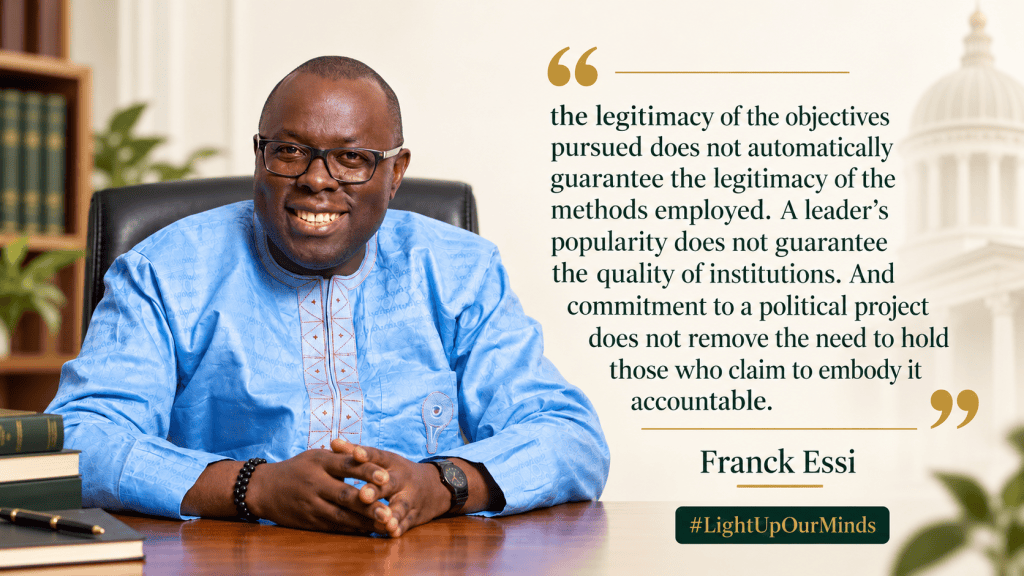
For the legitimacy of the objectives pursued does not automatically guarantee the legitimacy of the methods employed. A leader’s popularity does not guarantee the quality of institutions. And commitment to a political project does not remove the need to hold those who claim to embody it accountable.
We must therefore learn to assess political projects against several complementary requirements:
- Objectives: What changes are being pursued, and who stands to benefit?
- Methods: How are decisions made, and how are citizens involved?
- Results: What concrete improvements are achieved, and at what cost?
- Institutions: What mechanisms prevent abuses and allow mistakes to be corrected?
- Sustainability: Can progress be preserved and deepened beyond the leaders who initiated it?
These are the standards against which we can draw useful lessons from past political experiences.
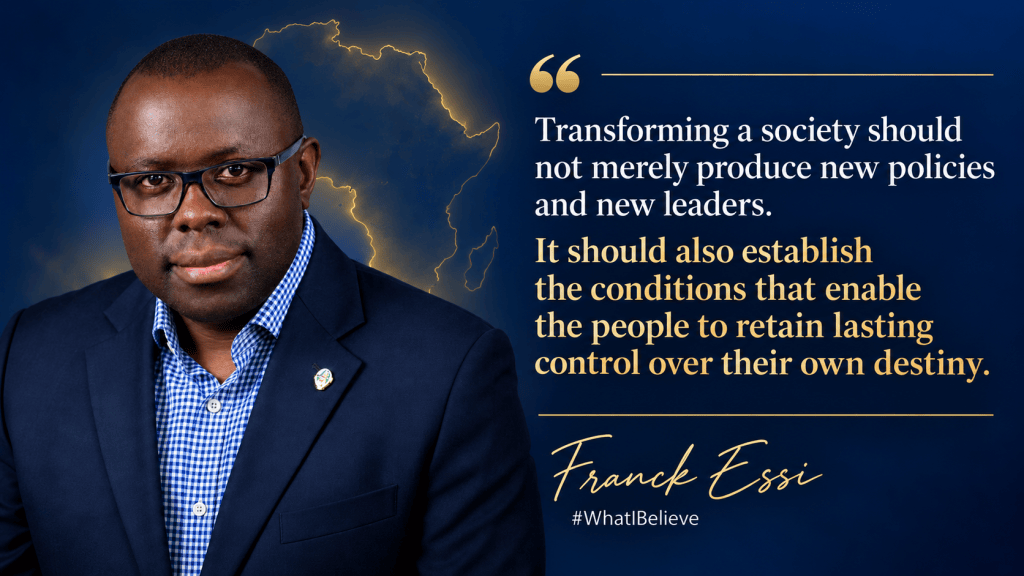
Transforming a society should not merely produce new policies and new leaders. It should also establish the conditions that enable the people to retain lasting control over their own destiny.
This, I believe, is how we should approach Sankara: neither reducing him to his mistakes nor placing him beyond criticism.
CONCLUSION – TURNING MEMORY INTO A SOURCE OF KNOWLEDGE, HIGHER STANDARDS AND ACTION
Let us hear once more from Captain Sankara:
“If Burkina Faso alone refuses to pay the debt, I will not be here at the next conference!”
Thomas Sankara, speech on debt, Addis Ababa, 29 July 1987.
This statement, made less than three months before his assassination, was above all a call for collective action. Sankara wanted to convince African leaders that they could not confront certain power structures alone. His death a few weeks later gives these words particular resonance, without in itself establishing the causes of or responsibility for his assassination.
Thirty-nine years after his death, the questions he raised continue to challenge us.
How can we make the people the genuine holders of political power? How can we build sovereignty that is actually exercised? How can we strengthen our economic and institutional capacities? How can we make the state serve its people? How can we turn integrity, discipline and hard work into collective standards? How can we profoundly transform our societies without compromising the freedoms and rights we claim to defend?
I believe we have much to learn from Thomas Sankara: from his ideas, convictions and achievements, but also from his shortcomings and the contradictions of his experience.
We must, however, move beyond admiration, slogans and repeated quotations.
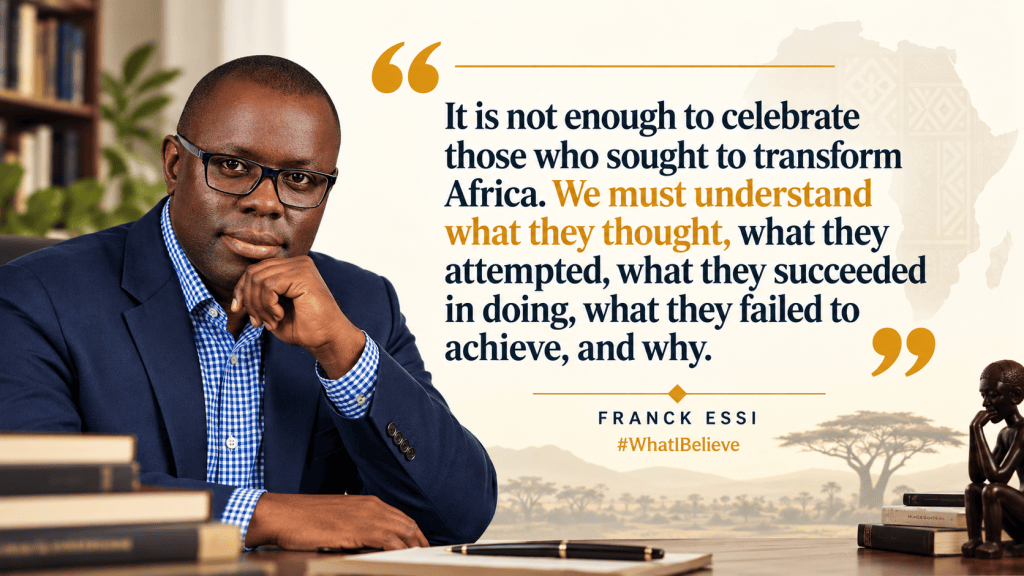
It is not enough to celebrate those who sought to transform Africa. We must understand what they thought, what they attempted, what they succeeded in doing, what they failed to achieve, and why.
For if we genuinely want to transform our societies, we must learn to distinguish intentions from results, convictions from methods, the popularity of leaders from the strength of institutions, and citizen mobilisation from the genuine exercise of popular sovereignty.
The real challenge, therefore, is not to reproduce Sankara, search for another Sankara or wait for a providential leader to come and save us.
It is to develop, individually and collectively, our capacity to think, organise, act, evaluate our results, correct our mistakes and build institutions capable of guaranteeing freedom, justice and progress over time.
This, I believe, is how we can turn the memory of Thomas Sankara into something more than an object of commemoration: a source of knowledge, higher standards and action to build the societies we want.
Franck Essi
#WhatIBelieve
#IdeasMatter
#ThePeopleFirst
#WeHaveTheChoice
#WeHaveThePower
#LightUpOurMinds
SOURCES AND REFERENCES FOR FURTHER READING
Speeches and Historical Documents
- Sankara, Thomas (1983). Political Orientation Speech, 2 October 1983. Text, audio and video. Foundational document outlining the project of democratic and popular revolution.
- Sankara, Thomas (1984). Address to the 39th Session of the United Nations General Assembly, 4 October 1984. Text, audio and video. Presentation of his vision of sovereignty, development, aid and international relations.
- Sankara, Thomas (1987). Women’s Liberation: A Requirement for the Future, 8 March 1987. Speech on women’s emancipation and the transformation of social relations.
- Sankara, Thomas (1987). The Debt Must Be Cancelled, OAU Summit, Addis Ababa, 29 July 1987. Text and video. Address on African debt, international solidarity and global economic relations.
Additional Documents and Analyses
- UNICEF (1985). Report of the UNICEF Executive Board, documents E/1985/31 and E/ICEF/1985/12. Data on Burkina Faso’s 1984 national vaccination campaign.
- International Labour Organization (1986). Report of the Committee on Freedom of Association concerning Burkina Faso. Documentation on teachers’ dismissals and violations of trade union freedoms.
- Harsch, Ernest (2013). The Legacies of Thomas Sankara: A Revolutionary Experience in Retrospect. Review of African Political Economy. A retrospective analysis of the achievements, political contradictions and legacy of Burkina Faso’s revolution.
- Jaffré, Bruno (2017). Thomas Sankara: La liberté contre le destin. Discours de Thomas Sankara. Éditions Syllepse. A collection of speeches and writings offering further insight into Sankara’s political thought and actions.

