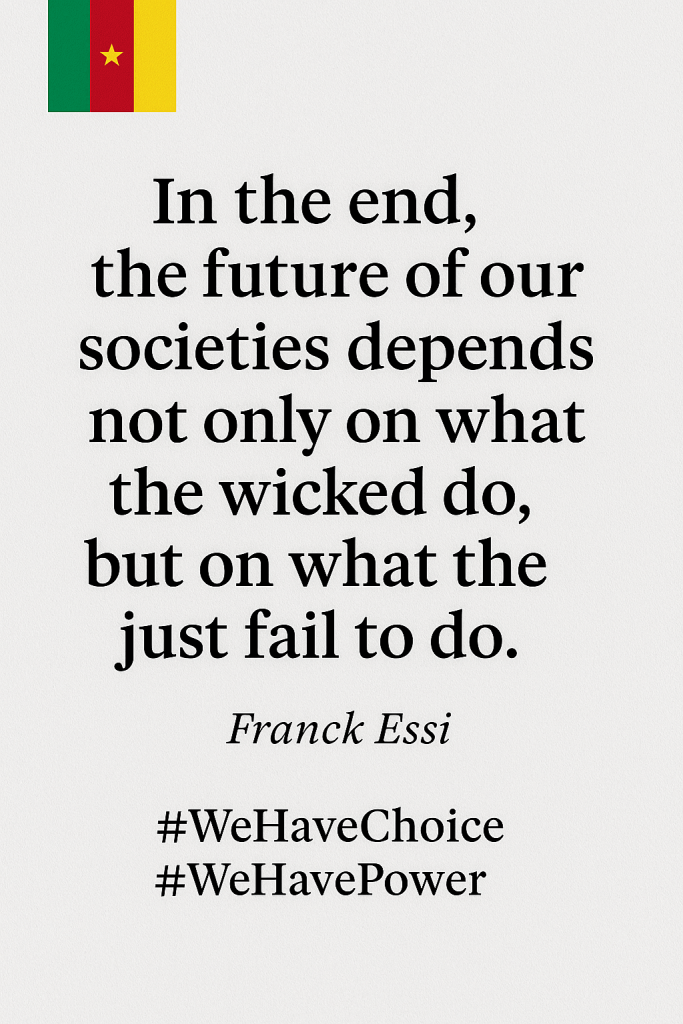
By Franck Essi
—
Many complain, few take action
In our daily conversations—in buses, markets, offices, or on social media—the observation is almost unanimous: we see injustice, we denounce corruption, we condemn tribalism, we lament violence and inequality. Most of us agree that “things are not going well.” But if we look more closely, how many of us turn our words into deeds? How many move from indignation to organized action? Very few. Yet history teaches us that words without action carry no weight in the face of evil’s persistence.
This collective inaction becomes the fertile soil where abuses of power, discrimination, crime, and injustice take root. Societies fall into a vicious cycle: the more citizens content themselves with complaining, the more destructive forces become entrenched and gain strength.
It is this paradox that an eighteenth-century thinker summed up in a phrase that has become universal.
—
Edmund Burke and the Lesson of the Enlightenment
Edmund Burke (1729–1797), British statesman and philosopher, is remembered as one of the intellectual founders of modern conservatism, but also as a lucid thinker on civic responsibility. A contemporary of the American and French Revolutions, Burke carefully observed the upheavals of his time.
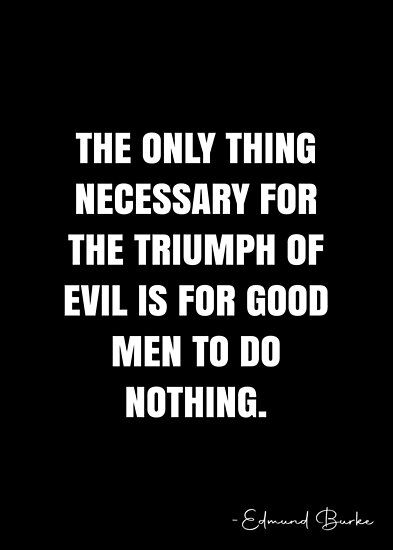
He is credited with the famous line: “The only thing necessary for the triumph of evil is for good men to do nothing.”
This statement, which has crossed centuries, is more than a clever turn of phrase. It is a warning. Burke reminds us that evil does not always need large armies or massive crowds to prevail. Often, it thrives on our silence, our hesitation, our surrender. In the absence of action, the virtue of ordinary citizens becomes evil’s greatest ally.
—
But what exactly do we mean by “evil”?
The word evil may sound abstract, yet it refers to very tangible realities. Evil is made up of all those forces—individual or collective—that destroy human dignity, attack justice, and prevent societies from flourishing.
Evil may take the form of corrupt power, siphoning off public resources and condemning populations to poverty.
Evil may be a destructive tribalism, artificially dividing citizens and fueling hatred between communities.
Evil may manifest as armed or terrorist violence, spreading death and fear.
Evil is also indifference to the suffering of others, cynicism that normalizes injustice, or propaganda that installs falsehoods as official truth.
Evil often prospers because it feeds on our weaknesses: fear, greed, resignation. It is not always spectacular. Sometimes it advances stealthily, cloaked in ideological or bureaucratic justifications, until it becomes the accepted “normal.”
—
And who are the “good men”?
On the other hand, good men—to use Burke’s expression—are those who, through moral conscience and humanity, can distinguish right from wrong and refuse to participate in evil. They are not necessarily heroes or saints. They are ordinary citizens:
– The mother who refuses to pay a bribe to enroll her child in school.
– The young person who dares to reject tribalist rhetoric from peers.
– The teacher who continues to do his job with integrity despite a failing education system.
– The civil servant who exposes corruption within his administration.
– The journalist who insists on pursuing truth in the face of censorship.
In short, good men are those who hold fast to justice and human dignity. But Burke warns us that moral conscience alone is not enough: it must be translated into concrete action—or it becomes meaningless.
—
The deeper meaning of Burke’s words
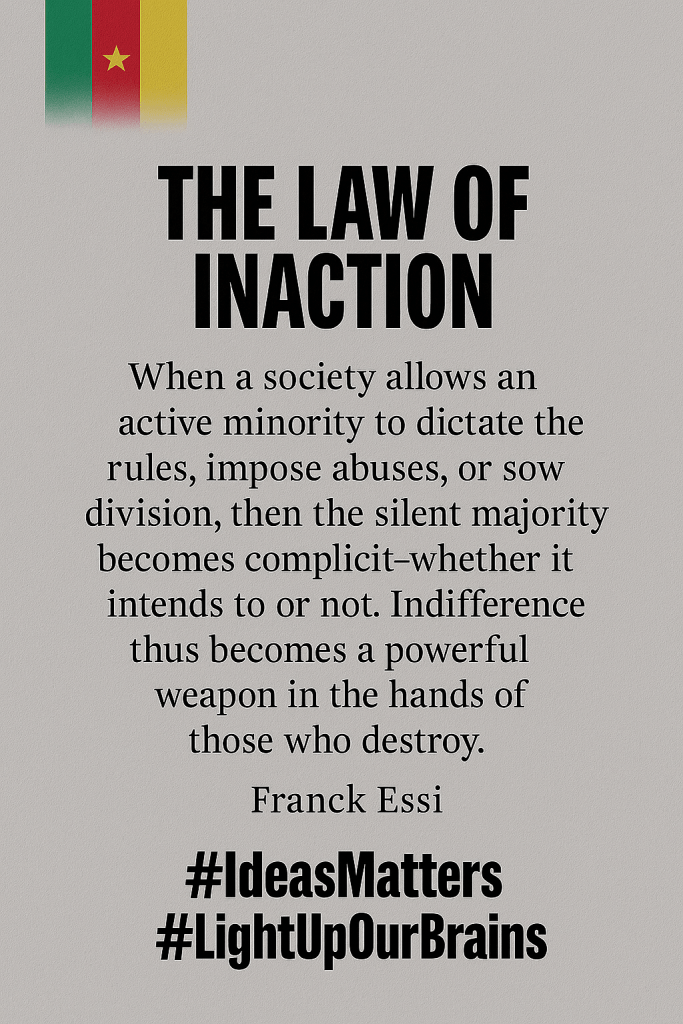
Burke’s phrase highlights a disturbing truth: evil flourishes not only because wrongdoers act, but also because those who know what is right choose silence, step back, or retreat into passivity.
The message is especially relevant today. In Cameroon, as in many other countries, corruption, tribalism, violence, extreme poverty, and authoritarianism persist not only because they are cultivated by those who benefit from them, but also because they are tolerated, normalized, and accepted by a majority that chooses the comfort of silence.
—
From Complaints to Action: What Must Be Done
The question then becomes urgent: what must we do to avoid complicity in evil through our inaction? The answers exist, and they are within the reach of every citizen, regardless of social standing or resources.
1. Seek knowledge and understanding.
Knowledge is the first weapon against evil. Read, get informed, check facts, understand the mechanisms of injustice, rise above rumors and manipulation. An informed citizen is harder to deceive and better equipped to act.
2. Speak out and raise awareness.
Breaking silence is already a form of action. Dare to tell the truth, denounce abuses publicly, encourage friends and relatives to think critically. Even a conversation among friends can plant a seed of change if it nurtures critical thinking and lucidity.
3. Organize collectively.
Isolated action has its limits. Collective action, however, is powerful. Joining an association, a union, a civic collective, a political or community movement transforms individual outrage into an organized, audible force.
4. Act in your immediate environment.
Civic engagement does not begin only in parliament or the corridors of power. It begins in neighborhoods, schools, families, and workplaces. Defending justice, transparency, and fairness through everyday gestures creates a new culture.
5. Practice personal integrity.
Refuse corruption, even in small matters; reject tribalist talk, even in informal conversations; treat each person with dignity regardless of background. Individual consistency is the foundation on which collective action is built.
6. Cultivate courage and perseverance.
Civic action demands courage. Risks exist—marginalization, criticism, sometimes repression. Yet history shows that it is through the persistence of a few that nations ultimately free themselves and transform their societies.
—
The Essential Truth: A Duty to Act
Edmund Burke left us with a timeless truth: evil triumphs only when it has no adversary. Its victory does not come from its intrinsic strength, but from the void created by the inaction of good men.
In Cameroon today, as elsewhere, every citizen must ask: am I among those who merely complain, or among those who transform indignation into action?
The struggle for justice, democracy, dignity, and the common good cannot be delegated. It is won when each of us, at our own level, decides not to remain spectators but to become actors.
#WeHavePower
#CivicEducation