By Franck Essi
—
66 years after “independence.”
43 years of Paul Biya in power.
More than 35 years since the return to multiparty politics.
And one question continues to haunt Cameroon’s political life:
How can the political system we live under truly be changed?
Since the early 1990s, three major strategies have shaped political debates in Cameroon.
Some forces have chosen to fight the system.
Others have chosen to fight within the system.
And still others attempt to fight outside the system.
These three approaches have structured — often without us fully realizing it — the different political trajectories of the past three decades.
—
- Fighting the system
Fighting the system means recognizing that the problem is not only how power is exercised, but the very nature of the political system itself: its rules, its institutions, its practices, and its political culture.
From this perspective, participating in existing mechanisms can sometimes be seen as legitimizing a deeply unbalanced political order.
This logic has appeared at several moments in our recent history.
We can think of the “ghost town” protests of the early 1990s, when political and social forces attempted to force democratic opening through popular pressure.
We can also recall the 2008 “hunger riots,” which revealed deep social anger against the economic and political conditions imposed by the system.
More recently, certain citizen mobilizations and forms of radical political contestation follow this same logic:
applying pressure on the system to force it to change.
—
- Fighting within the system
Another strategy consists of using existing institutions to try to gradually transform them from within.
This has been the path taken by many political parties since the return of multiparty politics.
Participating in presidential, legislative, and municipal elections.
Entering parliament.
Occupying available institutional spaces.
This strategy is based on a simple idea:
even imperfect, institutional space remains a space for political struggle.
But the experience of the past three decades raises a difficult question:
To what extent can a political system be transformed when the rules of the game themselves are deeply unbalanced?
Cameroon’s political history shows that this strategy carries a real risk:
that of gradually being absorbed by the system one sought to transform while at the same time legitimizing it.
—
- Fighting outside the system
A third approach consists of acting outside the formal political system, by building social dynamics capable of transforming society itself.
Here, the objective is not only the immediate conquest of power, but the construction of a real balance of power within society.
This can take many forms:
– citizen movements
– civil society organizations
– independent media
– civic education initiatives
– youth mobilization dynamics.
In Cameroon, many actors have invested in this space over the years:
citizen organizations, human rights groups, civic education initiatives, and social mobilization efforts.
But we must also recognize a reality: this path has not been sufficiently explored or structured in our country.
This weakness largely explains several phenomena that currently hinder political change:
– the growing depoliticization of the masses,
– the weakness of citizen mobilizations,
– the growing disconnect between political discourse and the lived realities of the population,
– and the lack of real mobilizing capacity among political and social forces.
History shows that political systems rarely change from the top alone.
They change when society itself becomes an organized political force.
—
My conviction
After several years of observation, engagement, and reflection on the political life of our country, my conviction is clear.
A system is not overthrown by politely respecting the very rules it designed to protect itself.
A system is not transformed by reproducing within the opposition the same political practices that made it possible.
History teaches us something simple:
political systems change when citizen pressure and social transformation become stronger than the mechanisms that reproduce power.
This is why, for my part, I believe much more in the need to fight the system and to build outside the system the civic forces capable of transforming it.
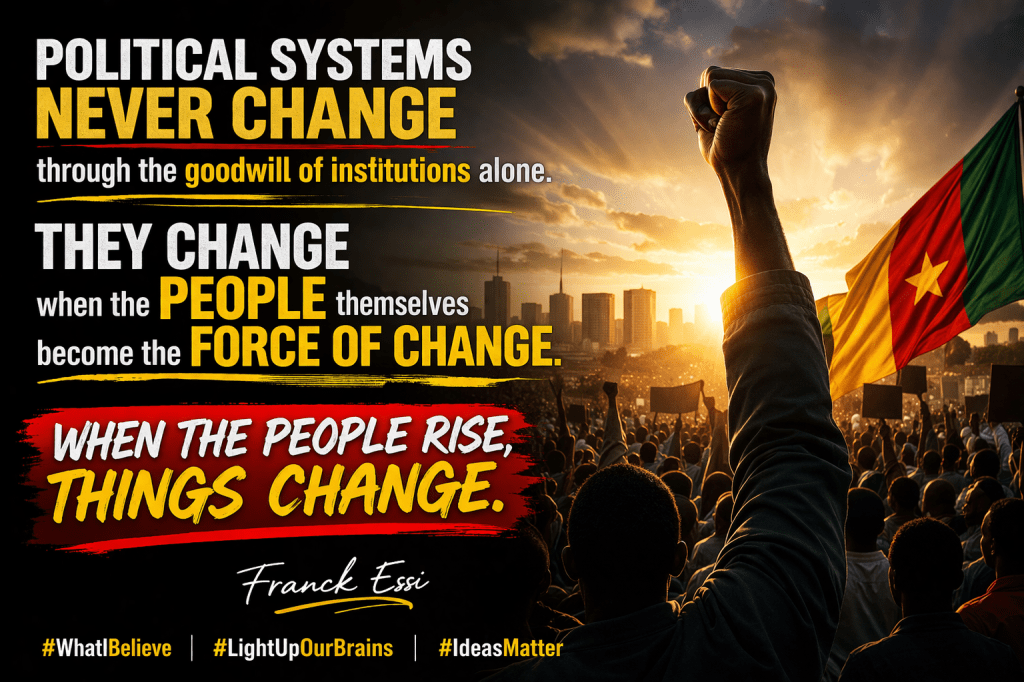
Because ultimately, political systems never change through the goodwill of institutions alone.
They change when the people themselves become the force of change.
When the people rise, things change.
Franck Essi
#WhatIBelieve
#LightUpOurBrains
#IdeasMatter


[…] What has just happened highlights, with unusual clarity, what each of these three paths reveals about its strengths, its limits, and its risks (Learn more here:https://franckessi.com/2026/04/04/changing-cameroon-fighting-the-system-fighting-within-the-system-o…). […]
J’aimeJ’aime