By Franck Essi
—-
—-
Few figures have marked the political, intellectual and psychological history of Black people as much as Marcus Mosiah Garvey.
Before Martin Luther King, Malcolm X, Kwame Nkrumah, Jomo Kenyatta, Steve Biko and many others, Garvey had already understood one essential thing: a dominated people cannot truly liberate themselves if they do not begin by reconciling with themselves.
From our perspective, Marcus Garvey’s strength lies not only in what he said in his time, but also in what his ideas continue to tell us today, as Africans, descendants of Africans, oppressed peoples, or peoples still engaged in the difficult struggle for their sovereignty.
But that’s also what he tried to build.
For Garvey was not only a powerful orator, a thinker on Black dignity, or a prophet of popular Pan-Africanism. He was also an organizer, a builder, a creator of institutions, a man who attempted to transform a historical intuition into a global movement.
He did not simply tell black people that they had to rise up.
He tried to give them newspapers, organizations, businesses, symbols, conventions, networks, and instruments of collective action.
That’s what makes his journey so important.
The aim here is not to make Garvey into a saint, a prophet, or an untouchable figure. Rather, it is to look dispassionately at what his life, his ideas, his achievements, his successes, his limitations, and his contradictions can still teach us.
Because ultimately, Marcus Garvey poses a question that remains relevant: how can a people long dominated regain confidence in itself and become fully active participants in its own history?
—-
1- Domination does not always begin with weapons
Marcus Garvey was born on August 17, 1887 in Saint Ann’s Bay, Jamaica, into a society deeply marked by the legacy of slavery, racial hierarchies and colonial domination.
Coming from a modest background, he discovered very early on the poverty, injustice, and social and racial contempt suffered by Black people. But above all, he understood that domination is not limited to laws, weapons, institutions, or the economy.
It also acts on people’s minds.
She eventually convinces the oppressed that they are worthless. That they cannot create. That they cannot govern. That they cannot think for themselves. That they must wait for their salvation from others.
It is against this inner destruction that Garvey will build a large part of his struggle.
For him, true liberation cannot therefore be only political. It must also be economic, cultural, psychological and spiritual, in the deepest sense of the term, that is to say linked to the inner dignity of a people.
This is where Garvey becomes interesting for us.
He understood very early on that a people can be dominated not only by external forces, but also by the demeaning image they have come to accept of themselves. And when this image becomes entrenched, the domination becomes even more formidable.
—-
2- A people who ignore their history become dependent on the stories of others
Before becoming famous, Marcus Garvey traveled extensively. He worked in Central America, stayed in South America, and then in Europe, particularly in London.
These travels allowed him to observe a striking reality: everywhere he went, black populations generally occupied the most disadvantaged positions in society.
They work hard, but have little control.
They produce, but rarely own the means of production.
They contribute to the wealth of the societies in which they live, but generally remain far removed from the places where power, memory, the economy and representation are decided.
Garvey then understood that the Black condition was not just a Jamaican, American, or Caribbean problem. It was a global reality produced by slavery, colonization, racism, and dispossession.
He draws a fundamental conclusion from this, summarized in one of his most famous phrases:
« A people without the knowledge of their past history, origin and culture is like a tree without roots. »
This sentence sums up a large part of his thinking.
Colonizers did not simply control territories, exploit resources, and impose their political authority. They also imposed narratives.
They told the African people who they were. They explained their past to them. They classified their cultures. They ranked their languages. They presented their beliefs as backward, their political systems as primitive, and their knowledge as nonexistent.
The problem is that many dominated peoples end up adopting the way others see them.
This is where history becomes a weapon.
Knowing one’s history is not just about fueling nostalgia. It helps us understand where we come from, what happened to us, why we are in a particular situation, and how we can get back on our feet.
A people without memory becomes easily manipulated.
He becomes a prisoner of narratives fabricated by others, often in the service of their interests.
—-
3- Political liberation begins with mental liberation
One of Marcus Garvey’s strongest contributions concerns the psychological question. For him, lasting oppression begins in the mind.
That is why he declares:
« We are going to emancipate ourselves from mental slavery because while others might free the body, none but ourselves can free the mind. »
« We are going to free ourselves from mental slavery, because even if others can free the body, no one can free the mind for us. »
This idea would later be taken up by several figures of Pan-Africanism and popularized in world culture by Bob Marley.
It remains highly relevant.
Because mental chains are often more powerful than physical chains.
A person can have the right to vote, freedom of movement, a degree, and still consider themselves incapable. A people can have a flag, a national anthem, ministers, embassies, institutions, and still think according to the categories of those who have dominated them.
A country can be legally independent and yet remain psychologically colonized.
This is why Garvey placed so much emphasis on self-confidence, historical pride, memory, and collective consciousness.
From our perspective, this is a crucial lesson for contemporary Africa. As long as we continue to believe that everything that comes from the outside is necessarily superior to what we are capable of producing, we will struggle to build truly sovereign societies.
The most effective form of domination is not always that which involves physical force. It is often that which convinces the victim that they are incapable of being anything other than what they have been asked to be.
—-
4- Collective trust is a political force
Marcus Garvey was repeating often :
« If you have no confidence in yourself, you are twice defeated in the race of life. «
He added :
« With confidence, you have won even before you have started. «
This idea applies to individuals. It also applies to peoples.
When a society deeply doubts itself, it ends up delegating its destiny. It waits for others to think for it, produce for it, finance for it, decide for it, invest for it, and sometimes even come to tell it what it should desire.
That’s exactly what Garvey refused.
For him, Black populations had to stop seeing themselves as victims condemned to suffer. They had to think of themselves as historical actors capable of organizing themselves, creating, undertaking, building institutions and influencing the course of the world.
The confidence he speaks of is therefore not a mere emotion. It is a political resource.
It is what allows a people to move from complaint to action, from dependence to initiative, from shame to dignity.
A people who do not believe in themselves can hardly build anything great, solid, and lasting.
—-
5. Ideas are not enough: organization is necessary.
In 1914, Marcus Garvey founded the UNIA, the Universal Negro Improvement Association .
His ambition is immense: to create a global movement capable of bringing together people of African origin around a common project of dignity, development, solidarity and autonomy.
A few years later, the UNIA became one of the largest Black organizations in modern history. It had branches in several countries, mobilized large crowds, and gave millions of Black people a sense of belonging to a single historical community, beyond the borders inherited from slavery and colonization.
What is important here is that Garvey does not just give speeches.
He wants to organize.
He talks about education, economics, entrepreneurship, discipline, the press, institutions, networks, and collective mobilization.
In other words, Garvey understands that dignity is not simply proclaimed. It is built.
It is built through awareness, organization, work, economic mastery, and the ability of a people to become the architect of their own destiny.
This is what makes his experience particularly valuable.
Garvey didn’t just tell Black people they should be proud. He tried to create the instruments of that pride. He didn’t just talk about liberation. He tried to build a movement capable of achieving it.
The UNIA was therefore not just a militant organization. It was an attempt to create a global infrastructure of Black consciousness, solidarity, and action.
In our tropical climate, we often have a lot of indignation, a lot of diagnoses, a lot of anger, and sometimes even a lot of clear thinking. But we regularly lack the patient, structured, and sustainable organization that allows things to change.
A good idea, without organization, often remains a pious wish.
One can be right on a moral, historical or intellectual level and still lose, if one does not know how to build the instruments capable of transforming ideas into a balance of power.
Garvey reminds us, therefore, that a people who want to liberate themselves must learn to organize themselves.
—-
6- Build your own means of communication
One of Garvey’s great achievements was understanding very early on that the battle for emancipation is also a battle of communication.
At a time when the mainstream media rarely talk about Black people except through the categories of contempt, fear, exoticism, or domination, Garvey understands that it is necessary to produce his own narratives.
It was in this spirit that he launched The Negro World , the UNIA’s newspaper.
This newspaper quickly became one of the most influential Black media outlets of its time. It circulated in the United States, the Caribbean, Latin America, Europe, and even in some African colonies, sometimes despite bans by colonial authorities.
It wasn’t just a newspaper.
It was a political school.
It was a training space.
It was a place where Black people scattered across the world could discover that they shared common wounds, but also common aspirations.
Through this journal, Garvey gives a voice to those whom the great communication systems rendered invisible.
It shows that a dominated people must learn to speak about themselves, by themselves, for themselves, and before the world.
Because those who do not control their own narrative always risk being trapped in the narrative of others.
A people who do not tell their own story often end up inhabiting the story told by others.
This is a major lesson for our time.
Today, we have social networks, digital platforms, blogs, podcasts, and online media. But the question remains the same: what do we do with these tools? Do they only serve to make us react, distract us, and divide us, or can they become instruments of awareness, education, and collective organization?
Garvey understood, long before our digital age, that a movement without its own media always depends on the words of others.
—-
7- Economic autonomy as a condition of dignity
Garvey does not separate dignity from economics.
For him, a people who depend entirely on others to produce, transport, finance, process, sell and buy remains fragile.
It is with this logic that he encourages the creation of black businesses and that he launches, in 1919, the Black Star Line , a shipping company conceived as an instrument of economic autonomy and connection between the black populations of the world.
The idea was audacious.
It wasn’t just about having boats.
The goal was to create a symbol.
A symbol of Black economic power.
A symbol of trade between Africa, the Caribbean, the Americas and the diaspora.
A symbol intended to tell Black people: we too can own, transport, trade, invest, undertake and connect to the world by our own means.
The Black Star Line faced serious difficulties. It suffered from management problems, strategic errors, financial obstacles, internal tensions, and external pressures. Ultimately, it failed.
But it would be too easy to reduce this initiative to its failure.
Its historical importance lies in the fact that it gave concrete form to a fundamental idea: political freedom without economic capacity remains fragile.
Garvey wanted to show that emancipation could not remain a moral demand. It had to become a material capability.
This lesson remains highly relevant today.
A people can proclaim its sovereignty, but if it does not control its infrastructure, its businesses, its financing channels, its means of production, or its strategic resources, its sovereignty remains limited.
From this perspective, the Black Star Line was simultaneously an ambition, an experiment, a failure, and a lesson.
It reminds us that wanting autonomy is not enough. We also need the skills, governance, rigor, transparency, discipline, and institutions capable of sustaining this autonomy over time.
—-
8- The 1920 Convention: when a people declares itself a subject of history
One of the most important moments in Garvey’s career was the large convention organized by the UNIA in New York in 1920.
This convention brought together delegates from several countries and resulted in the adoption of the Declaration of Rights of the Negro Peoples of the World .
This text is important because it affirms, in an era of racial segregation and colonial domination, that black people have rights, dignity, a history, and a place in the world.
He affirms their right to be respected.
Their right to organize.
Their right to self-government.
Their right to build their own institutions.
Their right to refuse humiliation.
The symbolic power of such a moment should not be underestimated.
In a world where Black people were often treated as objects of domination, Garvey and the UNIA invited them to think of themselves as subjects of history.
This convention shows that Garvey did not just want to mobilize emotions. He wanted to give dignity a political structure.
He wanted pride to become a declaration.
Let the declaration become an organization.
May the organization become a power.
It is this articulation between consciousness, symbol and institution that makes his struggle unique.
—-
9- « Up, you mighty race »: the call to action
One of Marcus Garvey’s most famous phrases remains:
« Up, you mighty race, accomplish what you will. »
« Stand up, great race; accomplish what you will accomplish. »
This phrase is not just a slogan. It is a call to action.
Garvey sought to convince Black people that they could become agents of their own destiny. But he didn’t just ask them to believe. He also asked them to act.
He asks them to study, to undertake, to organize, to invest, to build institutions and to take their future seriously.
Hope without action changes nothing.
Pride without organization doesn’t produce much.
Conscience without collective discipline can remain mere rhetoric.
That’s what Garvey understood.
For him, black dignity had to be translated into structures, businesses, schools, newspapers, movements, networks and institutions capable of lasting.
This is a lesson we need to reflect upon.
We sometimes like grand speeches, grand proclamations, grand outrage. But the crucial question remains: what are we actually building?
—-
10- Without mastery of knowledge, natural resources are useless
Contrary to some caricatures, Marcus Garvey places education at the center.
He states :
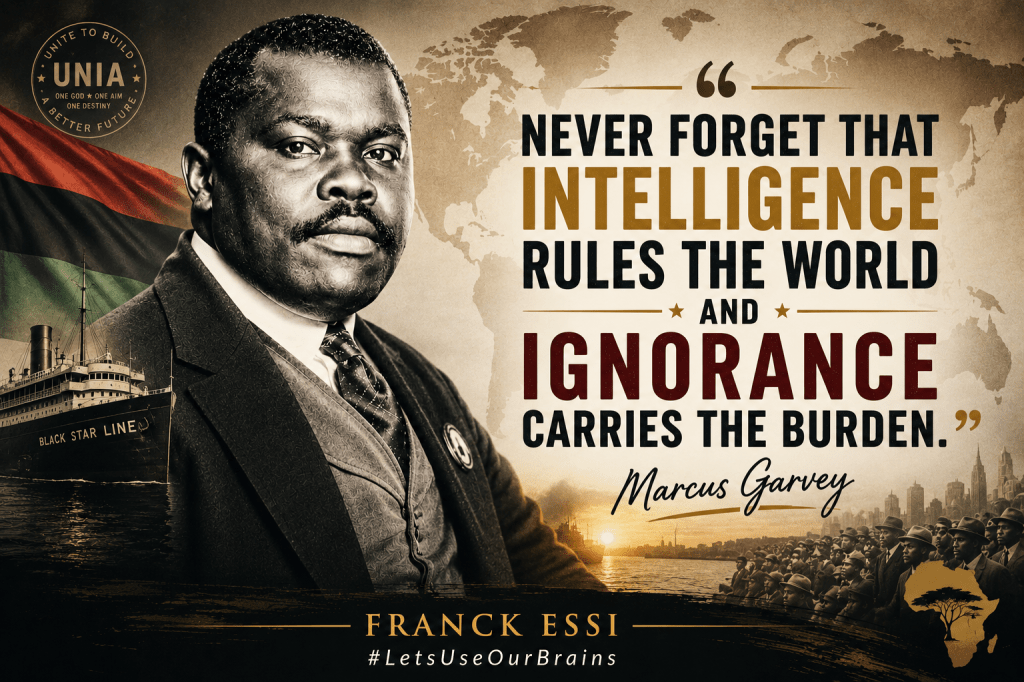
« Never forget that intelligence rules the world and ignorance carries the burden. «
This statement should be pondered in all African countries.
Natural resources alone are not enough to make a people powerful. One can have oil, gold, cobalt, timber, gas, diamonds, fertile land, and still remain poor, dependent, and humiliated.
What transforms resources into power is collective intelligence. It is science, technology, organization, training, the ability to produce, to transform, to negotiate, to anticipate and to invent.
For us Africans, this lesson is crucial.
We can possess immense wealth and remain weak if we do not master the knowledge, the techniques, the institutions, or the instruments for transforming our own resources.
A country that does not control knowledge often ends up selling its wealth at low prices and buying back at very high prices what others have manufactured with its own raw materials.
That is why education is not just a matter of school.
It is a question of sovereignty.
—-
11- Admiring Garvey should not lead us to idolize him
An honest reading of Marcus Garvey cannot ignore his contradictions.
Garvey was a visionary. But he was also a man of his time, with its limitations, excesses, and blind spots.
Some of his positions on racial separation, some statements on miscegenation, his highly centralized leadership style, as well as the difficulties encountered by some economic projects like the Black Star Line , have generated much criticism.
We need to face these facts.
Great historical figures should not be transformed into idols.
Idolatry prevents one from thinking.
Reading Garvey should not mean repeating Garvey. Studying him should not mean approving everything he said. Admiring him should not lead us to suspend our critical thinking.
What interests us about Garvey is not the perfection of a man. It is the power of a historical intuition: no people can recover sustainably if they do not first rebuild their memory, their confidence, their capacity for organization and their will to act.
We must therefore take from him what enlightens us, discuss what poses a problem, and refuse to replace critical thinking with devotion.
We can learn from a man without turning him into a statue.
And that’s probably the best way to do justice to history.
—-
12- Garvey’s legacy extends far beyond his time
Marcus Garvey’s influence spanned the 20th century.
It can be found in particular among Kwame Nkrumah, Jomo Kenyatta, Malcolm X, in the Nation of Islam, in the Rastafari movement, in several currents of pan-Africanism, as well as in many contemporary struggles for black dignity and African emancipation.
But his legacy is not limited to those he inspired.
It is also in the symbols that he helped to establish.
The red, black and green flag popularized by the UNIA has become one of the great symbols of black consciousness and pan-Africanism.
The Negro World newspaper demonstrated the power of a media outlet conceived as an instrument of liberation.
The Black Star Line, despite its failure, left the idea that a dominated people cannot be content with demanding rights if it does not also build the economic means of its dignity.
The 1920 convention showed that a humiliated people could assemble, name themselves, assert their rights and present themselves to the world as a political subject.
His most profound contribution, therefore, may not be solely institutional.
It’s psychological.
Garvey helped tell millions of Black people that they had the right to be proud of who they were.
He told them that they were not condemned to shame, marginalization, dependence, or permanent imitation of others.
He told them that they could produce, think, build, trade, govern, write their own history and become agents of their own destiny.
In its time, it was a profoundly revolutionary message.
And to some extent, it still remains so today.
—-
13- What Marcus Garvey still tells us today
More than a century after his great speeches, the question posed by Garvey remains relevant.
How can a people who have been dominated for a long time regain confidence in themselves?
How can he break free from material dependence, but also from mental dependence?
How can it cease to be merely an object of history and become a subject of history again?
Garvey’s answer consists of a few simple but difficult-to-implement requirements: know your history, believe in your worth, develop your abilities, organize yourself, and act.
Nothing lasting can be built on self-loathing.
Nothing great can be built in ignorance of one’s past.
Nothing solid can be built without organization.
Nothing liberating can be built by constantly waiting for an external savior.
Marcus Garvey didn’t succeed at everything. He didn’t think everything through. He didn’t escape the contradictions of his time.
But he had the immense merit of raising a question that Africa and its diaspora still cannot avoid:
Do we simply want to be treated better in a world order conceived by others?
Or do we want to become fully active participants in our own story?
Perhaps this is where Garvey remains most relevant.
He is not only inviting us to celebrate the past.
It forces us to think about our responsibility in the present.
Franck Essi
#IdeasMatter
#WeHaveTheChoice #WeHaveThePower #TurnOnOurBrains
To delve deeper
To read Garvey directly
- The Philosophy and Opinions of Marcus Garvey — Marcus Garvey.
The definitive work for direct access to his speeches, letters, and interventions.
https://archive.org/details/philosophyopinio0000garv
For a historical and academic approach
- The Marcus Garvey and Universal Negro Improvement Association Papers — Robert A. Hill, ed .
A major reference for understanding Garvey, the UNIA, and their historical impact.
https://www.ucpress.edu/book/9780520072080/the-marcus-garvey-and-universal-negro-improvement-association-papers - Marcus Garvey: Life and Lessons .
A useful collection for students, activists, and readers who want to engage with his thought in a structured way.
https://archive.org/details/marcusgarveylife0000garv
For documentary and educational resources
- UCLA Marcus Garvey Project
https://www.international.ucla.edu/africa/mgpp/ - National Humanities Center — Marcus Garvey and the UNIA
https://nationalhumanitiescenter.org/tserve/twenty/tkeyinfo/garvey.htm - Jamaica Information Service — Garvey and Black Pride
https://jis.gov.jm/information/get-the-facts/black-is-beautiful-garveys-message-of-racial-pride/ - PBS — Marcus Garvey / Look for Me in the Whirlwind
https://www.pbs.org/wgbh/americanexperience/films/garvey/

