By Franck Essi
——
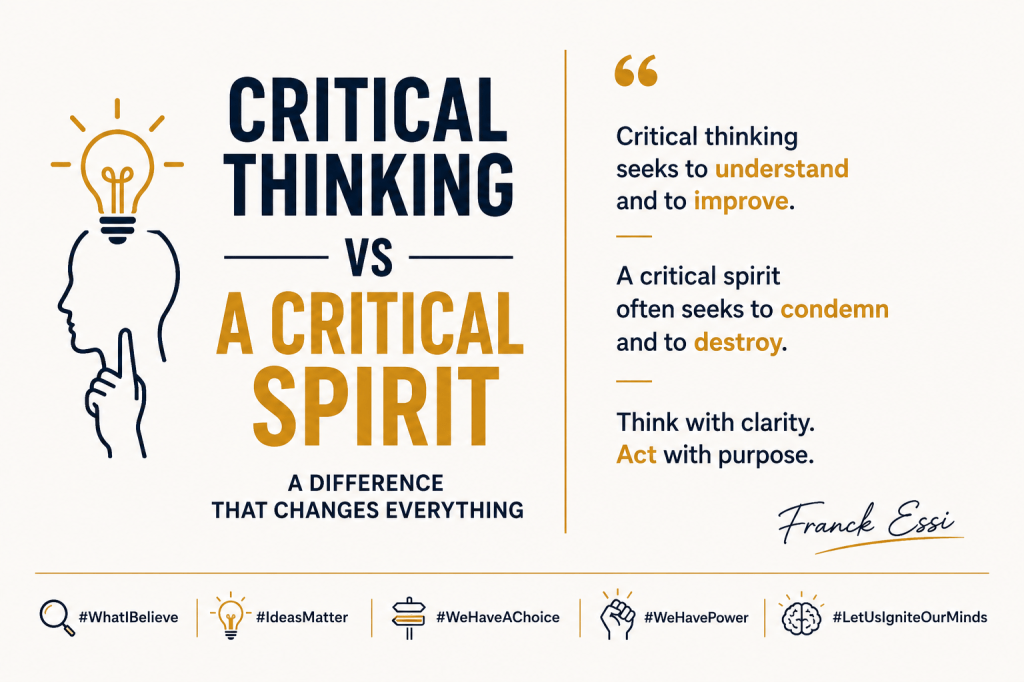
In our families, organizations, businesses, civic movements, political parties, and public debates, there is a confusion that I find increasingly concerning: we often confuse critical thinking with a critical spirit.
At first glance, the difference may seem minor. Yet it is fundamental. One helps us better understand reality, correct mistakes, improve practices, and move things forward. The other can become a permanent posture of judgment, cynicism, suspicion, and sometimes even destruction.
Critical thinking enlightens. A critical spirit exhausts.
Critical thinking seeks understanding. A critical spirit often seeks condemnation.
Critical thinking asks questions. A critical spirit delivers verdicts.
It is therefore worth reflecting on this distinction, especially in an era where social media, social frustrations, political crises, and collective disappointments often encourage constant criticism at the expense of deep reflection.
——
Critical Thinking Is Essential to Any Society That Wants to Remain Alive
A society that no longer questions anything is a society in danger. A family where no one can ask questions quickly becomes suffocating. A company where decisions cannot be challenged eventually repeats the same mistakes. A political or civic organization where the leader’s line can never be questioned gradually becomes a sect. A country where citizens cannot criticize those in power is drifting toward authoritarianism.
We must therefore defend critical thinking. We must cultivate it. We must teach it. We must encourage it.
Having critical thinking does not mean being against everything. It does not mean distrusting everyone. It does not mean rejecting all authority. It does not mean believing oneself smarter than everyone else.
It simply means refusing to swallow ideas, speeches, rumors, slogans, and decisions without examination.
It means asking:
▶ What are the facts?
▶ What is the evidence?
▶ Who is speaking?
▶ In whose interest?
▶ What is being said?
▶ What is not being said?
▶ What other interpretations are possible?
In this sense, critical thinking is an exercise in lucidity. It protects us from manipulation, propaganda, emotional overreaction, and our own illusions.
Because the truth is that we are not only deceived by others. We are also sometimes deceived by our anger, our fears, our loyalties, our wounds, our identities, and our interests.
——
A Critical Spirit Is Something Different
A critical spirit does not always seek understanding. It often seeks flaws.
It enters a meeting and immediately notices what is wrong. It hears a proposal and begins looking for ways to tear it down. It observes an initiative and searches for mistakes. It comments on everything. It suspects everything. It condemns everything.
It rarely asks: “How can we improve this?”
Instead, it says: “You see? I knew this would never work.”
In a civic or political movement, critical thinking might say:
“This mobilization strategy is not reaching enough young people. How can we adjust our language, channels, and methods?”
A critical spirit might say:
“You people never know how to mobilize anyone.”
Those are not the same thing.
In a business setting, critical thinking might say:
“The budget appears underestimated. We may need to revisit our assumptions before launching the project.”
A critical spirit might say:
“This project is poorly designed. As usual.”
Again, not the same thing.
In a family, critical thinking might tell a young person:
“Your project is interesting. But have you thought about the risks, the funding, and the practical steps?”
A critical spirit might say:
“You dream too much. You are going to fail.”
Still not the same thing.
In the first case, we help someone see more clearly. In the second, we may cut their wings before they have even tried to fly.
——
The Problem Is Not Criticism Itself
We must criticize. We must question. We must denounce injustice. We must reject mediocrity, manipulation, abuse, and incompetence when they destroy lives, organizations, and nations.
The problem begins when criticism becomes an identity.
When a person exists only through negation.
When they can no longer recognize what is right, useful, or courageous in others.
When they can no longer say:
“I disagree on this point. But on that point, I must acknowledge there has been progress.”
In political and civic circles, this nuance is often missing.
People are quickly forced to choose sides.
If you criticize your own camp, you are accused of betrayal.
If you recognize something positive in an opponent, you are accused of compromise.
If you introduce nuance, you are accused of lacking courage.
If you refuse oversimplification, you are accused of distraction.
Yet political maturity often begins precisely there: in the ability to think against oneself, against one’s group, against one’s immediate emotions, and against the slogans that conveniently confirm our beliefs.
——
On Social Media, the Confusion Becomes Even More Dangerous
We live in an era where a rumor can travel across a country before the truth has finished tying its shoes.
A picture taken out of context can inflame thousands.
An unverified accusation can destroy a reputation.
A sentence cut from its context can turn a serious discussion into an artificial scandal.
In such an environment, critical thinking verifies before sharing.
It asks:
▶ Is this true?
▶ What is the source?
▶ Is the context complete?
▶ Am I sharing this simply because it confirms my anger?
▶ Would I share it just as quickly if it targeted someone I admire or a cause I support?
A critical spirit moves faster.
It sees.
It reacts.
It comments.
It accuses.
It shares.
Then it moves on.
But the damage remains.
Damaged reputations remain. Poisoned debates remain. Divided communities remain.
We do not build a serious civic culture through digital mob reflexes.
We do not build a mature democracy through unverified outrage.
We do not liberate a people through rumors, even when those rumors appear to serve a just cause.
——-
In Politics, This Distinction Is Vital
Our countries need citizens who are capable of criticizing those in power.
That is not negotiable.
When leaders lie, it must be said.
When they steal, it must be said.
When they repress, it must be said.
When they manipulate institutions, it must be said.
When they confiscate a nation’s wealth, it must be said.
But countries also need citizens capable of going beyond denunciation.
Because saying “everything is bad” is not enough.
Saying “they are all the same” is not enough.
Saying “nothing will ever change” is not enough.
These statements may sound insightful.
But very often they produce discouragement.
They create helplessness.
They nourish cynicism.
They pull citizens away from collective action.
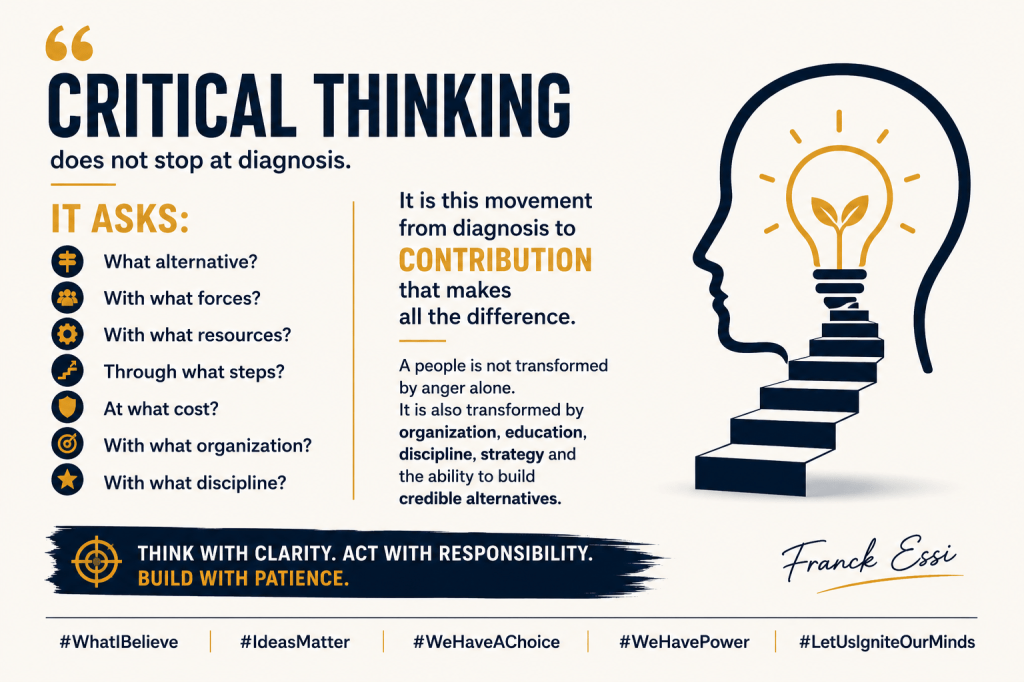
Critical thinking does not stop at diagnosis.
It asks:
▶ What alternative?
▶ With what resources?
▶ With what allies?
▶ Through what steps?
▶ At what cost?
▶ With what organization?
▶ With what discipline?
It is this movement from diagnosis to contribution that makes all the difference.
Because a people is not transformed by anger alone.
It is also transformed by organization, education, discipline, strategy, and the ability to build credible alternatives.
——
Within Organizations, a Critical Spirit Can Become a Slow Poison
There are people who never come with proposals but are always available to explain why everyone else’s proposals will fail.
They mobilize no one, yet criticize those who mobilize too few.
They write nothing, yet judge those who write.
They organize nothing, yet explain why the organization is poor.
They take no risks, yet constantly find fault with those who do.
Of course, we must listen to criticism.
We must accept observations.
We must avoid the arrogance of believing that every criticism is an attack.
But we must also recognize that there is such a thing as lazy criticism.
Comfortable criticism.
The kind of criticism that watches the battle from the terrace and grades those who are actually on the field.
That does not build strong organizations.
It exhausts volunteers.
It discourages initiative.
It sometimes kills courage and creativity.
——
The Real Question Is One of Intention and Contribution
When I criticize, what am I truly seeking?
Do I want to understand?
Do I want to improve something?
Do I want to protect something valuable?
Do I want to warn against a real danger?
Or do I simply want to prove that I was right?
Do I want to humiliate?
Do I want to settle scores?
Do I want to exist through negation?
These questions matter.
They concern all of us.
Because none of us permanently stands on the side of critical thinking.
Any of us can slide into a critical spirit.
Any of us can be tempted by the ease of judging without understanding, condemning without proposing, suspecting without verifying, and destroying without building.
We must therefore remain vigilant.
Not only toward others.
But also toward ourselves.
——-
My Deep Conviction
Our time does not need fewer criticisms.
It needs better criticisms.
More informed criticisms.
Fairer criticisms.
Braver criticisms.
More responsible criticisms.
Criticisms capable of saying no without contempt, denouncing without dehumanizing, correcting without humiliating, questioning without destroying, and opposing without abandoning the truth.
Critical thinking is a force for progress.
A critical spirit often becomes a force of erosion.
The first seeks light.
The second often seeks flaws.
The first opens pathways.
The second sometimes closes hearts.
The first transforms indignation into contribution.
The second sometimes transforms anger into a permanent posture.
In families, businesses, associations, civic movements, political parties, and states, we need women and men capable not only of seeing what is wrong, but also of contributing to what can be made right.
Because societies do not change only because of those who denounce.
They change above all because of those who denounce with lucidity, propose with seriousness, and build with patience.
Franck Essi
#WhatIBelieve
#IdeasMatter
#WeHaveAChoice
#WeHavePower
#LetUsIgniteOurMinds
 franckessi.com