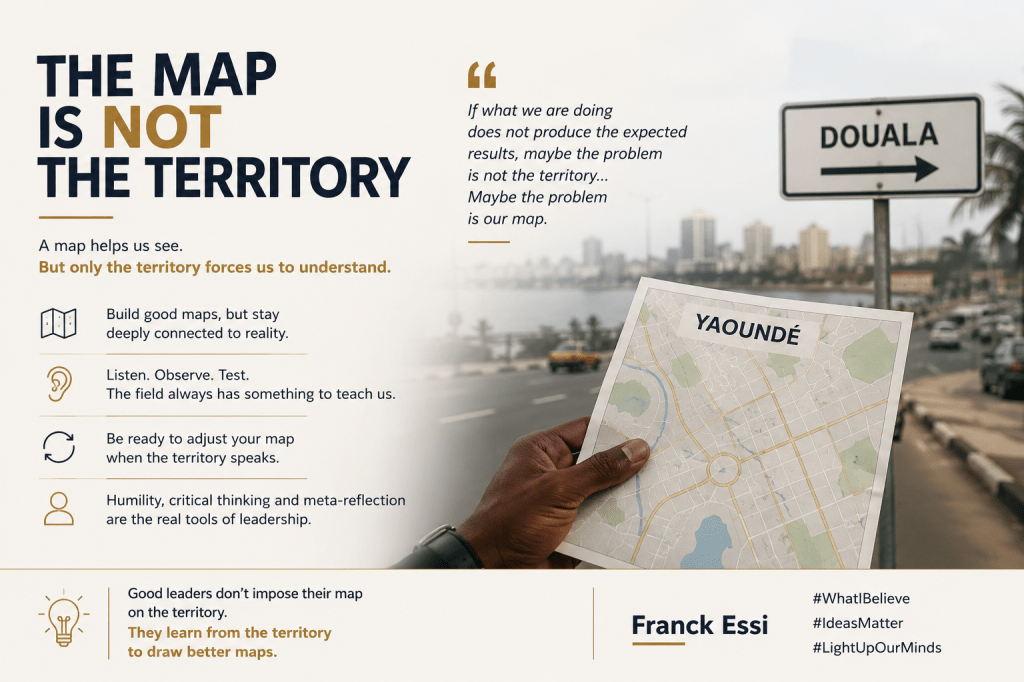
Imagine someone who wants to drive around Douala, but is holding a map of Yaoundé.
They may be very serious. They may be motivated. They may be disciplined. They may even have a good car, enough fuel, a GPS, a team around them, and a carefully prepared travel plan.
But if their map is that of Yaoundé while they are driving in Douala, they will probably end up lost.
They will look for Bastos in Bonabéri. They will expect the Nlongkak roundabout in Akwa. They will think of Messa where they should be understanding Deido. They will be surprised that the roads do not match, that the landmarks are not the right ones, that the distances are not as expected, and that traffic does not behave as planned.
The problem will not necessarily be a lack of will.
The problem will not necessarily be a lack of intelligence.
The problem may be deeper: they are using an unsuitable representation to act within a different reality.
This, in my humble opinion, is one of the great difficulties of life, leadership, management, politics, and transformation initiatives: we sometimes confuse the map with the territory.
The map is the representation we have of reality. It is the strategic plan, the diagnosis, the budget, the organizational chart, the activity schedule, the expert report, the concept note, the logical framework, the well-designed PowerPoint presentation. It is also our personal perception of things: our beliefs, memories, mental habits, preferences, and certainties.
The territory, however, is living reality. It is the field, with its resistance, delays, contradictions, real actors, hidden interests, emotions, power relations, unforeseen events, and opportunities often invisible from the office.
A map is necessary. Without a map, we risk moving blindly. We improvise. We react. We scatter our efforts. Any serious action requires at least some vision, method, and planning.
But a map remains a simplification of reality. It sheds light, but it also reduces. It guides, but it does not replace observation. It helps us decide, but it never frees us from the duty to verify.
The danger perhaps begins when we fall in love with our maps.
We then begin to believe:
- that because a project is well written, it will be well implemented;
- that because a strategy is coherent on paper, it will be accepted by the actors;
- that because an indicator is well formulated, transformation is already underway;
- that because a speech is attractive, reality has changed;
- that because a leader speaks with confidence, they necessarily understand the field;
- that because a plan has been validated in a meeting, it already corresponds to people’s real lives.
This is how many initiatives fail. Not always because of a lack of intelligence, but perhaps sometimes because of too much abstraction. Not always because of a lack of resources, but because of our difficulty in listening to what reality is telling us. Not always because of bad faith, but because we preferred defending our map to understanding the territory.
In organizations, this can happen when a management committee imposes a reform without sufficiently listening to the teams who will have to implement it.
In personal life, this can happen when someone builds an ideal image of themselves, but struggles to look honestly at their real habits, inconsistencies, fears, or limitations.
In politics, this can happen when we speak about the people without listening to the people, when we claim to transform society through slogans, imported models, or overly quick readings of reality.
In transformation projects, this can happen when we confuse activity with impact, meetings with progress, communication with change, apparent agreement with real commitment.
Critical thinking may begin precisely here: daring to question the quality of our maps.
It invites us to ask ourselves a few simple but decisive questions:
- Does what I think I know still correspond to reality?
- Have the people affected by this initiative truly been listened to?
- Do the facts confirm my hypothesis, or am I simply defending my idea?
- What weak signals am I ignoring?
- What is not working, but that I may be refusing to see?
- Does my plan explain the field, or is it trying to force the field into my plan?
- What must I adjust now, before failure becomes obvious?
This is where meta-reflection comes in: the ability not only to think, but to think about the way we think.
Meta-reflection pushes us to examine our own lenses. It asks us: where do my certainties come from? What may my experience be preventing me from seeing? What may my status be preventing me from hearing? What may my ego be preventing me from acknowledging?
In my humble opinion, this quality is precious for those who hold responsibility. But it is just as necessary for ordinary people engaged in their everyday projects: parents, teachers, entrepreneurs, activists, managers, students, community leaders, citizens.
Because each of us moves forward with maps. Maps about success. Maps about love. Maps about money. Maps about power. Maps about others. Maps about ourselves. Some help us. Others imprison us.
Maturity perhaps begins when we accept this simple truth: if what we are doing does not produce the expected results, we may need to stop blaming only the territory and begin also questioning the map.
Perhaps our diagnosis is incomplete.
Perhaps our method is outdated.
Perhaps our language no longer speaks to people.
Perhaps our allies are not who we imagined them to be.
Perhaps our priorities do not address the real problems.
Perhaps our way of leading blocks what we claim to be liberating.
A lucid leader, it seems to me, is therefore not someone who brutally imposes their map on the territory. Perhaps it is someone who patiently learns to read the field, listen to signals, correct their assumptions, adjust their strategy, and humbly recognize that reality is always more complex than our representations.
In life as in collective action, we should probably beware of certainties that are too neat, diagnoses that are too comfortable, and plans that are too perfect. The world is not a diagram. A society is not an Excel spreadsheet. An organization is not an organizational chart. A human being is not a category.
The map helps us see.
But only the territory forces us to understand.
And sometimes, the greatest intelligence simply consists in stopping, looking around, and admitting with clarity:
“I may be driving in Douala with a map of Yaoundé.”
Franck Essi
#WhatIBelieve
#IdeasMatter
#LightUpOurMinds

