By Franck Essi
We live in strange times.
Everywhere, we are encouraged to become leaders.
Books talk about leadership. Conferences talk about leadership. Social media celebrates leaders. Training programs promise to turn everyone into a leader.
Listening to some of these messages, being a follower can almost seem like a failure. As if following meant being weak. As if contributing behind the scenes were less noble than speaking in front of everyone. As if we only truly existed when we were leading.
Yet this obsession with leadership hides a fundamental truth:
There are no great leaders without great followers.
Better still:
The ability to follow well often comes before the ability to lead well.
This is the deeper meaning of the old saying:
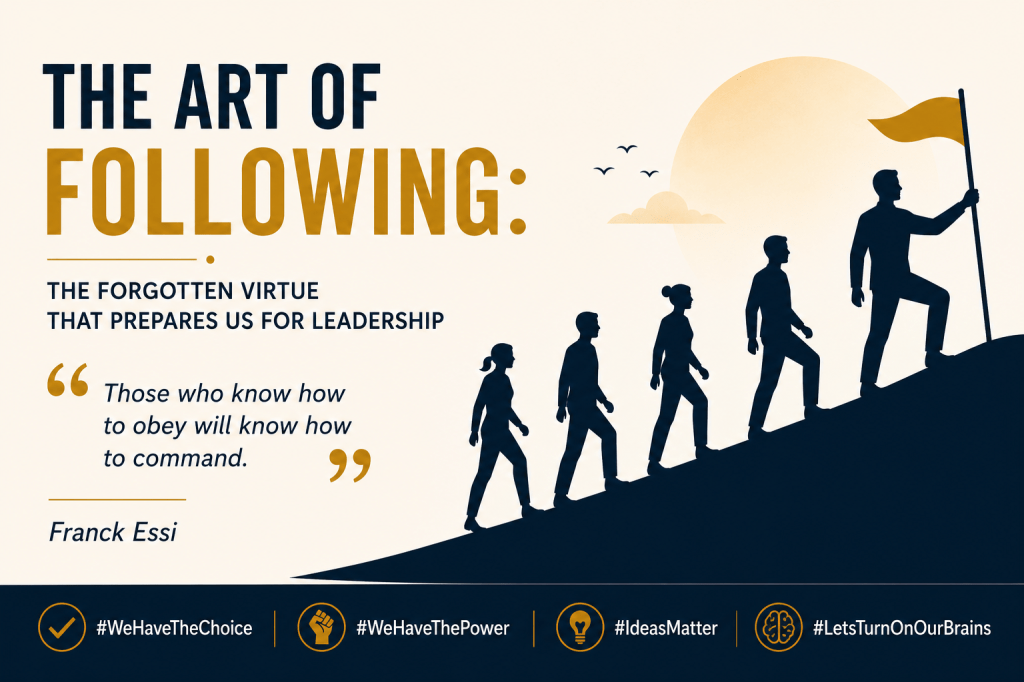
“Those who know how to obey will know how to command.”
A sentence often misunderstood, sometimes used to justify submission, when in fact it contains precious wisdom when understood with discernment.
The follower: an unfairly devalued figure
In the collective imagination, following is often associated with weakness.
A follower is seen as someone who lacks initiative, someone who does not think for themselves, someone who waits for instructions, or someone who simply executes what others have decided.
This view is reductive.
To follow intelligently is not to submit blindly.
To follow intelligently is to understand a vision, embrace a cause, contribute to a collective project, and place one’s talents at the service of a goal greater than oneself.
In a football team, not everyone can be captain. But without the defenders, midfielders, forwards, goalkeeper, substitutes, and technical staff, the captain wins nothing.
In a company, the CEO may have a remarkable vision. But if the teams do not understand that vision, take ownership of its goals, and translate it into concrete action, it will remain a mere speech.
In a citizens’ movement, a leader may carry a powerful message. But if no one relays the messages, organizes activities, trains new members, mobilizes resources, or follows up on decisions, the movement eventually runs out of energy.
Great human achievements are always the result of cooperation between those who lead and those who follow.
Why good followers often become the best leaders
Many people want to command before they have learned how to follow.
They want to give direction before they have learned how to listen.
They want to be respected before they have learned how to respect.
They want to be obeyed before they have learned discipline.
They want to be visible before they have learned how to serve.
Yet following is a great school.
1. Following teaches the realities of the field
Those who follow see the concrete consequences of decisions.
They discover:
- what truly works;
- what blocks progress;
- daily constraints;
- team frustrations;
- the difficulties of execution.
A person in charge who has never experienced the field may lead with arrogance. They may believe that giving an order is enough to produce a result.
But between a decision and its execution, there are people, constraints, limited resources, habits, fears, and resistance.
Those who have learned to follow know that leading is not only about deciding. It is also about making action possible.
2. Following develops humility
One of the most common diseases of power is ego.
The follower learns that the project is more important than their own person.
They discover that they can play a decisive role without constantly being at the center of attention.
In a meeting, the person taking notes may seem less important than the person speaking. Yet without proper minutes, decisions may be forgotten.
In a civic activity, the person preparing the room, welcoming participants, or handling logistics rarely receives applause. Yet without them, the event may fail.
In a company, an assistant who anticipates logistical details can save an entire mission.
There are silent contributions that are sometimes worth more than the most brilliant speeches.
3. Following teaches collective discipline
Many organizations fail not because they lack ideas, but because they lack discipline.
Decisions are made, but not followed.
Promises are made, but not delivered.
People criticize, but do not contribute.
People want to benefit from the results, but refuse to take part in the effort.
Being a good follower means understanding that an organization does not work only through good intentions.
It works through commitments kept.
This means:
- respecting deadlines;
- respecting time;
- doing one’s part of the work;
- reporting back;
- informing others when one cannot keep a commitment;
- supporting collective decisions once they have been made.
Discipline is not the enemy of freedom. It is often the condition for collective effectiveness.
4. Following teaches us to understand those who will follow tomorrow
A former follower knows what teams feel.
They know what a poorly explained instruction produces.
They know what a decision imposed without listening can cause.
They know what it means to work without resources.
They know the cost of despising small roles.
That is why the best leaders are often those who have not forgotten what it means to be on the other side.
They know that the people they lead are not merely executors.
They are intelligences, sensitivities, talents, experiences, hopes, and sometimes wounds.
Bad followers often produce bad leaders
The way we follow today often prepares the way we will lead tomorrow.
An opportunistic follower may become an opportunistic leader.
An undisciplined follower may become a disorderly leader.
A follower who constantly rejects collective decisions may become a leader unable to build a stable organization.
A follower who constantly criticizes without contributing may become a leader who talks a lot but builds little.
A follower who flatters the chief to obtain advantages may reproduce tomorrow a culture of clientelism and mediocrity.
We do not automatically become better simply because we gain a position of responsibility. Power often reveals what we cultivated before it.
The art of critical followership
Let us be clear, however.
Being a good follower does not mean accepting everything.
Blind obedience can become dangerous.
In a family, an organization, a political party, a company, or a State, following must never mean giving up one’s conscience.
A good follower keeps their critical thinking alive.
They support without flattering.
They execute without abandoning responsibility.
They contribute without becoming servile.
They can say:
- “I understand the decision, but I believe it carries a risk.”
- “I am ready to contribute, but the objectives need to be clarified.”
- “This direction seems contrary to our values.”
- “We can do better if we organize ourselves differently.”
The best follower is therefore not a sheep — and I am sorry that the sheep, such an intelligent animal, has become the symbol of blind followership; I use it here only for illustration.
Nor are they a courtier.
Nor are they a mere executor.
They are a demanding partner.
They know when to support.
They know when to alert.
They know how to obey a just decision.
They also know how to refuse what destroys dignity, truth, or the common good.
The particular challenge of citizens’ and political movements
In citizens’ and political movements, this question is essential.
We often encounter two drifts.
The first is to blindly follow a leader.
In this case, the organization becomes dependent on one person.
The chief thinks for everyone.
Activists repeat.
Fear replaces debate.
Loyalty becomes submission.
The second drift is that everyone wants to be the leader.
In this case, the organization becomes difficult to govern.
Everyone wants to speak.
Everyone wants to decide.
Everyone wants to impose their own sensitivity.
But few accept the difficult, repetitive, invisible, yet indispensable tasks.
A serious organization needs both qualities:
- people capable of taking responsibility;
- people capable of loyally supporting a common vision;
- people capable of criticizing without destroying;
- people capable of following without disappearing;
- people capable of leading without crushing others.
Organizational maturity begins when everyone understands that they can be a follower in some situations and a leader in others.
True greatness is not always about being in front. Sometimes it is about helping the collective move forward.
Those who know how to obey will know how to command
The saying “Those who know how to obey will know how to command” should not be understood as an invitation to servile obedience.
Rather, it means that one must have experienced certain demands before asking them of others.
Those who have never respected a fair instruction will struggle to make others respect a fair direction.
Those who have never accepted accountability will struggle to build a culture of accountability.
Those who have never made the effort to understand a collective decision will struggle to gain people’s support when they have to decide.
Those who have never served may confuse leadership with domination.
To command, in the noble sense of the word, is not to impose one’s ego.
It is to care for a common direction.
It is to assume responsibility.
It is to organize people’s energy around a useful goal.
We command better when we have learned what execution costs.
The leader without a title: reconciling leadership and followership
This is where the concept of the “leader without a title,” popularized by Robin Sharma, becomes particularly interesting.
It reminds us of a simple but powerful idea:
Leadership is not first a position. It is a way of being and acting.
One may have no official title and still exercise positive influence.
One may not be president, director, team leader, or coordinator, and still help things move forward.
A young activist who arrives on time, welcomes new members, clarifies information, and encourages others is already exercising leadership.
A colleague who proposes a better work method, helps others, and protects team spirit is already exercising leadership.
A citizen who refuses rumors, checks facts, eases tensions, and encourages collective organization is already exercising leadership.
A person who does not hold the microphone, but raises the quality of the group through seriousness, loyalty, lucidity, and a sense of service, is already exercising leadership.
This is why, at its core, the concept of the leader without a title reconciles leadership and followership.
It tells us that one can follow without being passive.
One can contribute without being inferior.
One can embrace a common vision without giving up one’s conscience.
One can be far from the top of the organizational chart and still exercise decisive influence.
A good follower is therefore not the opposite of a leader.
They are often a leader in training.
They are sometimes an invisible leader.
They are always an essential actor in the collective.
My deep conviction
We have probably spoken too much about leadership and not enough about followership.
We have taught people to want to be in front.
We have taught them less how to contribute effectively when they are not in front.
Yet strong organizations, high-performing companies, sustainable citizens’ movements, and prosperous nations depend as much on the quality of their followers as on the quality of their leaders.
Those who cannot follow a common vision will struggle to carry one.
Those who cannot listen will struggle to be heard.
Those who have never learned to serve may use power for themselves rather than for others.
I deeply believe that one of the best schools of leadership remains the art of being an excellent follower.
But I also believe that followership, when it is intelligent, critical, committed, and responsible, is already a form of leadership.
This is precisely what the concept of the leader without a title invites us to understand.
We do not need to wait for a position before exercising positive influence.
We can lead by example.
We can serve with intelligence.
We can follow with dignity.
We can contribute with high standards.
We can exercise leadership without title, without noise, without spotlight, but with impact.
Those who know how to follow well today will often be better prepared to lead well tomorrow. But those who follow with conscience, courage, and responsibility are already leading something: themselves, their attitude, their contribution, and the energy they bring to the collective.
Franck Essi
#WeHaveTheChoice
#WeHaveThePower
#IdeasMatter
#LetsTurnOnOurBrains