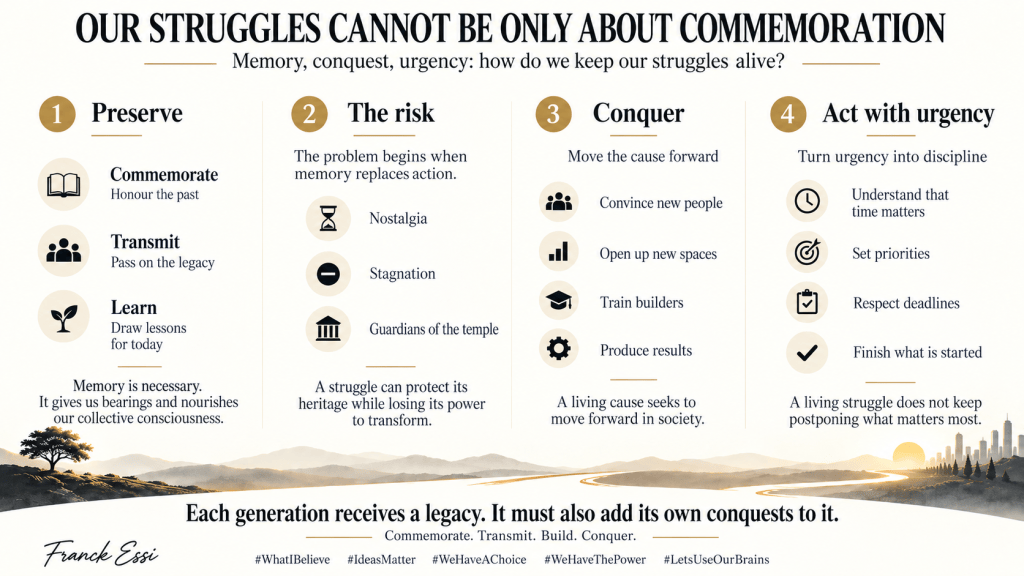
Why we need to cultivate a spirit of conquest and a sense of urgency
By Franck Essi
For several years now, like many others, I have taken part in commemorations dedicated to important figures, events and periods in our political and social struggles. I believe these moments matter. They help keep our collective memory alive, transmit important reference points to younger generations and, at times, allow us to rediscover women and men whose courage, ideas and sacrifices still have much to teach us.
I also believe that a people who forget their history become weaker. A generation that knows little about the struggles that came before it will find it harder to understand the freedoms it enjoys, the injustices that remain and the reasons why some forms of engagement are still necessary. We must therefore continue to remember, transmit, honour and learn.
But one question keeps coming back to me more and more often: what do we do with this memory once the commemorations are over?
The problem is not that we commemorate. The problem begins when commemoration gradually becomes a substitute for building the next victories. When we become more comfortable telling the story of yesterday’s great struggles than thinking seriously about those of today. When we know the names, speeches and battles of our predecessors better than the expectations, frustrations and aspirations of the people we hope to mobilise now.
That is when a memory that is necessary can also begin to confine us.
When memory no longer moves us enough
In many activist or progressive spaces, the energy of transformation can, over time, gradually give way to a logic of preservation. We protect symbols, guard orthodoxy, repeat historical references and constantly remind ourselves of the sacrifices made by previous generations.
All of this can be useful. But it is not enough.
An organisation can remain deeply faithful to its history while becoming progressively less capable of acting on its own time. It can continue holding meetings, issuing statements, organising anniversaries and recalling its finest moments while losing ground in society. It can also find itself speaking mainly to people who already think like it, while new generations, new codes, new concerns and new spaces of influence develop elsewhere.
This is how, sometimes without even realising it, we can become guardians of the temple. We protect the heritage, but build less. We know exactly what was done, but are less certain about what we want to achieve now. We defend the memory of struggles that were once living, inventive and forward-moving forces, but we risk turning them into fixed traditions.
This question obviously does not concern only others. It concerns me too. It concerns the organisations to which I belong and, more broadly, everyone who is committed to social or political transformation. Over time, any of us can end up protecting our habits more than our capacity to produce change.
Being faithful does not mean repeating
We sometimes confuse faithfulness to those who came before us with repeating their methods.
Yet the people we celebrate today were not simply loyal to an inheritance. They were often capable of understanding their own time, inventing new forms of organisation, taking risks and looking for ways to broaden their influence. They developed ideas suited to their context, used the tools available to them and built new balances of power.
Being faithful to their legacy therefore does not necessarily mean reproducing what they did. It also means trying to understand what in their attitude can inspire us today: their courage, their organisational capacity, their willingness to learn, their ability to adapt and their refusal to accept the existing order as inevitable.
We must therefore distinguish between the principles we want to preserve and the methods we must be willing to change. Values can remain the same while tools, strategies, audiences and forms of engagement evolve profoundly.
Two dynamics to cultivate: conquest and urgency
This reflection brings me to two dynamics that I believe are essential for any individual or organisation seeking to help transform society: a spirit of conquest and a sense of urgency.
Both ideas can easily be misunderstood.
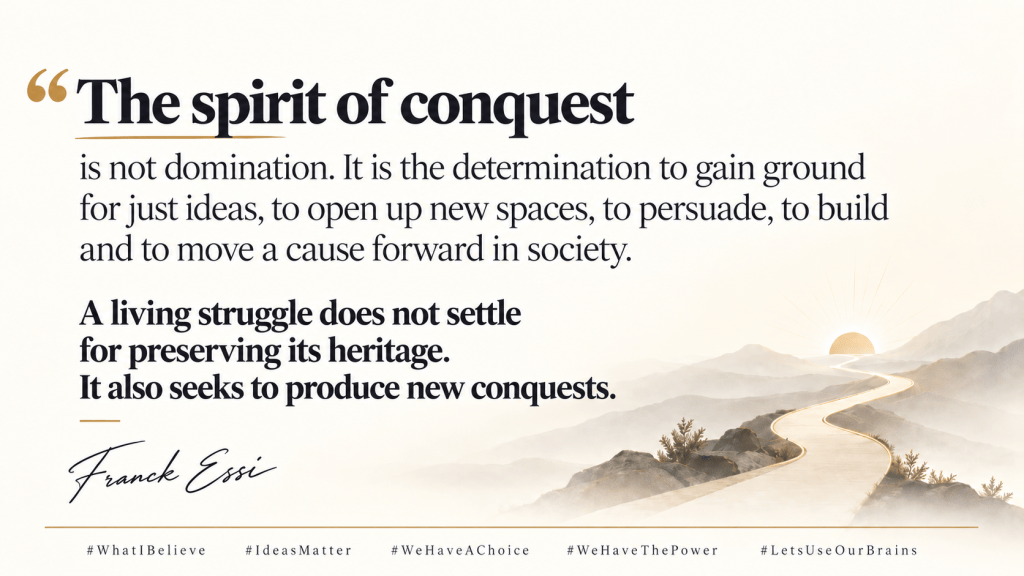
A spirit of conquest does not mean a desire to crush or dominate others. It means the determination to move a cause forward in society, broaden its influence, convince new people, gain new ground and gradually build a real capacity for transformation.
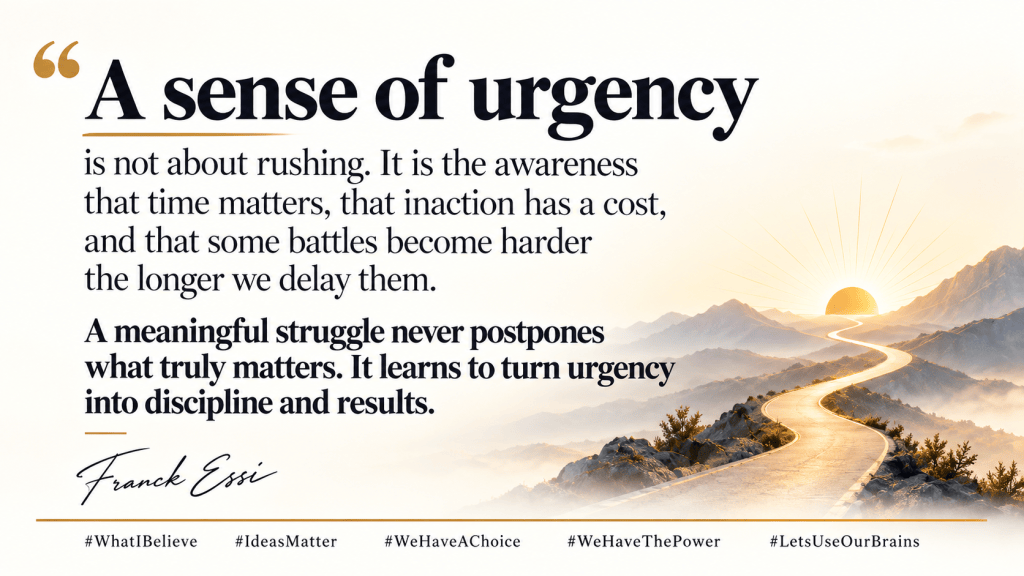
A sense of urgency does not mean living in constant haste or permanent agitation. It means understanding that time matters, that inaction has consequences and that some crises become harder to solve the longer they are allowed to continue.
These two dynamics are complementary. A spirit of conquest without a sense of urgency can produce admirable ambitions that are endlessly postponed. A sense of urgency without a spirit of conquest can produce a great deal of agitation without any clear direction.
We need both.
The spirit of conquest: seeking to move the cause forward
A movement rarely exists simply to preserve its identity. A political party is not created merely to keep its name alive. A citizens’ organisation should not limit itself to denouncing injustice or repeating its positions. If it sees itself as a force for transformation, it must seek to move reality in the direction it advocates.
Conquest can therefore take many forms. It can mean convincing new people, advancing an idea in society, establishing a presence in new territories, training new leaders, securing a right, building a new organisation, influencing public policy or becoming credible enough to shape collective decisions.
The question is therefore not only whether we are active. It is whether we are moving forward.
An organisation can have a full calendar and still gain no ground. It can organise many activities, publish regularly, bring its members together and yet remain for years with the same people, the same difficulties and the same level of influence.
It is therefore useful to ask ourselves, from time to time, a few simple questions:
- Have we convinced new people?
- Have we trained new leaders?
- Are we present in new social or geographical spaces?
- Are our ideas better understood than before?
- Have we achieved concrete changes?
- Are we more capable of influencing society today than we were a few years ago?
These questions do not reduce activism to numbers. They simply help us determine whether our efforts are actually producing movement.
Moving beyond our usual circles
A culture of conquest also requires us to move beyond the spaces in which we already feel comfortable.
It is always easier to speak to people who understand our references, know our vocabulary and already share our indignation. But a cause does not progress simply because those who already believe in it regularly meet among themselves.
We must be able to reach out to those who do not think like us, who are not yet interested in politics or whose concerns are very different from ours. This requires listening, understanding and sometimes reconsidering the way we communicate.
We must learn to engage with:
- young people and their evolving codes;
- workers, entrepreneurs and professionals;
- traders, farmers and community actors;
- artists, academics and content creators;
- people living in neighbourhoods and villages;
- those who feel disconnected from traditional political organisations.
This does not mean diluting our convictions. It means being able to explain how our ideas respond to concrete problems experienced by real people.
We cannot claim that we want to win over society while refusing to learn how to understand it.
Training builders, not only protesters
Our struggles need people who can denounce injustice, resist abuses of power, defend victims and demand accountability. This remains essential.
But it is not enough.
Transforming a society also requires people who can organise, manage, administer, communicate, negotiate, build teams, mobilise resources and design credible public policies.
We must therefore ask ourselves whether our organisations are preparing people only to oppose the current system, or whether they are also preparing people who can build something better.
This question is crucial. We can know very clearly what we reject without knowing enough about what we want to build. We can be highly effective in protest and far less prepared when the time comes to take responsibility, manage an institution or turn ideas into concrete decisions.
A culture of conquest must therefore train both resisters and builders.
A sense of urgency: remembering that time is not neutral
The second dynamic is a sense of urgency.
In many organisations, we sometimes end up behaving as though we had unlimited time. The same internal reforms can be discussed for years. The need to train a new generation is repeatedly acknowledged but constantly postponed. We know that certain methods no longer work, yet we continue using them out of habit.
But time produces effects.
A generation that no longer sees reasons to hope may eventually withdraw from public life for good. An institution that continues to deteriorate becomes harder to rebuild. An organisation that fails to prepare its succession can lose, within a few years, skills accumulated over several decades. An injustice that is repeated long enough can eventually come to be seen as normal.
We must therefore understand that doing nothing is not always a neutral position.
Constantly postponing a decision has consequences. Failing to train new people has consequences. Refusing to adapt an organisation while society changes also has consequences.
A sense of urgency means keeping this reality in mind.
Urgency is not haste
We must, however, remain careful.
We also know organisations in which everything becomes urgent. Every message requires an immediate response. Every event becomes a priority. Activists spend all their time reacting to current affairs and eventually have no time left to build.
That is not the kind of urgency I am talking about.
A real culture of urgency should, on the contrary, make us more disciplined. It should push us to prioritise, identify the few battles that truly matter and devote enough time to preparing them properly.
It should help us to:
- set clear priorities;
- define precise responsibilities;
- work with deadlines;
- genuinely follow up on decisions;
- finish what we start;
- regularly assess what works;
- change what no longer works.
There is nothing spectacular about these practices. Yet much of lasting transformation depends precisely on this kind of discipline.
We must also learn to finish
I believe one of our collective challenges is sometimes less a shortage of ideas than the difficulty of turning ideas into completed processes.
We launch initiatives. We adopt resolutions. We draft plans. We hold meetings. Then new emergencies arise, the energy fades and we move on to something else.
A sense of urgency should also be a discipline of completion.
It should lead us to return regularly to a few questions:
- What had we decided to do?
- What have we actually done?
- What remains unfinished?
- Why was it not done?
- What have we learned?
- What is the next step now?
These may sound like very operational questions. Yet they are profoundly political, because a vision that never becomes a series of concrete actions eventually loses its capacity to mobilise.
Worn-out systems do not necessarily disappear on their own
Another reason to cultivate both a spirit of conquest and a sense of urgency is that worn-out political or social systems do not always disappear spontaneously.
A system can be inefficient and endure. It can be deeply unpopular and endure. It can accumulate crises and endure. It can even be profoundly unjust and continue to function for a very long time.
The weakness of what exists does not automatically create the strength capable of replacing it.
An alternative must be built. It must develop credible ideas, train women and men, build organisations, win public trust, learn how to mobilise resources, build alliances and gradually become capable of assuming the responsibilities it claims to seek.
In other words, the erosion of a system never removes the need to build an alternative force.
Waiting for things to change by themselves is rarely a sufficient strategy.
Memory as a starting point, not an end point
I remain deeply attached to the memory of our struggles.
I believe we must continue to commemorate our martyrs, our resisters, our victories and the major moments of our history. I believe we must pass these stories on to younger generations and continue to produce serious work on our past.
But I would like every commemoration to also lead us to look forward.
After remembering what was done yesterday, we should also be able to ask:
- What has changed since then?
- What has not changed?
- What have we learned?
- What mistakes should we avoid repeating?
- What battles must we fight today?
- What new generations must we prepare?
- What victories do we want to pass on to those who come after us?
Memory then becomes a resource for action rather than a simple ritual.
What I believe
I believe that peoples need memory.
I believe we must continue to honour those who opened the paths on which we walk today. We must preserve their stories, transmit the meaning of their sacrifices and learn from their struggles.
But I also believe that the best way to keep a legacy alive is to allow it to produce new victories.
Our heroes should not only give us dates to commemorate. They should also give us courage, lessons, responsibilities and perhaps even a certain impatience with what still remains to be done.
Every generation receives something from those that came before it. But every generation must also add something to that inheritance.
Ours cannot therefore be satisfied with recounting the victories of others.
It must also prepare its own.
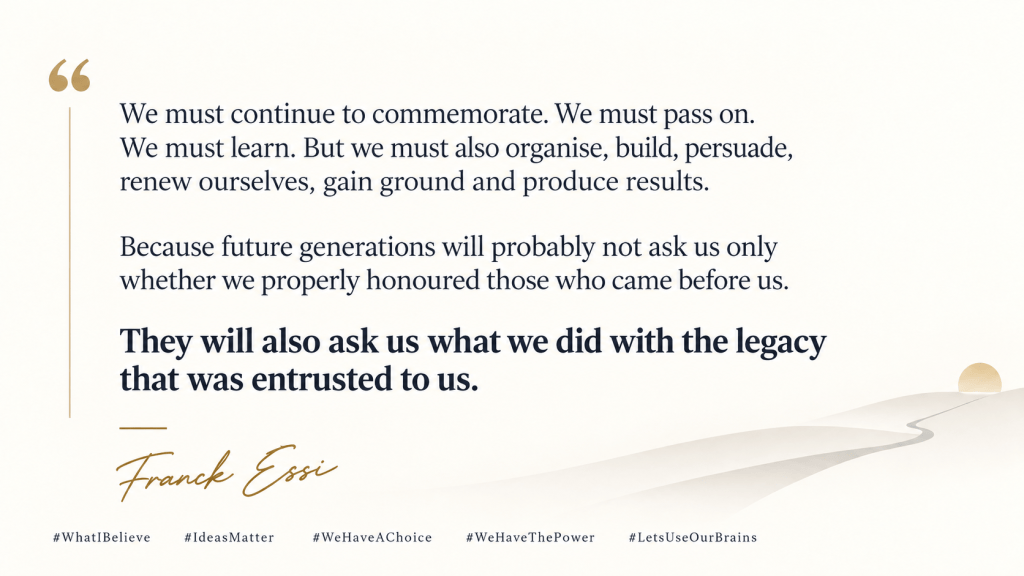
We must continue to commemorate. We must transmit. We must learn. But we must also organise, build, convince, renew ourselves, gain ground and produce results.
Because future generations will probably not ask us only whether we properly honoured those who came before us.
They will also ask what we did with the legacy that was entrusted to us.
And perhaps that is the question that should give our struggles today a little more spirit of conquest and a little more sense of urgency.
Franck Essi
#WhatIBelieve
#IdeasMatter
#WeHaveAChoice
#WeHaveThePower
#LetsUseOurBrains