By Franck Essi | 27 October 2026
Why do people facing the same difficulties struggle to join forces to overcome them? In Cameroon, divisions do not simply separate communities and territories. They run across generations, social groups, institutions and organisations. This fragmentation, sustained by inequality, power relations and certain social practices, weakens our ability to act together and represents a major obstacle to nation-building.
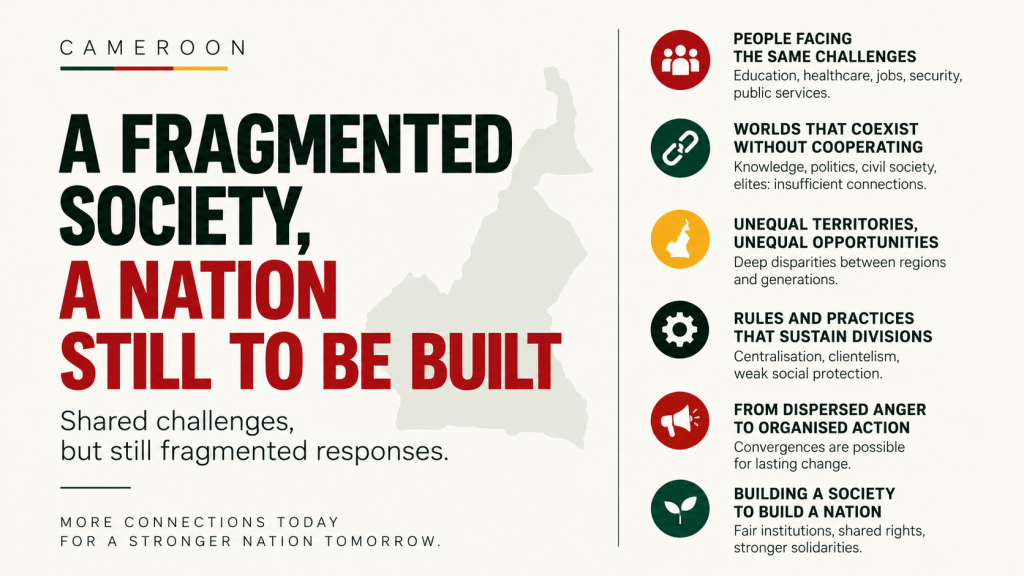
In Cameroon, we may suffer the same injustices, denounce the same failures and yet remain unable to build a common response. Frustrations accumulate and demands multiply, but the forces capable of transforming the country too often remain scattered.
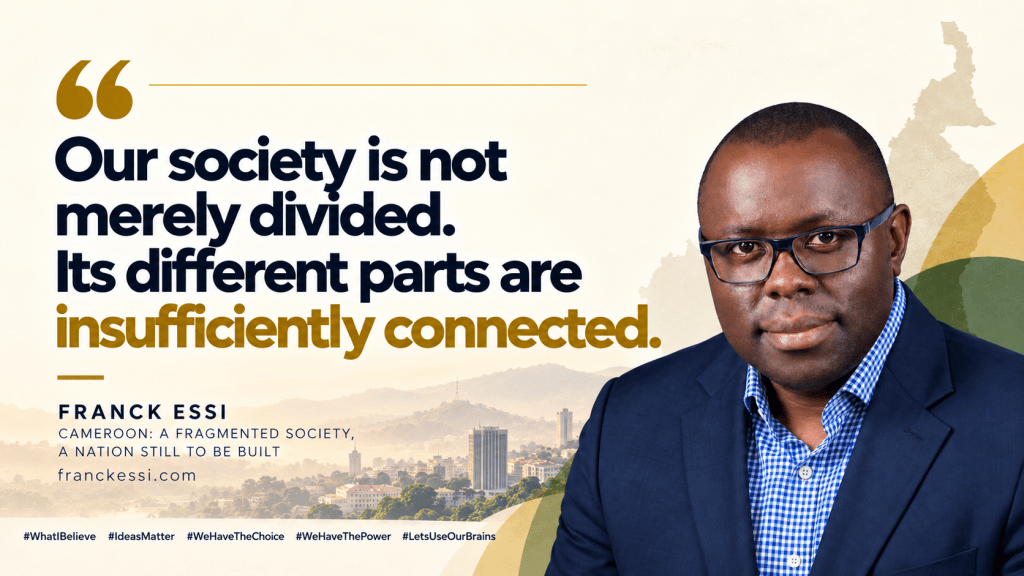
Our society is not merely divided. Its different parts are insufficiently connected. This lack of connection weakens our ability to shape our future.
The situation of teachers is revealing. The payment of their entitlements, career management and working conditions are not simply internal professional matters. They raise broader questions about public administration, the management of public resources and the actual priority given to education.
According to the Directorate General of the Budget, outstanding salary-related liabilities across the public service were estimated at CFAF 193 billion on 1 January 2025. During the first half of that year, CFAF 78.5 billion in salary-related arrears was paid, including CFAF 45.4 billion for secondary and basic education [1]. These amounts do not relate exclusively to teachers, but they demonstrate the scale of the administrative and budgetary issues associated with their demands.
When teaching conditions deteriorate, the consequences extend beyond classrooms. They affect pupils, families and ultimately society as a whole.
Yet such interdependence is not enough to produce a common mobilisation. Parents may support teachers’ claims while opposing strikes that disrupt their children’s schooling. Others may lack the time, resources or organisational structures needed to take part. Their interests converge, but immediate constraints keep them apart.
The same difficulty arises in healthcare, agriculture, entrepreneurship and the defence of civil liberties. Behind different demands lie recurring expectations: institutions that work, rights that are upheld, public resources that are properly managed, opportunities that are more fairly distributed and leaders who are accountable.
Our problems are interconnected. Our responses remain fragmented.
This paradox has struck me for years. We have researchers, entrepreneurs, trade unions, associations, civic organisations and political parties. We are not starting from nothing. But these resources do not automatically become a collective force.
Skills without cooperation, organisations without coordination and initiatives without continuity are not enough to transform a country.
Overcoming the divisions within our society is therefore not merely an additional contribution to social cohesion. It is essential to our ability to act and to strengthen our national community.
Social worlds that coexist without joining forces
Every society brings together different groups, institutions and interests. Such diversity is not an anomaly. Nor does it inevitably condemn us to powerlessness.
The sociologist Émile Durkheim showed that the differentiation of functions could strengthen solidarity among individuals. By performing different roles, people also become interdependent. But interdependence does not automatically produce cooperation.
The problem begins when differences become barriers and groups lack the relationships needed to understand one another, negotiate and act together.
Three phenomena help explain this situation:
- Compartmentalisation, when each group operates in its own world, with its own references, networks and priorities.
- Disconnection, when relationships between groups and institutions are weak, conflictual or unproductive.
- Atomisation, when individuals and groups remain isolated and lack the means to organise sustained collective action.
These phenomena are particularly visible in relationships between the different spheres of society.
Between the scientific and political worlds, for example, the knowledge produced remains insufficiently used in public decision-making.
Cameroon has universities, research centres, statistical institutions and experts in numerous fields. Yet producing statistics, studies and evaluations does not guarantee that they will be used to design and improve public policy.
Consider education. Public institutions have data on enrolment, teacher requirements, infrastructure and learning outcomes. But to what extent does this knowledge actually guide recruitment, training or resource allocation?
What is the point of an evaluation if its conclusions change nothing? What is the value of a consultation if the decision has already been made?
Responsibility does not rest solely with decision-makers. Researchers and intellectuals must also take seriously the constraints of action: limited resources, competing interests, institutional resistance and power relations. A convincing recommendation on paper is not yet a practical strategy for change.
Knowledge must not ignore the conditions of its implementation. Political power must not invoke those constraints to avoid critical scrutiny.
Another divide concerns relations between political parties and civic organisations.
Budget transparency, corruption, public services, civil liberties and social justice are all issues that could bring trade unions, associations, citizens’ movements and political parties together.
Yet these organisations frequently pursue their initiatives separately. Differences in methods, rivalries among leaders, competition for resources and fear of political co-option may sustain this distance.
These concerns are not always unjustified. But they should not lead to a permanent mistrust that rules out all cooperation.
An organisation can preserve its autonomy while negotiating specific commitments. A political party can support a demand without seeking to control it. Cooperation can be limited, transparent and reversible.
Independence is not measured by the absence of partners. It is measured by the freedom to decide which commitments to undertake.
The gap between elites and the wider population also deserves attention.
In our political system, certain figures become privileged intermediaries between their communities and the central government. They may facilitate access to authorities, intervene in appointments, support infrastructure projects or mobilise resources for their localities.
Such interventions may address real needs. They become problematic, however, when communities must depend on these intermediaries to obtain services or rights that institutions should ordinarily guarantee.
A degree, wealth, an administrative position or privileged access to decision-makers may confer influence. None automatically confers the right to speak on behalf of others.
We must distinguish personal achievement, the ability to act as an intermediary and the legitimacy to represent a community.
A community is not the private clientele of an influential individual. Its members are citizens, not permanent recipients of someone’s protection.
When representation depends more on proximity to power than on the consent of the people, the relationship may be reversed: the intermediary becomes the person who explains decisions taken at the top rather than the person who carries the demands of the people upwards.
Generations and territories that do not experience the same country
The compartmentalisation of our society also appears in relationships between generations and territories.
Cameroon has an exceptionally young population. According to the United Nations Population Fund, approximately 41% of its inhabitants were under the age of 15 in 2025 [2].
Yet the country’s highest political offices remain largely occupied by leaders from older generations. Paul Biya’s extraordinary longevity in power, dating back to 1982, is the most visible expression of this reality.
This is not about setting young people against older generations. Experience is valuable. Age alone neither disqualifies nor legitimises anyone.
But seniority must not become a permanent entitlement to positions of responsibility.
When opportunities for renewal are closed off, the problem goes beyond individual careers. It concerns access to decision-making, the circulation of ideas and institutions’ capacity to prepare for the future.
Leadership succession should be organised through credible rules, rather than depend on the goodwill of those already in office.
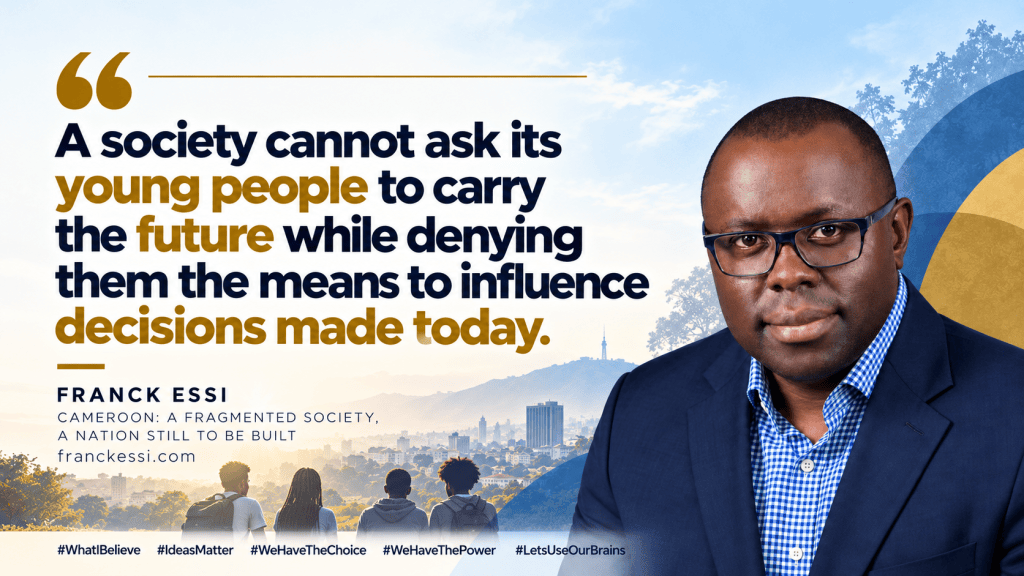
A society cannot ask its young people to carry the future while denying them the means to influence decisions made today.
Territorial divisions are equally troubling.
According to Cameroon’s National Institute of Statistics, 37.7% of the population lived below the national poverty line in 2022, or approximately 10.1 million people. The national average hides substantial disparities: poverty affected 56.3% of rural residents compared with 21.6% of urban residents. The rate reached 69.2% in the Far North, compared with 8.3% in Douala and 10.8% in Yaoundé [3].
These figures reveal profoundly different experiences of life in the same country.
For some, the urgent concern is finding work, paying rent or spending less time in traffic. For others, it is obtaining water, reaching a health centre, having a passable road or simply living safely.
These priorities do not contradict one another. They express different aspects of the same demand for territorial justice.
The problem begins when a difficulty enters the national debate only because it affects people who already have a public voice or access to centres of power.
A territory should not need the attention of a powerful patron for its needs to be recognised.
Security and humanitarian crises deepen these distances.
In the North-West and South-West regions, communities have lived with the consequences of armed conflict for a decade. In the Far North, attacks by armed groups and displacement continue to affect living conditions. These crises are compounded by conflicts in neighbouring countries and climate-related shocks.
United Nations humanitarian estimates indicated that approximately 2.9 million people needed assistance in Cameroon in 2026 [4].
These divisions also have deep historical roots.
The reunification of 1961 brought together two territories shaped by different colonial, administrative, linguistic and legal experiences. The transition from a federal to a unitary state in 1972 altered the institutional foundations of that union.
Researchers Piet Konings and Francis Nyamnjoh have analysed how these changes contributed to feelings of marginalisation among sections of the Anglophone population [5].
This history alone cannot explain every cause of the current conflict. But it reminds us that nation-building requires taking seriously the experiences and expectations of the country’s different communities.
For a family living with fear, kidnappings or interrupted schooling, everyday life may be far removed from that of populations relatively spared by armed conflict.
Suffering does not become a national concern only when it reaches the centres of power or the major cities.
Social inequalities create another kind of separation. People who can afford private alternatives in education, healthcare or other essential services may experience the failings of public services differently from those who have no alternatives.
The aim is not to condemn individual choices, but to examine their possible consequences for solidarity.
When we can find a way around a failing service, we may also lose sight of the urgency of repairing it.
Yet a private solution primarily protects those who can pay for it. It does not replace a collective guarantee.
Divisions sustained by rules, dependencies and practices
Our divisions did not emerge out of nowhere. Nor can they be explained by some supposed cultural inability to live together.
They are reproduced through the history of institutions, the organisation of power, economic conditions and rules governing access to resources.
Cameroon’s political history has been marked by a strong concentration of power. The formation of the independent state, reunification in 1961, the creation of a single party in 1966 and the transition to a unitary state in 1972 all strengthened central authority in different ways.
Centralisation did more than determine where decisions were made. It also shaped how local actors seek access to resources, responsibility and political recognition.
In a highly centralised system, proximity to the top can become more valuable than the ability to organise collective initiatives locally.
Despite successive reforms, decentralisation continues to face significant constraints.
In its 2024 Public Finance Review, the World Bank examines how centralisation, clientelism and inequitable resource allocation affect the quality of public services [6]. A 2025 analysis also identifies political, administrative and financial obstacles to decentralisation and estimates that local authorities received 4% of the central government budget in 2023, within the scope covered by the study [7].
How can territories be expected to meet people’s needs without being given the means to act?
Financial dependence can shape behaviour. Securing a favourable decision from a central official may count for more than building local cooperation. Local authorities may be driven to compete for resources instead of developing complementary approaches.
Clientelist mechanisms reinforce these dependencies.
When employment, appointments, contracts or opportunities depend more on relationships than on rules, the message to citizens is clear: do not rely solely on your rights; find someone with influence.
We must distinguish solidarity from clientelism. The former helps a person overcome a difficulty. The latter makes access to resources or advantages conditional on a relationship of favour, loyalty or dependence.
The problem is not that relatives and friends help each other. It begins when relationships replace rules and belonging to a network becomes decisive in access to public resources.
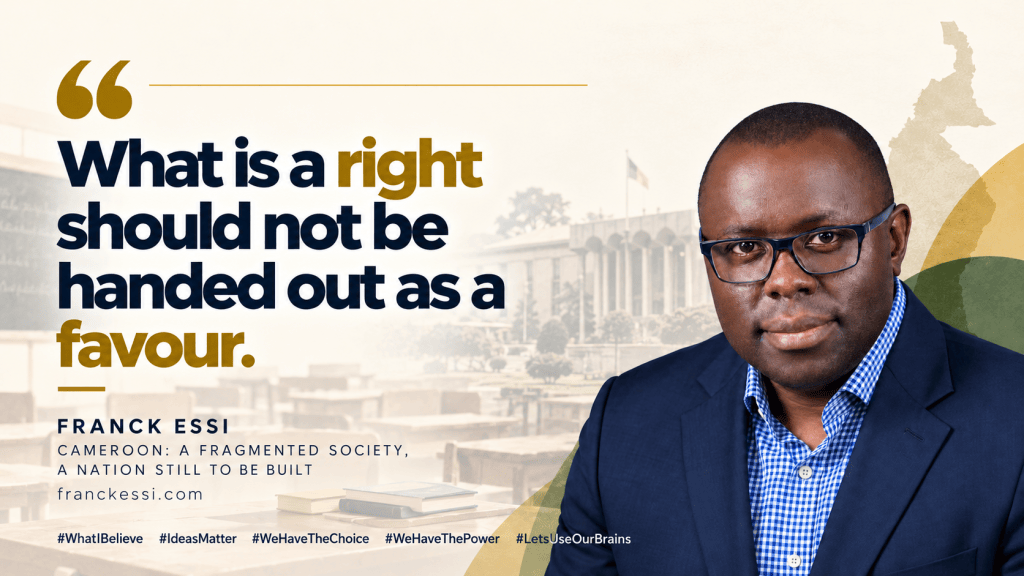
What is a right should not be handed out as a favour.
These dependencies may also be sustained by restrictions on civil liberties.
In its statement of 31 October 2025, the African Commission on Human and Peoples’ Rights expressed concern about post-election violence in Cameroon, deaths, arrests and internet shutdowns. It condemned the excessive and disproportionate use of force against peaceful demonstrators, as well as acts of vandalism [8].
This statement is not a comprehensive judicial assessment. It nevertheless underscores the importance of the conditions in which citizens can express disagreement and organise.
When engagement involves significant risks, people may choose silence or withdrawal. Fear can reinforce isolation and reduce opportunities for cooperation among groups that nevertheless share similar concerns.
We cannot demand participation while undermining the guarantees that make it possible.
Economic conditions also play a vital role.
According to the OECD, excluding healthcare, only 11% of Cameroon’s population benefits from at least one social protection programme. In 2021, households directly bore approximately 70% of total health expenditure [9].
In these circumstances, family and community networks often become essential for healthcare, education, employment or coping with emergencies.
It would be unfair to systematically blame citizens for relying on such forms of solidarity when collective systems of protection do not sufficiently meet their needs.
An absent institutional guarantee cannot be replaced by speeches about national unity.
The problem arises when only the most influential networks allow access to opportunities. Weak institutions then reinforce personal dependencies, which may in turn divert efforts from improving common institutions.
But we are not outside this problem.
We sometimes denounce favouritism while seeking exceptions for relatives. We demand democracy while refusing disagreement within our own organisations. We defend national unity while spreading prejudice about other communities.
This does not mean everyone bears equal responsibility. Those who exercise power, set rules and control public resources have particular obligations.
But each of us must also examine what we reproduce in our own sphere of action.
Institutions shape behaviour. Behaviour can also reinforce the very institutions we claim to oppose.
From scattered anger to organised action
Sharing a frustration is not enough to build collective strength.
Difficulties in hospitals affect healthcare workers, patients and their families. Access to energy matters to entrepreneurs, workers and consumers. The quality of public management matters to all those who rely on public services.
The World Bank also highlights budget preparation and execution practices that undermine transparency and efficient resource allocation [6].
These are not matters for specialists alone. They directly affect the resources available for public policies.
That does not mean all problems have the same cause. Meaningful convergence does not erase differences. It identifies common mechanisms on which groups can act together.
I distinguish four complementary stages:
- Convergence of concerns: recognising that a problem affects several groups.
- Convergence of analysis: agreeing on some of its causes.
- Convergence of objectives: defining the changes to achieve.
- Convergence of action: coordinating efforts to achieve them.
None of these stages automatically produces the next.
We can share a diagnosis but disagree about methods, defend a common goal yet mistrust one another, or mobilise during a crisis only to part ways immediately afterwards.
Organisation begins precisely where spontaneous agreement is no longer enough.
It requires rules, a division of responsibilities, decision-making procedures and accountability. Without these, alliances depend on personalities and circumstances.
This challenge also affects organisations seeking to transform society. How can we ask different social groups to cooperate when disagreement within political parties, trade unions and citizens’ movements systematically leads to splits?
The ability to reach compromises is not a weakness. It is an essential competence in a pluralistic society.
We must also consider the costs of participation.
Someone who risks losing work, income, safety or essential support may hesitate to join a mobilisation even when they agree with its aims.
Calling that person a coward provides neither protection nor the means to act.
A lasting movement cannot be built by asking the most vulnerable to bear all the risks. Support must be organised, burdens shared and real constraints taken seriously.
Courage matters. But it cannot replace protection or strategy.
Several African experiences help us reflect further.
In Senegal, the Y’en a marre movement connected electricity cuts, everyday hardship and criticism of governance to specific civic goals. Launched in 2011, its ‘My card, my weapon’ campaign encouraged young people to register to vote. In June 2011, the movement also joined mobilisation against a proposed change to presidential election rules. These actions illustrate how different concerns can be linked to identifiable goals and methods of action [10, 12]. Other experiences, including Balai Citoyen in Burkina Faso and Filimbi and Lucha in the Democratic Republic of Congo, also deserve study.
These experiences are not ready-made models to import. Alliances can collapse, and mobilisations do not always yield the transformations people hope for.
They nevertheless show that sustained collective action needs understandable objectives, trust, appropriate organisations and the ability to maintain cooperation beyond immediate circumstances.
Collective strength does not lie merely in the number of dissatisfied people. It also lies in their ability to organise.
The accumulation of anger is not, by itself, a strategy for transformation.
Building society to build a nation
Speaking of a nation still to be built does not mean denying what already unites us. It means that this sense of belonging must become more tangible through rights, institutions and everyday relationships.
A national community is not measured by symbols alone. It is also measured by what it guarantees its members and the obligations they accept towards one another.
Proclaimed unity is not enough. It must be reflected in the ability to exercise rights without seeking a powerful patron, participate in decisions affecting one’s future, benefit from fair rules and recognise other people’s difficulties as common concerns.
We must distinguish two complementary requirements.
Building society means developing relationships of trust, exchange, cooperation and solidarity among different individuals and groups.
Building a nation means grounding these relationships in shared political belonging, a common future and mutual responsibilities.
The two are not identical. National identity can coexist with profound inequalities. Economic exchange can grow without creating sufficient political solidarity.
But a national community remains fragile when it cannot organise solidarity among its components.
Cameroon’s renewal therefore cannot be reduced to replacing leaders or revising legal texts, however necessary such changes may be.
Changing people without changing the rules is not enough. Changing the rules without transforming practices and relationships is not enough either.
Overcoming fragmentation requires fairer institutions, effective decentralisation, autonomous and accountable organisations, stronger social protection and enduring mechanisms of cooperation among different actors.
It also requires a culture of disagreement and compromise in which differences do not automatically lead to rupture.
Yet these transformations do not depend on the state alone.
They also concern us in our families, businesses, associations, communities and political organisations.
Listening to people whose experience differs from ours. Defending a right even when we are not personally threatened. Recognising an injustice even when it affects a group to which we do not belong.
The aim is not to abolish community, professional, cultural or political affiliations. It is to prevent them from becoming insurmountable barriers.
A strong society is not a society without conflict. It is one capable of handling conflict without destroying the foundations of living together.
This capacity cannot be improvised during crises. It is built through respected rules, honoured commitments, credible institutions and repeated experiences of cooperation.
We possess skills, organisations, initiatives and resources. Our weakness lies not only in what we lack. It also lies in our difficulty bringing what we already have together into a common force.
We do not need to be identical. We do not need to agree on everything. But we must stop treating challenges that shape our collective future as unrelated problems.
Building society means creating the connections that enable us to live and act together. Building a nation means grounding those connections in a shared sense of destiny and mutual responsibility.
We cannot build a lasting nation unless we first learn to build a more connected and cooperative society.
Franck Essi
#WhatIBelieve
#IdeasMatter
#WeHaveTheChoice
#WeHaveThePower
#LetsUseOurBrains
References and documentary sources
[1] Cameroon Ministry of Finance, Directorate General of the Budget. Budget Execution Review as at June 2025, November 2025.
Cliquer pour accéder à Revue_de_lexecution_du_budget_fin-juin-2025-bon.pdf
[2] United Nations Population Fund (UNFPA). Cameroon — World Population Dashboard, 2025 demographic estimates.
[3] Cameroon National Institute of Statistics. Fifth Cameroon Household Survey (ECAM5): Key Indicators, May 2024 (2022 data).
[4] United Nations Office for the Coordination of Humanitarian Affairs (OCHA). Cameroon: Humanitarian Needs and Response Plan 2026.
[5] Konings, Piet and Francis B. Nyamnjoh. “The Anglophone Problem in Cameroon”, The Journal of Modern African Studies, vol. 35, no. 2, 1997, pp. 207–229.
[6] World Bank. Cameroon Public Finance Review: Collect More, Spend Better to Achieve Vision 2035 Goals, 2024.
Cliquer pour accéder à P178982-1056460b-fd05-4158-bbe6-114370399c6d.pdf
[7] World Bank. Analysis of political, administrative and financial constraints on decentralisation in Cameroon, 2025.
Cliquer pour accéder à P179778-63e8f093-b382-451b-bf70-fdd8bccfcb7e.pdf
[8] African Commission on Human and Peoples’ Rights. Press release on the human rights situation in the Republic of Cameroon, 31 October 2025.
[9] Organisation for Economic Co-operation and Development (OECD). Financing Social Protection in Cameroon: The Role of General Taxation, Social Contributions and the Informal Sector, OECD Publishing, Paris, 7 May 2026 (original published in French).
[10] Dimé, Mamadou, Pascal Kapagama, Zakaria Soré and Ibrahima Touré. “Entre la rue et l’internet : pratiques revendicatives et stratégies de mobilisation de Y’en a marre, du Balai citoyen, Filimbi et de la Lucha”, Africa Development, vol. 45, no. 4, 2020.
https://doi.org/10.57054/ad.v45i4.625
[11] Durkheim, Émile. The Division of Labour in Society, originally published in French in 1893.
[12] Y’en a marre movement. “Historique”: ‘Ma carte, mon arme’ campaign (2011) and June 2011 mobilisation.

