From outrage to action, from denunciation to solutions, from isolated victories to lasting change.
By Franck Essi
I welcome all citizen mobilisations against injustice, abuse of power, corruption, violence, scandals, and the many forms of misconduct that continue to affect our country.
Every time citizens refuse to remain silent, denounce an injustice, stand up for a victim, or demand accountability from those in power, they demonstrate that our society has not entirely lost its capacity to resist.
A society that can still feel outrage is a society that has not completely surrendered.
These mobilisations also remind us of an important reality: citizens respond differently to injustice. Some are aware, engaged, and ready to act. Others have become resigned, discouraged, or convinced that nothing can change. Still others understand the problems but hesitate to get involved, sometimes out of fear of the consequences, sometimes because they doubt the effectiveness of collective action.
We should not necessarily confuse silence with indifference, or a lack of mobilisation with a lack of awareness. In an environment where civic engagement can carry personal, professional, economic, or security risks, many citizens may share the same outrage without finding a way to express it.
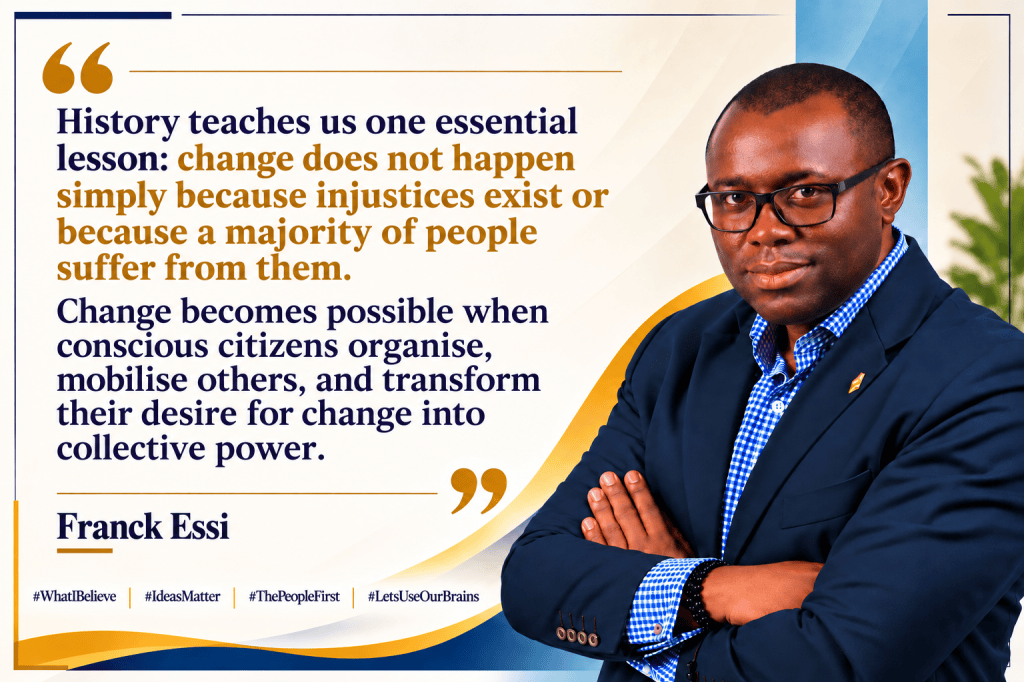
But history teaches us one essential lesson: change does not happen simply because injustices exist or because a majority of people suffer from them. Change becomes possible when conscious citizens organise, mobilise others, and transform their desire for change into collective power.
That is why I salute all those who, despite the difficulties, continue to mobilise in defence of rights, justice, human dignity, and the common good.
However, we must also ask ourselves a fundamental question:
How can we ensure that our mobilisations produce real, profound, and lasting change, rather than brief moments of outrage followed by a return to business as usual?
In other words, how can we truly put first things first in our struggles?
In my view, this requires at least five important shifts in how we think about and conduct civic action.
Focus more on solutions than on merely denouncing problems
Denouncing injustice is necessary. It is often the first act of resistance against arbitrariness, impunity, or indifference.
But denunciation alone is not enough.
We can multiply publications, statements, petitions, demonstrations, and social media campaigns without necessarily achieving the changes we seek.
Making a problem visible is not the same as solving it. The intensity of our outrage is not a measure of the effectiveness of our action.
Once a problem has been identified, documented, and understood, the bulk of our efforts should focus on the solutions we want and the concrete means of securing their adoption and implementation.
This requires us to ask several questions:
- What exactly do we want to change?
- What decisions would help remedy the injustice or put an end to the problem?
- Who has the authority to make those decisions?
- What legal, civic, and collective means can we mobilise to secure these changes?
- How will we know whether our mobilisation has actually produced results?
Consider a scandal involving public officials.
Denouncing it may legitimately lead to demands for investigations, sanctions, and the possible recovery of misappropriated public resources.
But a mobilisation genuinely focused on solutions must go further.
It must also seek to secure:
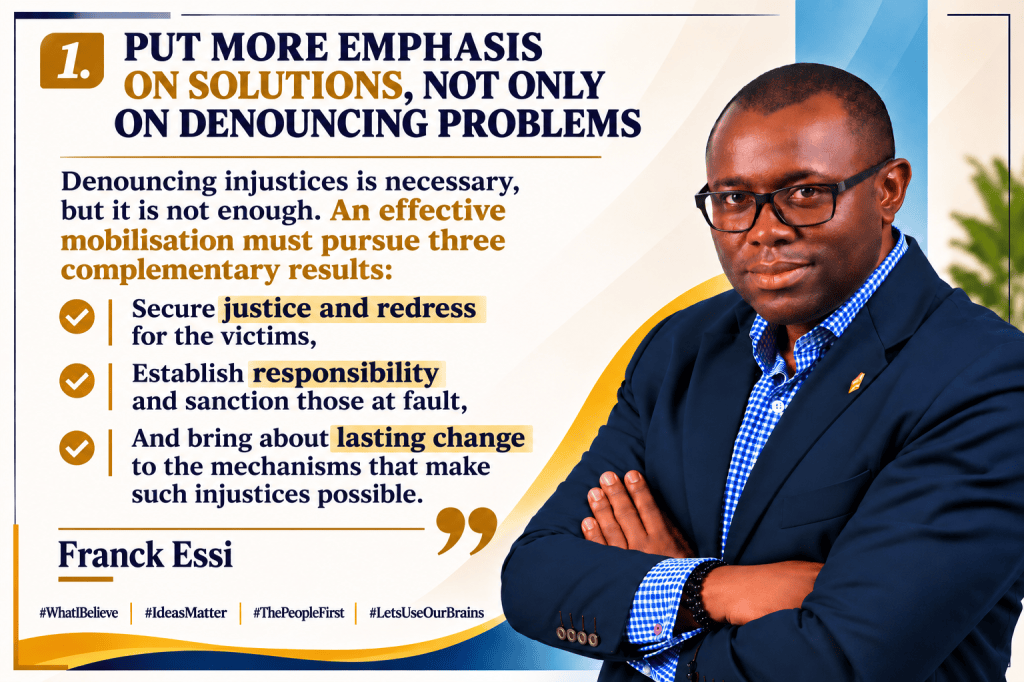
- For the victims: protection, recognition of the harm suffered, redress, and access to justice.
- For those responsible: the establishment of facts, determination of responsibility, and effective enforcement of the penalties provided by law.
- For institutions: correction of the failures that made the scandal possible.
- For society: concrete safeguards to reduce the risk of similar abuses occurring again.
The point, therefore, is not to choose between sanctions and reform. Both are necessary.
Punishing those responsible without fixing the system leaves intact the conditions that enabled the abuses. Reforming the system without establishing responsibility may, in turn, perpetuate impunity.
Effective mobilisation must pursue justice for victims, accountability for perpetrators, and the transformation of the mechanisms that enable injustice.
Prioritise structural change without neglecting individual injustices
Every injustice deserves our attention. Every victim deserves to be heard. Every abuse must be open to denunciation and redress.
But we must learn to look beyond individual cases.
When a scandal breaks, our attention generally focuses on the facts, the victims, and those allegedly responsible. Emotions run high. Reactions multiply. Voices rise to demand justice.
Then, gradually, public attention fades. Another scandal emerges. A new wave of outrage replaces the previous one.
And all too often, the same practices continue.
We move from one scandal to another, from one wave of outrage to another, from one mobilisation to another, without sufficiently changing the mechanisms that produce these injustices.
This is one of the great traps of civic action: devoting all our energy to fighting the symptoms of a problem without addressing its root causes.
When a scandal occurs in a hospital, the question should not only be who deserves to be sanctioned. We must also examine hospital financing, quality of care, oversight mechanisms, the accountability of hospital management, patients’ rights, and avenues for redress.
When corruption is exposed, we must examine those involved, but also public procurement rules, oversight mechanisms, transparency in public finances, judicial independence, and the conditions that make the misappropriation of public resources possible.
When a woman suffers violence, our mobilisation must demand justice for her, but it must also question prevention mechanisms, victim protection, access to support services, institutional practices, and the social norms that perpetuate such violence.
An individual case must become an entry point for understanding and transforming a broader collective problem.
This requires us to systematically ask three major questions:
- What is it about the current functioning of our society and institutions that makes this injustice possible?
- Which rules, practices, institutions, or power relations must we change to prevent or sustainably reduce its recurrence?
- How can we use mobilisation around this particular case to secure those transformations?
This approach allows us to move beyond mere reaction.
It compels us to develop a vision for change, identify specific reforms, and place our mobilisations within a broader perspective.
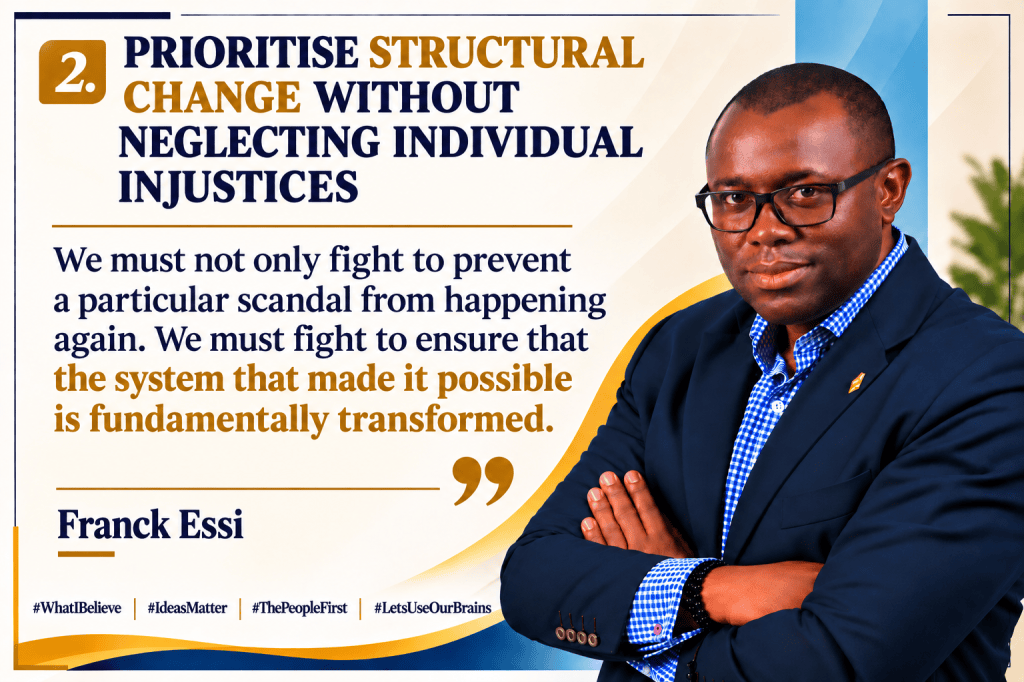
We must not fight only to prevent a particular scandal from happening again. We must fight to fundamentally transform the system that made it possible.
Turn temporary mobilisations into permanent civic organisations
A spontaneous mobilisation can expose an injustice, attract public attention, and compel those in authority to respond.
But it quickly reaches its limits when it is not supported by an organisation capable of sustaining the effort over time.
Outrage is often intense but short-lived. Scandals follow one another. Media outlets and social networks shift their attention. Citizens return to their daily concerns.
Meanwhile, the interests that perpetuate injustice remain organised.
They may have financial resources, networks of influence, institutional connections, and considerable capacity to wait until public mobilisation loses momentum.
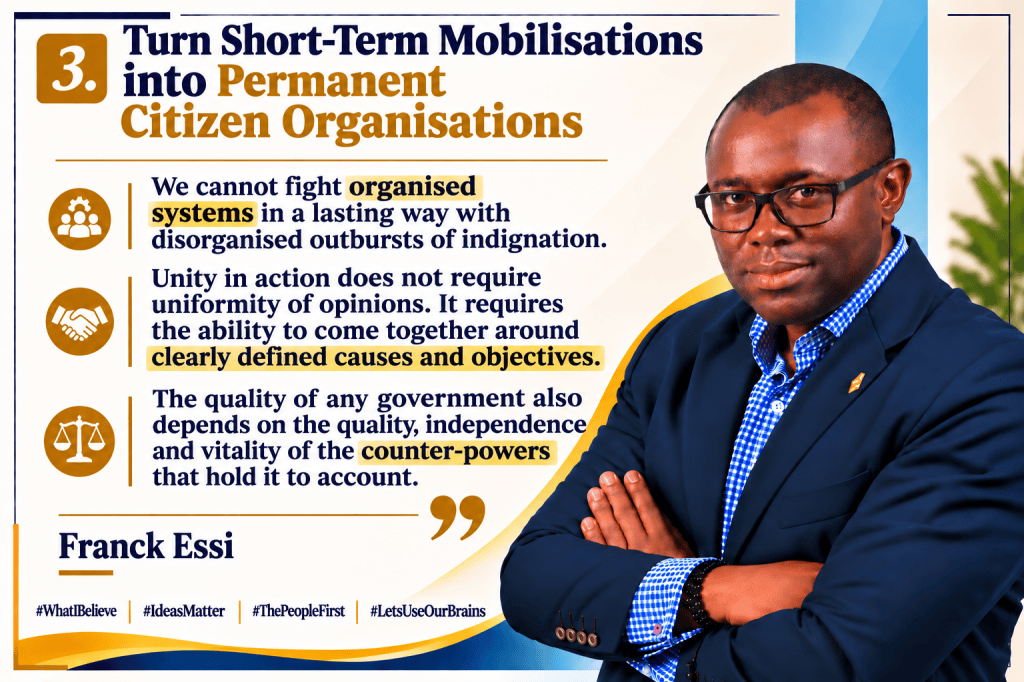
We cannot sustainably confront organised systems with disorganised outrage.
That is why our mobilisations must gradually lead to the establishment of permanent mechanisms for civic monitoring, early warning, solidarity, and collective action.
This includes:
- Citizen monitoring networks capable of gathering, verifying, and documenting information about injustices and institutional failures.
- Early warning mechanisms that allow abuses to be reported promptly while protecting victims, witnesses, and whistleblowers.
- Research and policy teams capable of identifying the causes of problems and developing realistic solutions.
- Support and solidarity mechanisms to assist victims and citizens who take risks in defending the common good.
- Mobilisation and follow-up mechanisms to sustain civic pressure until the desired changes are secured and effectively implemented.
These organisations must also learn to work together.
Associations, trade unions, professional organisations, citizen movements, human rights defenders, independent media, and other actors committed to the public interest have every reason to build common ground.
This does not mean giving up their autonomy or agreeing on every issue.
It means learning to identify shared objectives and coordinate their efforts whenever necessary.
Unity in action does not require uniformity of opinion. It requires the ability to come together around clearly defined causes and objectives.
A strong civil society is not simply one that reacts to scandals. It is a civil society that investigates, documents, proposes, mobilises, supports, monitors, and perseveres.
It is a civil society capable of becoming a genuine counterweight to power.
The quality of those in power also depends on the quality, independence, and vitality of the countervailing forces that hold them accountable.
Move from emotional mobilisation to strategic action
Outrage is a valuable source of energy. It can awaken consciences, break silence, and inspire engagement.
But outrage alone is not a strategy.
Being angry about an injustice does not mean knowing how to put an end to it.
An effective struggle requires understanding the problem, identifying the actors involved, assessing power relations, and choosing the methods of action most likely to achieve the desired results.
This requires distinguishing several elements:
- The objective: the specific change we want to achieve.
- The decision-makers: the individuals or institutions with the authority to act.
- Potential allies: the actors who could contribute to the mobilisation.
- The obstacles: the interests, practices, and power relations standing in the way of change.
- The means of action: legal proceedings, public campaigns, nonviolent collective action, institutional advocacy, and other forms of civic pressure.
- Indicators of progress: verifiable facts that will tell us whether we are genuinely moving forward.
We must also learn to prioritise our battles.
All injustices deserve attention, but our capacity for action is not unlimited. We do not have infinite human resources, unlimited financial means, or the permanent attention of the public.
We must therefore know where to concentrate our efforts to achieve the most significant changes.
This does not mean abandoning certain victims or treating certain injustices as unimportant.
It means organising our efforts to address problems whose resolution can sustainably improve the lives of the greatest number, while maintaining solidarity with those experiencing individual injustices.
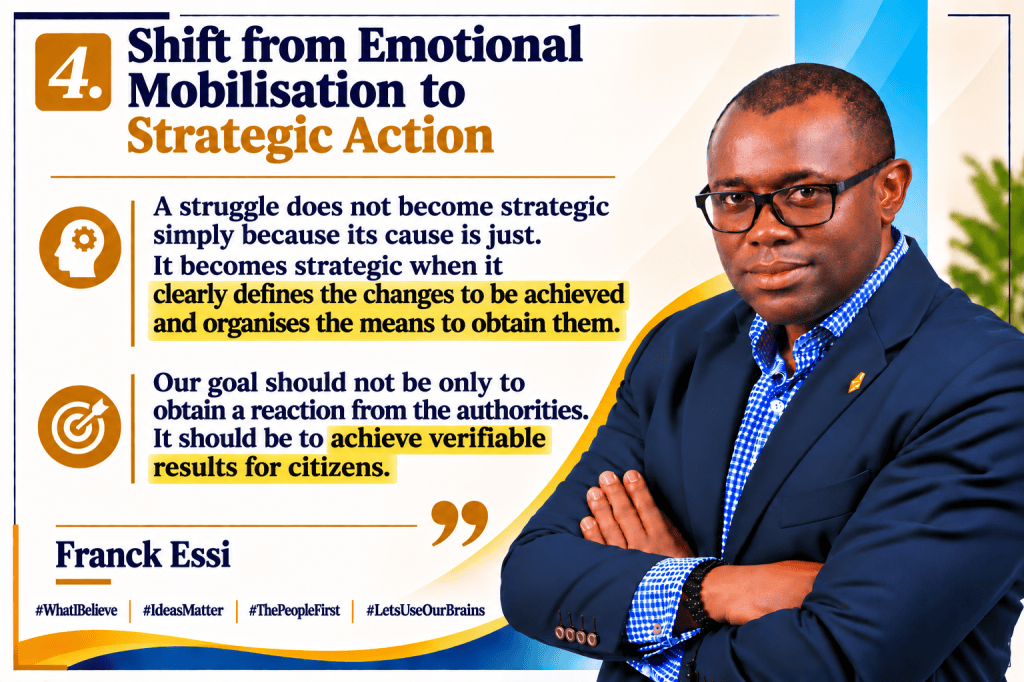
A struggle does not become strategic simply because its cause is just. It becomes strategic when it clearly defines the changes sought and organises the means to achieve them.
We must also learn to distinguish symbolic victories from real victories.
An official statement, the announcement of an investigation, the suspension of an official, or the promise of reform may represent progress.
But such announcements should not automatically be regarded as definitive victories.
Real results are measured by decisions taken, commitments honoured, remedies secured, rules changed, and improvements actually experienced in people’s lives.
Our objective should not merely be to obtain a reaction from the authorities. It should be to secure verifiable results for citizens.
Make every struggle an opportunity to build greater civic power
There is one final dimension that is often overlooked in our mobilisations: what they help us build for future struggles.
A mobilisation may fail to achieve all its immediate demands and still produce important gains.
It may bring citizens together, help them better understand their rights, teach them to work collectively, develop new skills, build solidarity networks, and strengthen their confidence in collective action.
Conversely, a mobilisation may succeed in securing a particular demand without leaving behind any organisation, new skills, or additional capacity for action.
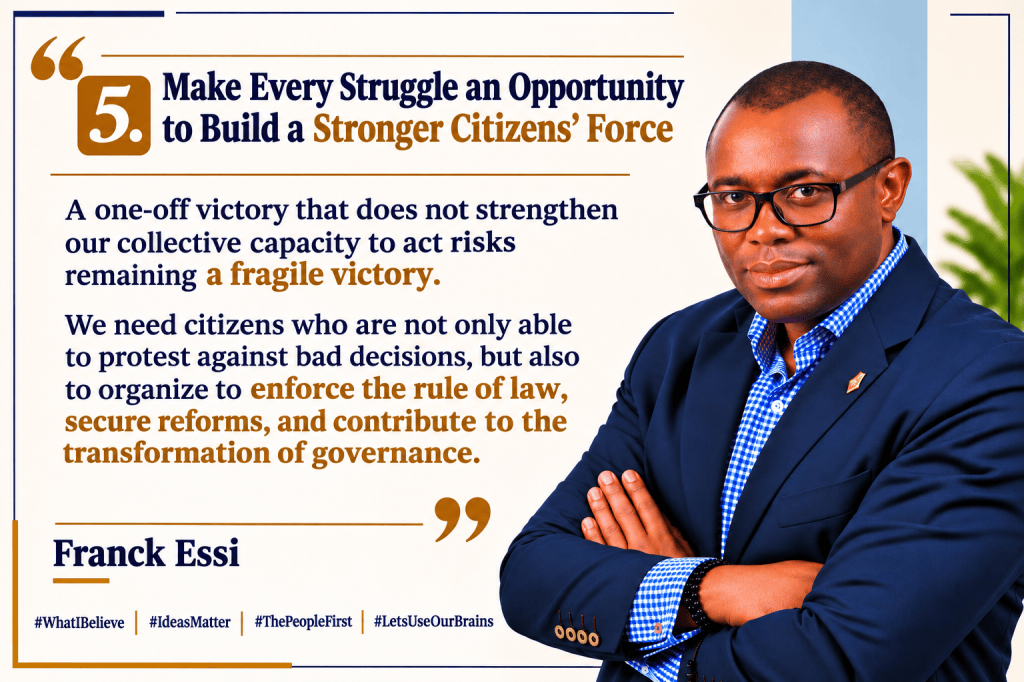
An isolated victory that does not strengthen our collective capacity to act risks remaining a fragile victory.
We must therefore evaluate our mobilisations at two levels.
First, the immediate results: have we obtained justice, redress, sanctions, or reform?
Second, the collective gains: are we better organised, better informed, more united, and more capable of defending our rights tomorrow?
This second dimension is fundamental.
Lasting social change does not depend solely on decisions made by those who govern. It also depends on citizens’ ability to organise, defend their interests, hold public authorities accountable, and participate in decisions affecting their future.
In a country like Cameroon, where institutional dysfunction, impunity, inequality, and the concentration of power contribute to numerous injustices, this question is particularly important.
We need citizens who are not only capable of protesting against bad decisions, but who can also organise to demand respect for the rules, secure reforms, and contribute to transforming governance.
This is how individual struggles can gradually contribute to a deeper transformation of the state, institutions, and relations between those who govern and those who are governed.
Our real challenge: transforming outrage into civic power
Ultimately, putting first things first in our struggles means refusing to confuse agitation with action, visibility with effectiveness, or outrage with transformation.
It means understanding that denunciation is necessary, but must lead to solutions.
It means recognising that holding those responsible accountable is essential, but must be accompanied by structural change.
It means understanding that temporary mobilisation can be useful, but must contribute to building permanent civic capacity.
Above all, it means recognising that the real challenge is not only to push back against injustice today, but to strengthen our society’s ability to prevent, confront, and correct the injustices of tomorrow.
We must therefore learn to transform:
- Our outrage into specific demands.
- Our demands into objectives for change.
- Our mobilisations into organised strategies.
- Our isolated victories into lasting reforms.
- Our experiences of struggle into permanent collective capacities.
True civic power does not lie solely in our ability to say NO to injustice.
It also lies in our ability to organise and bring about what we say YES to: justice, dignity, equality before the law, accountability of leaders, effective institutions, and a state that genuinely serves the people.
We must not simply become a society that expresses more outrage. We must become a society that organises better, acts more effectively, and achieves lasting change.
This requires courage, certainly. But it also requires method, discipline, perseverance, solidarity, and a clear vision of what we want to build.
Unjust systems do not survive only because those who benefit from them are powerful. They also survive when those who oppose them remain fragmented, react in isolation, and fail to build lasting collective strength.
Our challenge, therefore, is to ensure that every injustice we denounce brings us closer to a fairer society, every mobilisation makes us stronger, and every victory opens the way to deeper transformations.
Only then can we move from a succession of battles against the consequences of a system to a genuine process of transforming that system.
And that is how we will truly put first things first.
But before anything else, I want to salute all the women and men who stand up every day with courage and determination to defend justice, rights, and human dignity.
To those who speak out, document abuses, support victims, take risks, organise mobilisations, and refuse to surrender to resignation: your commitment matters.
To all victims of injustice, abuse, and violence: solidarity, strength, and courage!
Let us not settle for winning battles. Let us organise to change the rules of the game for good.
Franck Essi
#WhatIBelieve
#IdeasMatter
#ThePeopleFirst
#LetsUseOurBrains

