By Franck Essi
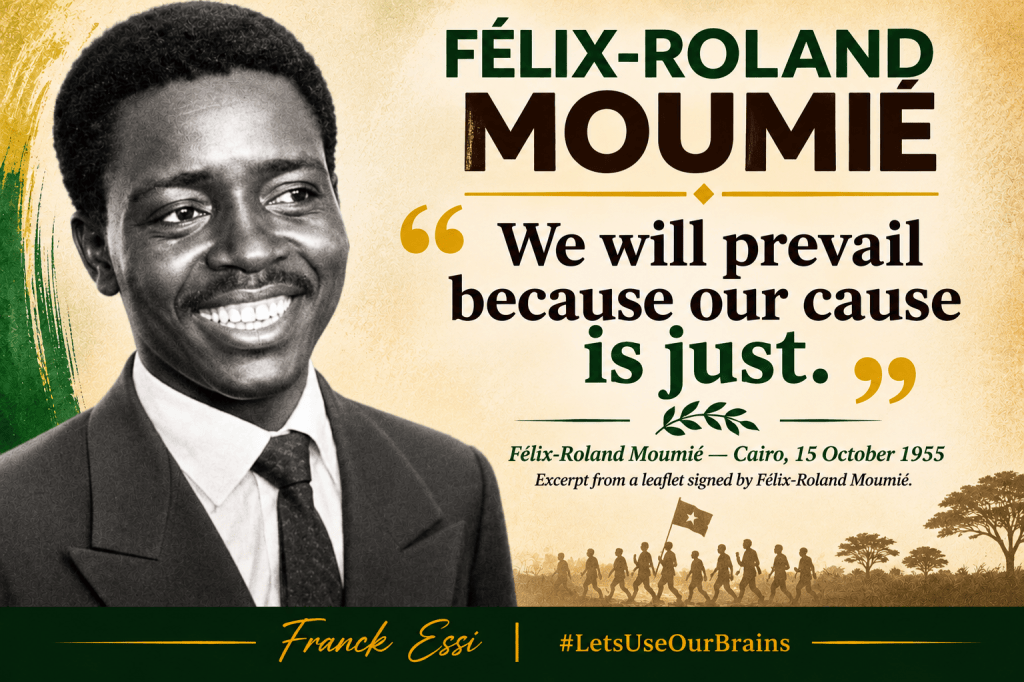
On 3 November 1960, Félix-Roland Moumié died in a hospital in Geneva, Switzerland. He had just turned 35. A few weeks earlier, he had been poisoned with thallium during a meal with William Bechtel, a man linked to French intelligence services.
Ten months earlier, on 1 January 1960, French-administered Cameroon had officially gained independence. Yet Moumié, one of the leading figures in the movement that had fought for that independence, was still living in exile. His party, the Union des populations du Cameroun (UPC, or Union of the Peoples of Cameroon), remained banned, and the war against the nationalists continued. Cameroon had become independent, but one of the men who had devoted his life to achieving that independence was still unable to return freely to his own country.
This contradiction captures part of the tragedy of our decolonisation. Sixty-six years after his death, Félix-Roland Moumié remains a major figure in our history. But beyond his assassination, how much do we really know about his life, his ideas, his struggles and his political choices?
His story deserves to be known, particularly by younger generations. Not to portray him as a flawless hero, but to understand what the struggle for independence meant at the time and what it can still teach us about building Cameroon.
A son of Foumban who became a doctor and nationalist leader
Félix-Roland Moumié was born on 1 November 1925 in Foumban. He was the son of Samuel Mekou Moumié, a Protestant evangelist, and Suzanne Mvuh. He grew up in an environment shaped by religious education, at a time when Cameroonians lived under colonial administration. After attending school in Foumban, Bafoussam and Dschang, he continued his education in Brazzaville and then Dakar, where he studied medicine.
Returning to Cameroon in 1947, he practised medicine in several towns, including Lolodorf, Bétaré-Oya, Mora, Maroua and Douala, where he worked at Laquintinie Hospital. His medical career was increasingly affected by his nationalist activities. Placed under surveillance by the colonial administration, he was subjected to several transfers, some of which were disciplinary in nature. These postings, intended in part to limit his political influence, also enabled him to discover different regions of the country and build relationships across them.
In 1948, he joined the Union des populations du Cameroun, founded on 10 April that year. He developed a close relationship with Ruben Um Nyobè, the movement’s Secretary-General. The two men came from different backgrounds: Um Nyobè had gained his experience through trade unionism and political activism, while Moumié was a doctor. But they shared one conviction: Cameroonians must be able to determine their own future.
In 1952, at the UPC congress in Éséka, Moumié became the party’s President. He was only 26. He played an active role in expanding the party’s presence, particularly in northern Cameroon, in Maroua, Garoua and Ngaoundéré. Originally from the Bamoun region, educated outside Cameroon and having worked in several parts of the country, he helped build a movement that sought to transcend ethnic and regional identities.
Moumié and his comrades did more than demand independence. They worked to build a political force capable of bringing Cameroonians from different backgrounds together around a common national project. This aspect of his journey deserves particular attention: a nation is not built through speeches about unity alone, but also through organisations, solidarity and shared commitments.
Independence, reunification and the sovereignty of the people
Moumié’s political project was initially built around two demands: independence and reunification. After the First World War, Cameroon had been divided between France and Britain. For UPC nationalists, this division imposed by colonial powers should not permanently determine the future of Cameroonians.
But their ambition went beyond ending foreign administration. By the late 1950s, as the French authorities prepared to transfer power to Cameroonian leaders, the UPC remained banned and several of its leaders were living in exile.
In the manifesto of 29 December 1959, Position de l’U.P.C. vis-à-vis de l’Indépendance du Kamerun (The UPC’s Position on the Independence of Kamerun), signed alongside Ernest Ouandié and Abel Kingué, Moumié challenged the conditions under which independence was being granted. For UPC leaders, the question was no longer simply to secure a date for independence, but to determine what independence would actually change.
Their position can be summarised around four complementary demands:
- Genuine political independence: replacing French administrators with Cameroonian officials should not conceal the continuation of the old structures of domination and dependence.
- Effective popular sovereignty: Cameroonians must be able to participate in decision-making, choose their leaders and hold the institutions governing their country accountable.
- Territorial reunification: the separation inherited from colonial partition should not prevent Cameroonian communities from building a shared future.
- Improved living conditions: independence should enable people to shape their economic future and benefit more fully from their country’s wealth.
Independence was not supposed to change merely who held power. It was meant to transform the relationship between those in power, institutions and the people.
The UPC did not represent every political tendency in Cameroon. Nevertheless, its exclusion from the independence process raised a fundamental question: could a new state be built on fully legitimate foundations while excluding a significant part of the nationalist movement?
This question remains highly relevant today. A state’s legal independence and its people’s effective sovereignty are not necessarily the same thing. A country may have a flag, a national anthem, a president and national institutions without its citizens having any meaningful ability to influence public decisions or freely choose their leaders.
From repression to exile: the difficult choices facing a movement
The year 1955 marked a decisive turning point in the UPC’s history. For several years, tensions had been growing between the nationalist movement and the French administration. The UPC expanded its activities, organised public mobilisation and denounced restrictions on Cameroonians’ political participation.
The arrival of Roland Pré as High Commissioner in late 1954 was accompanied by a tougher colonial policy towards the movement. The French authorities criticised the UPC’s mobilisation methods, its rhetoric and its opposition to colonial rule. They increasingly portrayed the party as a threat to public security and order. Nationalist leaders, for their part, denounced administrative restrictions, police interventions and provocations intended to weaken their organisation.
In May 1955, tensions escalated into violent clashes in several towns, particularly Douala. Demonstrations, interventions by security forces and acts of violence resulted in deaths, arrests and extensive damage. The colonial authorities blamed the UPC for the unrest and invoked the need to restore order. The nationalists rejected this interpretation and denounced political repression.
On 13 July 1955, the French administration banned the UPC and several affiliated organisations. The ban did not bring the movement to an end, but it fundamentally changed the conditions under which it operated. Deprived of opportunities for lawful political action, its leaders faced the prospect of underground activity, exile and armed resistance.
Moumié sought refuge in British-administered Cameroon, where he attempted to maintain the movement’s organisation and forge alliances. But in May 1957, the UPC was also banned there. Repression intensified, and part of the movement gradually turned to armed struggle.
Moumié supported this resistance, believing that the closure of political avenues and colonial violence made it necessary to continue the struggle by other means. Yet he did not abandon efforts to find a political solution.
In March 1960, when Cameroon was officially independent but the war was continuing, he presented proposals intended to restore peace. They included:
- A ceasefire to end the fighting;
- Guarantees against political prosecution and an amnesty;
- The release of political prisoners;
- The withdrawal of foreign troops;
- The postponement of elections to allow political participation under different conditions.
These initiatives show that he also envisaged a negotiated settlement, provided that nationalists could participate in political life and that the necessary guarantees were established.
His relationship with armed struggle must therefore be understood in all its complexity. He supported an insurrectionary strategy, some aspects and consequences of which raise serious questions, while also exploring opportunities for a political settlement. Understanding why a movement turns to armed resistance does not mean that every method it employs is necessarily justified.
Colonial repression played a decisive role in the radicalisation of the conflict. But the decisions taken by nationalist leaders must also be examined in light of their human and political consequences. The legitimacy of a cause does not guarantee the wisdom of every strategy chosen to defend it.
A Cameroonian leader at the heart of Pan-African solidarity
Moumié understood early on that the struggle for independence also had to be fought on the international stage. Because Cameroon was under United Nations trusteeship, the UPC used petitions, memoranda and diplomatic initiatives to advance its demands beyond national borders. In December 1956, a petition submitted by Moumié concerning French-administered Cameroon was registered with the United Nations.
After the party was banned, this international dimension became even more important. Moumié developed relationships with several African leaders involved in decolonisation movements, including:
- Gamal Abdel Nasser, in Egypt, whose country was an important centre for anti-colonial movements and Afro-Asian solidarity;
- Kwame Nkrumah, in Ghana, who championed African emancipation and supported several nationalist movements across the continent;
- Sékou Touré, in Guinea, whose country became a place of refuge and support for Cameroonian nationalist leaders in exile.
Through these relationships, Moumié sought political recognition, diplomatic backing, opportunities to organise and material support to sustain the struggle. He also established contacts with socialist countries and travelled to China in October 1959.
These initiatives reveal a leader who understood that Cameroon’s future was also being shaped by international power relations, at a time marked by decolonisation and the Cold War. But alliances came with their own constraints: states supporting liberation movements also pursued interests of their own. The challenge was therefore to secure support without losing control of the movement’s political objectives.
On 13 September 1958, Ruben Um Nyobè was killed by French forces in the Boumnyébel area. His death profoundly weakened the UPC. Moumié had to continue his work amid intensified repression, strategic divisions and the dispersal of the movement’s leaders. He sought to maintain its international networks and support resistance inside Cameroon.
On 1 January 1960, French-administered Cameroon officially gained independence. Yet Moumié remained in exile and challenged both the terms of independence and Ahmadou Ahidjo’s government. He remained one of the principal opponents of the emerging political order. A few months later, he was assassinated.
Geneva: the assassination and the subsequent disappearance of his remains
On 15 October 1960, Félix-Roland Moumié met William Bechtel at a restaurant in Geneva. Bechtel presented himself as a journalist interested in the Cameroonian cause. In reality, he had links to French intelligence services. During the meal, Moumié was poisoned with thallium. His condition deteriorated, and he died on 3 November.
Bechtel was identified as the principal suspect. He evaded Swiss justice for several years before being arrested in 1974. In 1980, the judicial proceedings ended without his being brought to trial, as the evidence gathered was considered insufficient.
This judicial outcome should not be confused with the conclusions of historical research. Subsequent investigations have documented Bechtel’s links to French intelligence and shed light on the circumstances of the poisoning. The research report published in 2025 by the Joint Franco-Cameroonian Commission provides important additional evidence drawn from French and Swiss archives.
The assassination occurred at a time when the French authorities were seeking to preserve their influence in Cameroon and support the consolidation of Ahidjo’s government against nationalist opposition. Two years after Um Nyobè’s death, the UPC lost another of its principal leaders. Ernest Ouandié and other activists continued the struggle, but the successive loss of key figures, combined with repression and internal divisions, profoundly weakened the movement.
Moumié’s assassination was not merely the death of one man. It deprived the nationalist movement of a leader, an organiser and a major figure in its international diplomacy.
After his death, Moumié was buried in Conakry, Guinea, a country that had welcomed several Cameroonian nationalist leaders in exile. His wife, Marthe Ekemeyong Moumié, herself a nationalist activist and a member of the Union démocratique des femmes camerounaises (UDEFEC, or Democratic Union of Cameroonian Women), spent decades bearing witness to the struggle and preserving his memory.
In 2004, when she travelled to Conakry, she discovered that her husband’s remains had disappeared from his tomb. This disappearance, often described as a desecration, added a particularly painful dimension to the story. The exact circumstances and any responsibility for the disappearance have not been fully established.
After being denied the possibility of living freely in his own country, Moumié was not even granted a burial place that would remain undisturbed.
Marthe Moumié devoted an important part of her life to bearing witness to this struggle. In 2006, she published Victime du colonialisme français : Mon mari Félix Moumié (A Victim of French Colonialism: My Husband Félix Moumié). In January 2009, she was found murdered at her home in Ebolowa.
Her life also deserves recognition. She was not merely the wife of a nationalist leader, but a committed activist, a witness to history and a woman who devoted part of her life to defending the memory of a collective struggle.
Officially recognised as a national hero: what place does he hold in our collective memory?
In December 1991, Cameroonian law officially recognised Félix-Roland Moumié as a national hero, alongside Ruben Um Nyobè and Ernest Ouandié. This recognition marked an important step in the official rehabilitation of figures who had long been fought against or marginalised by colonial and then postcolonial authorities.
But it raises a question: what does it mean to officially recognise someone as a national hero when citizens remain largely unfamiliar with his history, his ideas and the circumstances of his struggle?
National memory is not built through official declarations alone. It is built through the teaching of history, scientific research, the opening of archives and the preservation of places of remembrance. It is also shaped by the names we give to our streets, squares, public establishments and institutions.
In a refounded Cameroon, the way we honour the figures of our national history should also evolve.
Why not, for example, rename the present-day Laquintinie Hospital in Douala the “Félix-Roland Moumié Hospital”?
This hospital, where Moumié himself once practised medicine, currently bears the name of a French military doctor from the colonial era. Giving it Moumié’s name would be a powerful symbolic act: honouring both a Cameroonian medical professional and a patriot who devoted his life to his country’s freedom.
It would not be about erasing history, but about allowing the symbols of our collective memory to evolve in accordance with the values we wish to pass on. This reflection could naturally extend to other figures in our history, including the many women whose contributions to national emancipation remain insufficiently recognised.
What Moumié leaves us as a legacy
Félix-Roland Moumié died at the age of 35. He did not live to see reunification in 1961 or the political transformations that followed independence. We will never know what role he might have played in Cameroon in the decades that followed. But his short life offers several essential lessons:
- Freedom and sovereignty are more than symbols. They must translate into citizens’ ability to participate in decisions, hold institutions accountable and determine their own future.
- Great causes require strong organisations. Individual convictions are not enough. Movements must be capable of bringing people together, educating, mobilising and sustaining collective action.
- Strategic choices carry responsibility. A just cause never removes the obligation to assess the methods employed and their consequences for the population.
- A nation cannot be built sustainably by erasing parts of its own history. Understanding our past, including its most painful chapters, is essential to making sense of our present and preparing our future.
Moumié devoted his short life to a project greater than himself: a free, reunified Cameroon in control of its own destiny. His journey was marked by remarkable commitments, difficult choices, exile, repression and, ultimately, assassination. But what should challenge us today is not only how he died. It is above all what he lived for.
We do not need to portray Moumié as a perfect man to recognise him as a great patriot. The best way to honour him is not simply to celebrate his courage or condemn his assassination. It is to understand his ideas, learn from his struggles, draw lessons from his choices and accept our share of responsibility for building Cameroon.
Independence is not merely a date recorded in our history books. It is an enduring responsibility towards our people’s freedom, dignity and future.
Glory and honour to Félix-Roland Moumié! Tribute to Marthe Moumié and to all the women and men who devoted their lives to our country’s freedom.
Franck Essi
#WhatIBelieve
#IdeasMatter
#ThePeopleFirst
#LetsUseOurBrains
Main sources and references
- Joint Franco-Cameroonian Commission (2025). France’s Role in Repressing Independence and Opposition Movements in Cameroon, 1945–1971. https://www.vie-publique.fr/files/rapports/fichiers_joints/297054_version_anglaise.pdf
- Achille Mbembe (1996). La naissance du maquis dans le Sud-Cameroun, 1920–1960. Karthala.
- Meredith Terretta (2013). Nation of Outlaws, State of Violence. Ohio University Press.
- Meredith Terretta (2010). “Cameroonian Nationalists Go Global: From Forest Maquis to a Pan-African Accra”, The Journal of African History.
- Marc Michel (1999). “Une décolonisation confisquée ? Perspectives sur la décolonisation du Cameroun sous tutelle de la France, 1955–1960”, Revue française d’histoire d’outre-mer.
- Joseph Takougang (1996). “The Union des populations du Cameroun and its Southern Cameroons Connection”, Revue française d’histoire d’outre-mer.
- Marthe Ekemeyong Moumié (2006). Victime du colonialisme français : Mon mari Félix Moumié.
- UPC (1959). Position de l’U.P.C. vis-à-vis de l’Indépendance du Kamerun. https://www.loc.gov/item/2008700218/
- United Nations (1956). Petition from Mr. Felix-Roland Moumie concerning the Cameroons under French Administration, T/PET.5/995. https://digitallibrary.un.org/record/3795292
- Thomas Deltombe, Manuel Domergue and Jacob Tatsitsa (2011). Kamerun ! Une guerre cachée aux origines de la Françafrique, 1948–1971. La Découverte.

