On November 6, 1982, Paul Biya came to power. He would go on to promise Renewal, Rigour, and Moralisation.
On November 6, 2025, 43 years later, he was sworn in for an eighth term, following a disputed election and a deadly post-election crisis.
Once again, the promises were plentiful: jobs for young people, greater opportunities for women, faster implementation of development projects, a stronger fight against corruption, institutional reforms, peace, and security.
One year later, where are the results? Where are the promised changes?
The announced new government has yet to materialise. Commitments to youth employment have failed to deliver the expected results. Crises persist. The daily hardships faced by Cameroonians remain, and in many cases are getting worse. Meanwhile, the reforms undertaken have done little to fundamentally change how power is exercised.
Cameroon thus finds itself trapped in a double deadlock.
A political deadlock: the current institutional framework and balance of power make democratic alternation extremely difficult, let alone the emergence of a genuine political alternative. The very rules that are supposed to allow political change, in practice, help perpetuate the existing system.
A development deadlock: despite the projects announced, investments made, and reforms proclaimed, structural transformation remains far too limited. Whatever progress has been achieved has not translated into sufficiently deep and lasting improvements in the living conditions of most Cameroonians.
We are confronted with a system that can no longer deliver meaningful transformation, yet continues to obstruct the very possibility of change.
Meanwhile, at 93, Paul Biya is becoming increasingly absent from public life. In 2026, he broke his own record for time spent outside Cameroon, remaining abroad for 73 consecutive days.
And now, on top of all our existing crises, comes another major uncertainty: what will happen to Cameroon if the Head of State dies or becomes incapacitated?
This uncertainty represents a major political risk, felt both within Cameroon and beyond its borders. The creation of the office of Vice-President is no guarantee of a peaceful political transition. Beyond constitutional provisions, the real question is whether a system built around one man can survive his departure without plunging the country into yet another crisis.
No state should ever depend so heavily on the presence, health, or survival of a single individual.
44 years at the helm of the state. 44 years of renewed promises. 44 years of historic opportunities largely squandered.
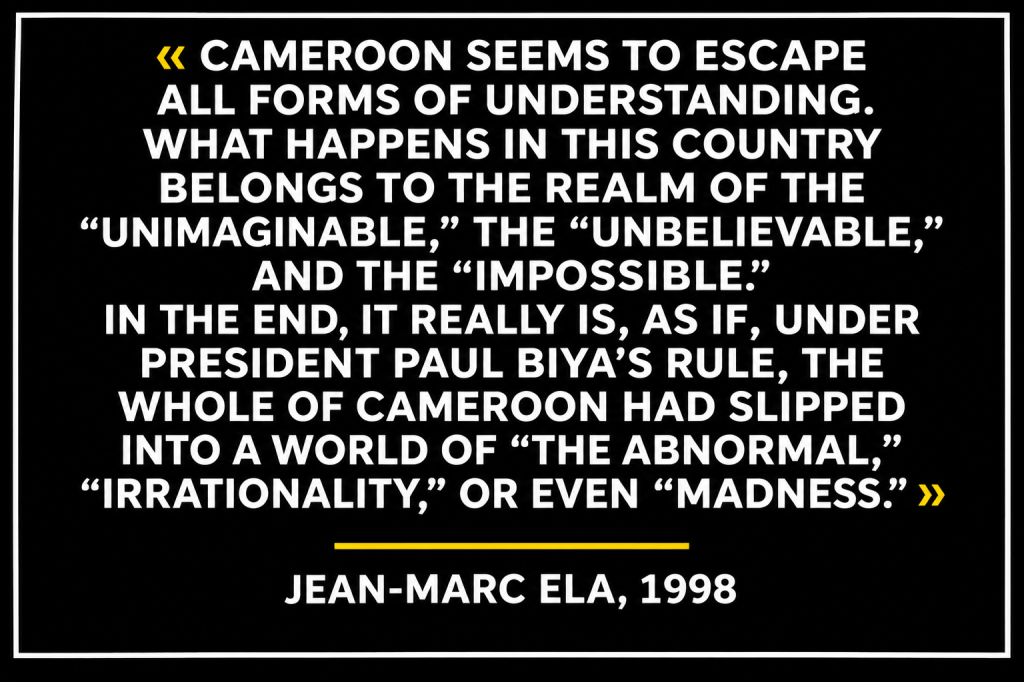
Jean-Marc Ela had already described a Cameroon where the « unimaginable », the « unbelievable », and the « impossible » seemed to have become the norm. A country overtaken by what defied all norms, by irrationality and madness.
His words resonate today with disturbing relevance.
For the greatest tragedy is not simply what this regime has done or failed to do. It is what it has gradually conditioned us to accept.
The extraordinary has become ordinary. The unacceptable has become routine. Failure to deliver results commensurate with promises no longer prevents fresh announcements. And longevity in power is presented as an achievement in itself.
So, is November 6 a cursed date for Cameroon?
No. Dates are not cursed. Nations are not condemned by the calendar.
What looks like a curse is, above all, the result of a political system that people have built, sustained, and perpetuated.
And what people have built, others can transform.
Cameroon does not need another promise of Renewal or fresh declarations of national greatness. It needs a genuine rebuilding of the State, the Nation, and Governance.
November 6 must not remain a symbol of power perpetuating itself. It must remind us of the urgent need to build a country that moves forward.
Franck Essi
#WhatIBelieve
#IdeasMatter
#ThePeopleFirst
#LetsUseOurBrains

