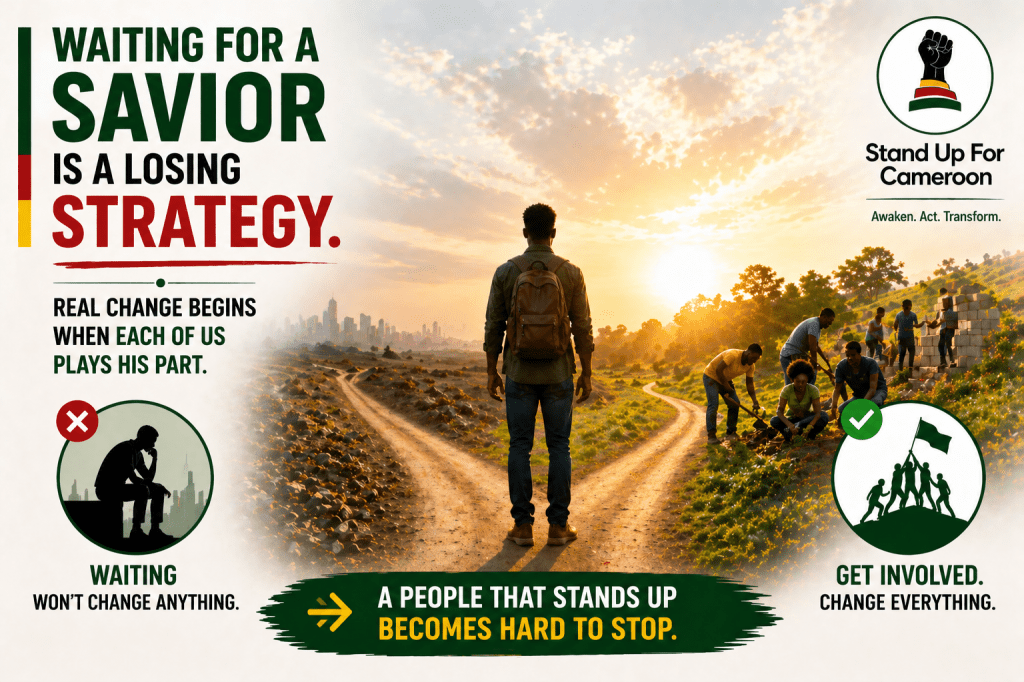
Why Waiting for a Savior Is a Losing Strategy
By Franck Essi
—–
One of the most dangerous habits in any society is the habit of waiting.
Waiting for the providential man.
Waiting for the exceptional leader.
Waiting for the one who will come, alone, to repair what several generations have allowed to deteriorate.
Waiting for the one who will think for us, decide for us, fight for us, organize for us, and eventually liberate us despite ourselves.
This expectation may feel comfortable. It gives the illusion that change is possible without any deep effort on our part. It relieves us of the duty to think seriously. It relieves us of the duty to organize patiently. It relieves us of the duty to assume our share of responsibility.
But this expectation is a trap.
Because no society can transform itself sustainably by proxy.
A leader can awaken consciences.
A leader can clarify a vision.
A leader can open a breach.
A leader can embody a historic moment.
A leader can give courage to those who are still hesitating.
But a leader cannot replace civic maturity.
He cannot sustainably organize citizens who refuse to organize themselves. He cannot build strong institutions with people who believe only in miracles. He cannot create collective discipline where everyone is waiting for someone else to carry the common burden.
This is where one of our great confusions begins: we often want strong leaders, but we do not always want to become responsible citizens.
—–
The problem is not leadership, but substitution
Let us be clear: every society needs leaders. It needs women and men who are able to see further, take risks, name the problems, propose a direction, and gather scattered energies.
The problem, therefore, is not having strong leaders.
The problem is believing that a strong leader can replace organized, responsible and mature citizens.
A true leader does not create passive worshippers. He helps women and men grow in conscience, character and responsibility. He does not say:
“Trust me, I will do everything in your place.”
He says instead:
“Let us build together the capacity to do what none of us can accomplish alone.”
That is the whole difference between the cult of the savior and the formation of mature citizens.
In many of our societies, we criticize the concentration of power in the hands of one man. But very often, we reproduce the same logic in our associations, political parties, citizen movements, families, churches and businesses.
We want “someone” to speak.
“Someone” to organize.
“Someone” to finance.
“Someone” to take the risks.
“Someone” to carry the fatigue, the criticism, the sacrifices and the responsibilities.
Then, when things do not move forward, we wonder why change is taking so long.
Sometimes, the answer is simple: too many people are waiting for a few individuals to carry what should be carried collectively.
——
The cult of the savior produces immature citizens
The cult of the savior is not only a strategic mistake. It is also a political and moral disease.
It teaches citizens to watch instead of act.
It turns activists into supporters.
It turns organizations into chapels.
It turns leaders into untouchable figures.
It turns disagreements into betrayal.
It turns criticism into a threat.
And, little by little, it prepares the disappointments of tomorrow.
Because when everything depends on a savior, everything becomes fragile:
- if he fails, hope collapses;
- if he gets tired, the movement slows down;
- if he compromises himself, consciences become confused;
- if he disappears, the organization shakes;
- if he is attacked, the whole project seems threatened.
A society that delegates its destiny to one man remains vulnerable.
But a society made up of citizens who are able to think, organize, contribute and hold their leaders accountable becomes much harder to manipulate, intimidate or stop.
Dependence says:
“Someone must come and save us.”
Responsibility asks:
“What is my share in the work that must be done?”
Dependence applauds leaders without building institutions.
Responsibility supports leaders while strengthening rules, teams, methods and structures.
Dependence looks for a hero.
Responsibility forms citizens capable of bringing forth many leaders.
—–
What does it mean to form mature citizens?
Mature citizens are not citizens without leaders. Nor are they citizens without emotions, anger, hope or inspiring figures.
Mature citizens are women and men who refuse to remain trapped in political, moral and organizational dependence.
They understand that the transformation of a society does not depend only on the sincerity of one man, the eloquence of one speech or the intensity of one moment.
Mature citizens learn to:
- distinguish emotion from analysis;
- reject magical solutions;
- seek serious information;
- accept disagreement without destroying one another;
- support their leaders without idolizing them;
- hold their leaders accountable without sabotaging collective action;
- transform indignation into organization;
- build institutions stronger than individuals.
Civic maturity begins when women and men stop confusing hope with passive waiting.
To hope does not mean sitting still and waiting for history to do the work for us. To hope means preparing. Learning. Contributing. Organizing. Holding firm over time.
—–
From complaint to contribution
Real change does not begin only in speeches, slogans or grand declarations. It begins when each person accepts the passage from complaint to contribution.
It is an inner conversion.
It means no longer asking only:
“What should others do?”
But beginning to ask:
“What must I do, at my level, with the means I have?”
In an association, the savior mentality appears when the same people prepare meetings, mobilize members, contribute financially, write documents and absorb the pressure, while others arrive at the last minute to judge, correct or applaud.
In a family, this logic appears when one person alone has to pay, organize, solve problems, advise, support and mediate, while others observe, consume or criticize.
In a citizen movement, it appears when many people share messages, applaud speeches and repeat slogans, but very few accept to train themselves, mobilize people around them, take concrete tasks, contribute financially and defend the cause over time.
In a nation, it becomes dangerous when citizens denounce the failure of leaders but refuse, themselves, to get informed, organize, defend the common good and demand accountability with consistency.
Responsibility therefore begins with simple actions:
- taking on a task and doing it seriously;
- respecting commitments;
- contributing with one’s means;
- proposing instead of only criticizing;
- learning instead of repeating;
- helping solve problems instead of merely commenting on them;
- supporting collective action even when no one applauds us.
But individual responsibility is not enough if it remains scattered.
A society is not transformed by isolated goodwill. It is transformed when these goodwill efforts learn to coordinate, endure and produce institutions.
—–
Organization turns goodwill into collective power
Goodwill is necessary. But it is not enough.
Many citizens are angry.
Many people have good intentions.
Many activists have courage.
Many young people want things to change.
But without organization, energy disperses.
Without method, indignation wears out.
Without discipline, enthusiasm fades.
Without institutions, victories remain fragile.
This is why the logic of the builder is superior to the logic of the savior.
The logic of the savior asks:
“Who will come and solve the problem in our place?”
The logic of the builder asks:
“What are we responsible for building, protecting and improving together?”
The logic of the savior produces spectators.
The logic of the builder produces citizens.
The logic of the savior waits for a miracle.
The logic of the builder creates habits, methods, teams, rules and discipline.
The logic of the savior seeks one exceptional man.
The logic of the builder forms thousands of responsible citizens.
And that is where the real power of a society begins.
A teacher who awakens critical thinking does their part.
A parent who educates children in responsibility does their part.
An activist who trains rather than manipulates does their part.
An entrepreneur who creates value with ethics does their part.
A citizen who rejects lies, corruption and hatred does their part.
A young person who chooses to learn, serve and build does their part.
Change becomes powerful when small responsibilities assumed by many people eventually produce a great collective force.
—–
The real question
The decisive question is therefore not:
Who will come and save us?
The real question is:
What share am I ready to carry myself so that things may change?
What truth am I ready to speak?
What responsibility am I ready to assume?
What discipline am I ready to practice?
What organization am I ready to strengthen?
What common good am I ready to defend?
What contribution am I ready to make, even when no one applauds me?
A society waiting to be saved often delays its own liberation.
But a society made up of citizens who rise, think, organize, contribute and assume their share of responsibility becomes difficult to stop.
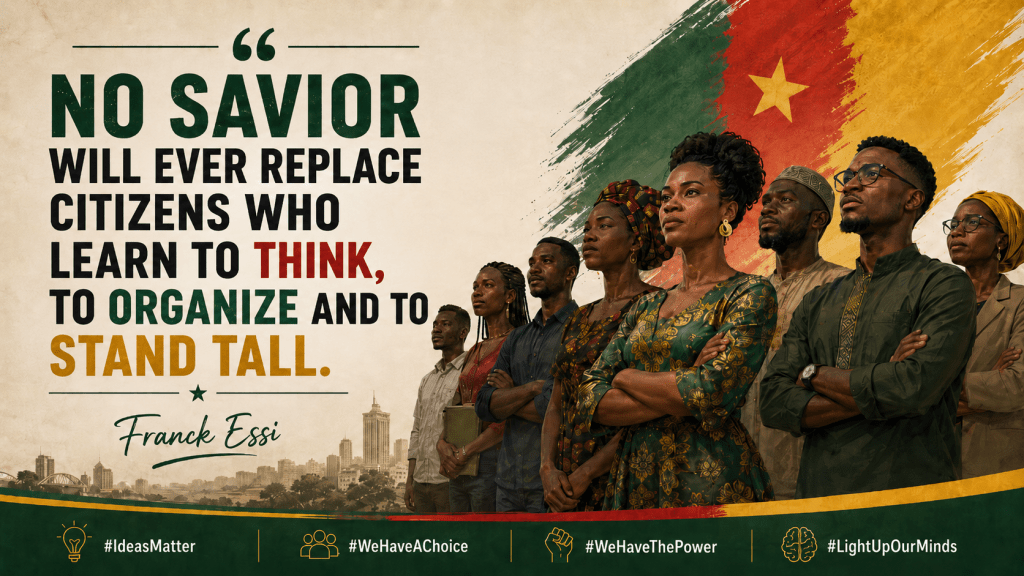
Because no savior will ever replace citizens who refuse to remain immature.
But no system can resist for long citizens who finally learn to think, organize and stand upright.
Franck Essi
#IdeasMatter
#WeHaveAChoice
#WeHaveThePower
#LightUpOurMinds