By Franck Essi
—–
Today, we talk a lot about leadership.
In organizations, companies, families, citizen movements and political parties, many people want to inspire, mobilize, influence or be followed.
All of that matters.
But none of it is enough.
A leader is not only someone who has a vision, ideas or followers.
A leader is also recognized by their ability to initiate concrete transformation.
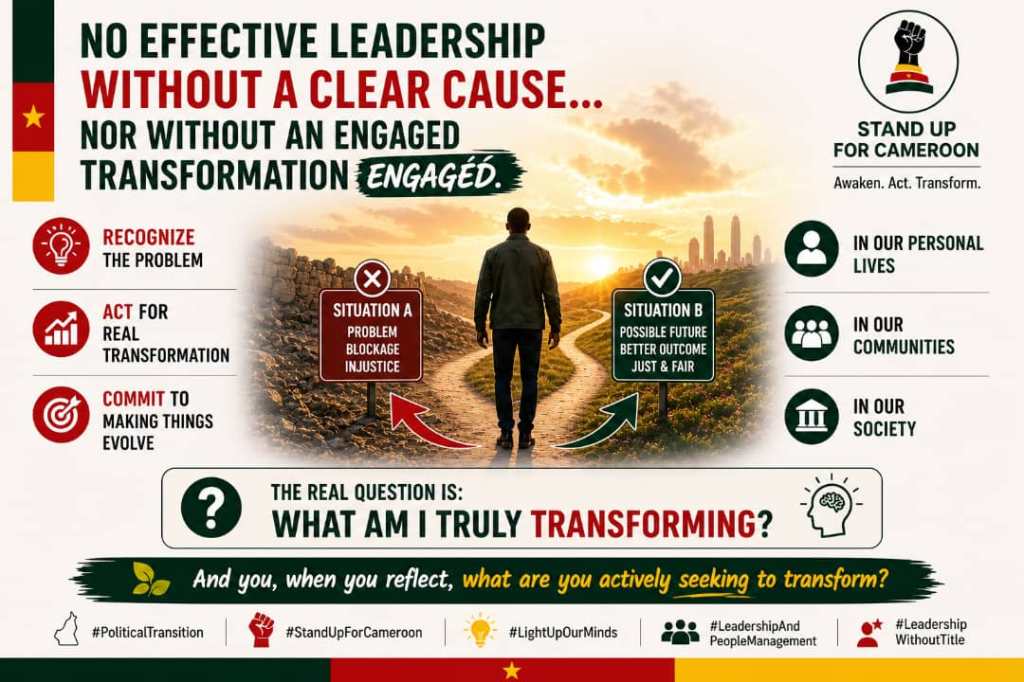
In other words, leadership begins when a person accepts to carry a cause and help move part of reality forward:
- from a situation A, marked by a problem, a blockage, an injustice or a weakness;
- toward a situation B, one that is fairer, better organized, more conscious, more effective or more humane.
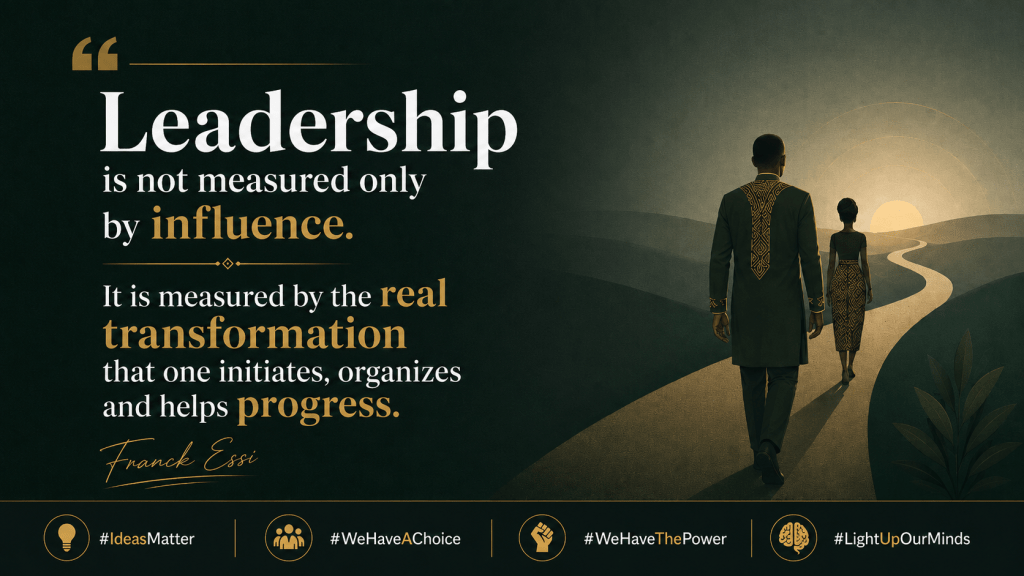
Leadership is therefore not measured only by speeches, influence or visibility. It is measured by the real transformation one initiates, organizes and helps move forward.
—–
1. Carrying a cause: the starting point of leadership
A leader does not simply seek to occupy a position.
A leader carries something greater than personal interest.
That cause can be great or modest. It can concern:
- one’s personal life: transforming habits, discipline or relationship with time;
- one’s family: improving communication, education, listening and responsibility;
- an association: clarifying organization, strengthening results and building a culture of contribution;
- a company: improving methods, service, performance or ethics;
- citizen engagement: awakening consciences, transforming practices and building fairer institutions.
Without a cause, leadership becomes a quest for image. With a cause, it becomes a responsibility.
—–
2. Transforming is not just speaking
It is possible to have good ideas without changing anything.
It is possible to deliver beautiful speeches without building anything.
It is possible to be visible without producing real impact.
That is why we must distinguish between:
- commentary, which analyzes what is wrong;
- denunciation, which exposes an injustice;
- mobilization, which gathers energies;
- transformation, which organizes concrete and lasting change.
Commentary can be useful.
Denunciation can be necessary.
Mobilization can be powerful.
But at some point, one must move further: organize, follow up, correct, evaluate and persevere.
A leader is not recognized only by what they say. A leader is also recognized by what they set in motion.
——
3. Transformation requires a method
Transforming a situation does not happen through good intentions alone.
It requires at least a minimum of method.
Every serious transformation generally requires:
- an honest diagnosis: understanding the real problem, its causes and its consequences;
- a clear vision: knowing where one wants to go;
- chosen priorities: avoiding the temptation to do everything at once;
- concrete actions: translating ideas into practices;
- new habits: repeating what builds change;
- regular follow-up: checking what is moving forward and what is blocking progress;
- courageous corrections: adjusting when reality resists;
- time: accepting that deep transformations are built over the long term.
For example, an association that wants to become more effective cannot simply say: “We must work better.”
It must ask itself:
- What are our real objectives?
- Who does what?
- What decisions have we made?
- Who follows them up?
- What is blocking us?
- What habits must we change?
That is where effective leadership begins.
—–
4. The leader organizes the passage from situation A to situation B
Leadership can be understood simply as the art of organizing a passage.
In personal life, situation A may be disorder, procrastination or inconsistency.
Situation B may be a more disciplined, stable and productive life.
In a family, situation A may be silence, tensions or misunderstandings.
Situation B may be better communication, more respect and greater shared responsibility.
In an organization, situation A may be improvisation, meetings with no follow-up and commitments that are not kept.
Situation B may be a clearer, more rigorous and more contributive organization.
In citizen engagement, situation A may be resignation, fear, division or waiting for a savior.
Situation B may be a more conscious, organized, courageous and responsible citizenship.
A leader is the one who refuses to settle into situation A and who works, step by step, to make situation B possible.
——
5. Leadership also begins with oneself
It is difficult to transform one’s surroundings sustainably while refusing to transform oneself.
Before wanting to change an organization, a family, a community or a society, one must sometimes begin by questioning one’s own consistency.
Do I practice what I ask of others?
Do I honor the commitments I make?
Do I truly contribute, or do I merely criticize?
Am I disciplined in the small things I present as important?
This does not mean that a leader must be perfect. No one is.
But it means that a leader must be engaged in a sincere effort toward consistency.
The credible leader is not the one who has no weaknesses. It is the one who honestly works to reduce the gap between what they proclaim and what they practice.
——
6. The right questions to ask ourselves
To know whether we are truly in a leadership dynamic, it may be useful to ask a few simple questions:
- What cause am I currently carrying?
- What specific problem am I confronting?
- What better situation am I trying to help bring about?
- What concrete process have I initiated?
- Who am I helping to move forward?
- What has already begun to change, even modestly?
- What still depends on my own discipline, contribution or consistency?
These questions are demanding.
But they are necessary.
They prevent us from confusing:
- popularity with impact;
- agitation with transformation;
- speeches with action;
- visibility with responsibility;
- the posture of a leader with real leadership.
—–
In the end
There is no effective leadership without a cause to carry.
But there is also no effective leadership without a transformation process to lead.
The cause gives meaning.
The diagnosis brings lucidity.
The vision gives direction.
The method gives the capacity to act.
Discipline gives continuity.
Example gives credibility.
Evaluation gives the possibility to correct.
To be a leader is to refuse merely to comment on the world. It is to commit to making it evolve, even modestly, but truly.
So the real question is not only:
Do I have a vision?
Do I have ideas?
Do I have support?
Do I have visibility?
The more demanding question is:
What am I truly transforming?
And when you think about it honestly,
what cause are you currently carrying, and what transformation are you trying to make possible?
Franck Essi
#IdeasMatter
#WeHaveAChoice
#WeHaveThePower
#LightUpOurMinds