By Franck Essi
——
We often know very well how to say what is wrong
In our families, neighborhoods, businesses, administrations, associations, and countries, we often know very well how to say what is wrong.
We know how to say that the State does not function well enough, that roads are poor, that meetings are sometimes useless, that young people lack opportunities, that leaders promise a lot and deliver little.
We also know how to say that parents are overwhelmed, that schools lack resources, that hospitals are poorly equipped, that businesses are badly organized, that citizen movements are losing momentum, and that many collective projects die in endless discussions.
And very often, we are not wrong.
We must not deny the problems.
In a country like Cameroon, and more broadly in many African countries, the difficulties are real. They are not imaginary. They can be seen in people’s daily lives: in the long waiting lines in some public services, in neighborhoods where water is lacking, in schools where parents sometimes have to contribute money to solve basic problems, in health centers where families must buy almost everything before a patient can be treated.
So the problems are there. We must name them because, in my view, no serious progress begins by denying reality.
But I also believe that there comes a time when diagnosis is no longer enough.
——
Being solution-oriented does not mean closing our eyes
Being solution-oriented is not about denying problems. It is about refusing to settle into them.
This, in my view, is where a common confusion lies.
Some people think that being solution-oriented means closing one’s eyes to what is wrong. That is not what I mean.
Being solution-oriented does not mean saying that everything is fine when everything is not fine. It does not mean asking citizens to remain silent. It does not mean asking workers to endure injustice quietly. It does not mean asking young people to smile in the face of unemployment. It does not mean asking communities to replace the State where the State must assume its responsibilities.
Nor does it mean turning deep problems into motivational slogans.
I do not believe that a slogan can repair a road. I do not believe that positive thinking can build a hospital. I do not believe that good intentions can replace serious public policy.
Some problems require time, resources, method, courage, organization, and sometimes even a balance of power.
So we must remain lucid.
But lucidity should not condemn us to powerlessness.
——
The real question: what part can I play?
At some point, it becomes useful to ask ourselves a simple question:
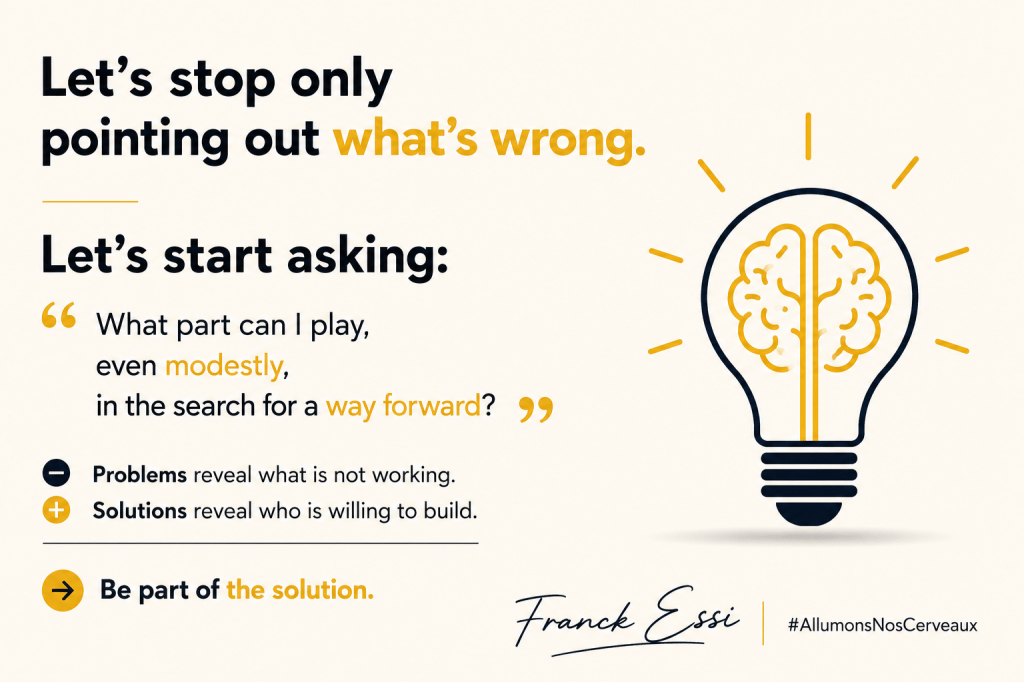
What part can I play, even modestly, in the search for a way forward?
This question does not solve everything.
But it changes something.
It moves us from permanent complaint to possible contribution.
In many situations, we spend a great deal of time saying: “Here is what is not working.”
That is sometimes necessary. But perhaps we should also learn to add: “Here is what we can try.”
There is a major difference between these two attitudes.
In the first case, we reveal a problem.
In the second, we open up a possibility.
And sometimes, opening up a possibility is already enough to bring some movement back where everything seemed blocked.
——
Moving from complaint to contribution
For me, being solution-oriented means trying to move from diagnosis to contribution.
It means learning to say:
- here is the problem;
- here is what we can try;
- here is what may depend on me;
- here is a possible first step;
- here is how we can track progress.
It does not mean always having the right answer.
It simply means refusing to let complaint become our only mode of expression.
We have sometimes grown used to believing that denunciation is enough. Yet denunciation may be necessary, but it is not always sufficient.
Sometimes we must denounce, propose, organize, follow up, correct, and start again.
This is often the price at which things move forward.
——-
A few simple but meaningful examples
In a neighborhood where garbage blocks the gutters, everyone can blame the municipality. And sometimes rightly so.
But residents can also come together, identify critical points, write officially to the authorities, follow up on the matter, and organize a first collective action.
This does not replace the municipality.
It does not absolve the State.
But it brings some movement back where there was only anger.
In a family, people can spend years repeating that no one is doing their part. But they can also propose a simple schedule of responsibilities, even an imperfect one, and start there.
In a company, people can complain every week about long, vague, and useless meetings. But they can also suggest a few simple rules:
- a clear agenda;
- expected decisions;
- one person responsible for each action;
- precise follow-up after the meeting.
In an association or a citizen movement, people can say that members are not committed. But they can also call two people, restart a conversation, propose a concrete task, draft a note, or prepare a simple and measurable activity.
In a village, people can wait for years for a borehole, a classroom, a health center, or a road to be decided from the capital. But they can also begin with serious local organization, transparent accounts, diaspora mobilization, and a realistic project.
A borehole.
A classroom.
A reading center.
Support for young farmers.
A better-organized cooperative.
One small project well done is sometimes worth more than ten grand speeches that are never followed by action.
——
Leadership without a title often begins there
I believe that leadership without a title often begins there.
Not in grand declarations.
Not only in official positions.
Not in the desire to control everything.
But in that inner disposition that asks:
What can I contribute here and now?
In our African contexts, this question matters.
Because we have sometimes inherited a culture in which everyone expects everything from someone else.
The citizen waits for the State. The State waits for donors. Young people wait for elders. Elders blame young people. The diaspora criticizes those at home. Those at home accuse the diaspora of speaking from afar. Members of an organization wait for the president. The president complains that members do nothing.
And meanwhile, the problems remain.
They grow old with us.
They become almost normal.
I believe we must break out of this circle.
Once again, this does not mean that each person must carry alone the weight of collective failures. It simply means that each person can search for their useful share of responsibility.
——-
What this posture can change
In an organization, this way of seeing things can change a great deal.
It can:
- reduce unnecessary frustration;
- strengthen trust;
- transform some criticism into progress;
- move a team from verbal fatigue to useful action.
Because many organizations do not only lack ideas.
They sometimes lack people ready to turn diagnoses into proposals, complaints into courses of action, criticism into shared responsibilities.
We often have people who are able to say what is wrong.
What we also need are people able to ask:
What do we do now?
Not with naivety.
Not with haste.
Not with denial.
But with the will to move forward.
——-
Opening up a possibility
There is, in my view, a major difference between saying:
“This is not working.”
And adding:
“Here is what we can try so that it works better.”
In the first case, we describe a dead end.
In the second, we search for a way out.
And sometimes, in our families, businesses, associations, villages, administrations, and countries, we need people who open up ways out.
Even small ones.
Even imperfect ones.
Even temporary ones.
Because one useful small step can sometimes bring movement back to what seemed blocked.
Problems reveal what is not working. Solutions reveal who accepts to build.
——-
Contribution can transform
Deep down, I believe that leadership does not begin only when we denounce a problem.
It begins when we accept, even modestly, to take part in solving it.
This is true in a family.
It is true in a business.
It is true in a citizen movement.
It is true in a village.
It is true in an administration.
It is also true, I believe, for a country.
We need people capable of seeing problems clearly without becoming prisoners of complaint.
People who think.
People who propose.
People who experiment.
People who correct.
People who move forward.
Because complaint may sometimes bring relief.
But contribution can transform.
Franck Essi
#IdeasMatter
#WeHaveAChoice
#WeHaveThePower
#SelfManagement
#LeaderWithoutTitle
#LightUpOurMinds