I say this with great humility: no one always enters a path of commitment with a perfectly clear awareness of what they are looking for, what they carry, and what they want to build.
I, too, like many others, have had to learn over time, through experience, and sometimes through mistakes, that we cannot move forward sustainably without having at least some sense of why we are moving forward.
In our militant, associative, civic, or political organizations, in Cameroon as in many African countries, we often meet women and men full of energy, passion, availability, and goodwill.
We see young people leaving their neighborhoods very early in the morning to attend a meeting.
We see activists contributing money despite limited means.
We see associations mobilizing for a school, a health center, a road, a village, or a community.
We see citizens standing up because they no longer want merely to complain in front of the television, at home, at the market, on campus, or in taxis.
All of this matters.
All of this deserves respect.
But, in my view, there is one question we do not always ask ourselves enough:
Why am I truly committed?
Emotion may bring us into commitment, but it is not enough to sustain it
We may commit ourselves because the atmosphere carries us.
Because a leader inspires us.
Because an elder brother, an elder sister, a friend, or a comrade drew us into the movement.
Because a political moment feels decisive.
Because an injustice in our country, our region, or our community pushes us to act.
Because we want things to change.
All of this can be legitimate.
I do not believe we should despise these first impulses. Very often, a journey of commitment begins with an emotion, anger, admiration, indignation, or an encounter.
But the problem begins when we remain trapped in that initial impulse, without ever transforming it into awareness, discipline, responsibility, and contribution.
Because lasting commitment cannot rest only on emotion, admiration, anger, the excitement of a rally, or the hope of an opportunity.
Emotion can light the flame.
But it is not enough to keep the fire burning over time.
An objective is not just a desire. It is a direction
An objective is not simply:
- wanting to be close to a leader;
- wanting to be seen in meetings;
- hoping to obtain a position;
- looking for an opportunity;
- following the movement because others are there;
- letting oneself be carried away by the atmosphere of a moment;
- or confusing physical presence with real contribution.
An objective is not just a desire. It is a direction.
And this direction is something no one can truly define in our place.
But we must also recognize one thing: the objective is not always clear from the beginning. It can be built gradually. It can emerge through contact with the field. It can become clearer after a mission, a responsibility, a conversation, a disappointment, a victory, or a trial.
We may begin with an intuition.
But we must learn to clarify it.
We may begin with anger.
But we must learn to turn it into a project.
We may begin with admiration.
But we must learn to become responsible ourselves.
We may begin with a desire for change.
But we must learn to ask ourselves what we are ready to contribute to it.
What kind of objective are we talking about?
In my view, we need to distinguish between several levels.
There is, first, the personal objective: what I want to learn, become, strengthen, or correct through my commitment.
There is, then, the militant or civic objective: the cause I want to serve, the injustice I want to fight, the transformation to which I want to contribute.
There is also the organizational objective: what our movement, association, party, collective, or network is truly seeking to build.
Finally, there is the strategic objective: the concrete results we want to achieve, the stages to cross, the priorities to assume, and the measurable changes to produce.
Without this clarification, everything becomes blurred.
We may be many, but scattered.
Motivated, but disoriented.
Present, but ineffective.
Loud, but not very transformative.
And this is where many organizations begin to exhaust themselves.
Without a clear objective, commitment becomes fragile
Without a clear objective:
- we follow without understanding;
- we act without coherence;
- we always depend on the energy of others;
- we wait to be motivated from the outside;
- we sometimes confuse agitation with contribution;
- we become easily discouraged;
- we move from one emotion to another;
- we criticize without proposing;
- we demand without building;
- and, over time, we become exhausted, scattered, or lost.
Without a relevant personal objective, what can we truly expect from ourselves? And above all, what can we seriously build with others?
In our African realities, these questions matter.
Because commitment does not live only in speeches. It also lives in villages without drinking water, in neighborhoods where young people are searching for direction, in schools lacking resources, in overwhelmed hospitals, in families waiting for concrete answers, and in communities hoping for fairer governance.
Faced with these realities, it is not enough to be indignant.
We must know what we want to help transform.
But organizations also have their share of responsibility
I believe, however, that it would be unfair to place all the responsibility on individuals.
If many activists, volunteers, or members move forward without a clear objective, it is also sometimes because organizations themselves do not sufficiently clarify their vision, priorities, methods, and expectations.
An organization cannot simply ask people to be committed.
It must also help them understand why they are committing themselves, how they can contribute, where they can grow, and what place they can occupy.
A serious organization should help each person clarify:
- what we want to change together;
- the values that bring us together;
- the responsibilities expected;
- the possible roles;
- the skills to develop;
- the behaviors to avoid;
- the results to aim for;
- the rules of collective functioning.
Members must clarify their commitment. But organizations must create the conditions for this clarification.
Otherwise, we attract energies that we do not train.
We mobilize presences that we do not structure.
We raise expectations that we do not turn into responsibilities.
And, sooner or later, confusion produces frustration.
A personal objective must remain connected to the common good
There is another important point of vigilance.
Having a personal objective is not enough. That objective must also be aligned with a cause greater than oneself.
Because one can have a clear objective and still be deeply individualistic.
One may want to shine.
One may want to control.
One may want to position oneself.
One may want to exist through the organization.
One may want to use the collective as a personal springboard.
This type of objective may generate energy.
But it does not necessarily build a healthy organization.
In my view, a relevant objective must be personal, ethical, and collective at the same time.
It must answer three simple questions:
- What do I want to become?
- What do I want to contribute?
- What cause greater than myself am I ready to serve?
This is where commitment becomes deeper.
We no longer come only to ask:
What can I gain here?
We also begin to ask ourselves:
What can I learn? What can I give? What can I help build?
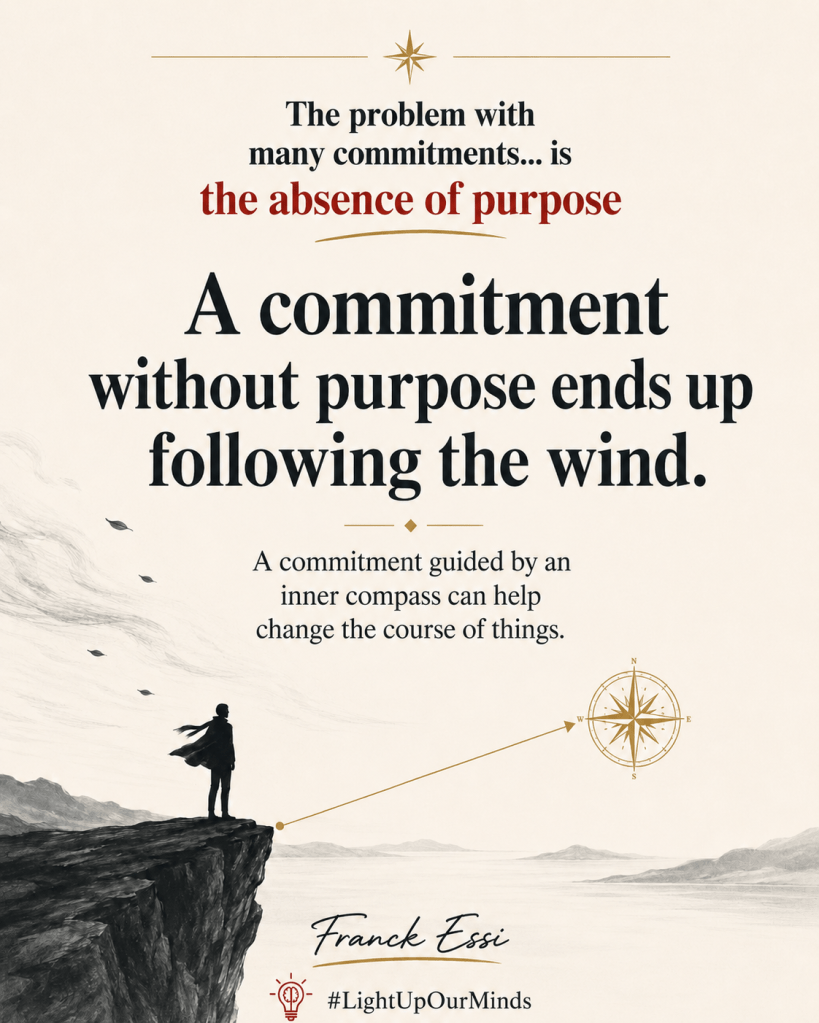
Defining one’s objective means giving oneself a compass
Because defining one’s objective means giving oneself a compass.
It means knowing, even amid disorder, frustrations, contradictions, and delays, why we continue to move forward.
It means refusing to be carried only by events.
It means moving from mere presence to more conscious contribution.
It means learning not to depend only on the leader’s energy, the group’s atmosphere, or the heat of the moment.
In an organization, a person with a clear objective does not merely come to consume collective energy.
They also come to bring something to it.
They reflect.
They propose.
They learn.
They correct themselves.
They move forward, even modestly.
And above all, they understand that commitment is not only about visibility, but about responsibility.
Clarifying one’s commitment is already a first act of leadership
Having a clear objective is already a first form of leadership.
Because leadership does not always begin with leading others.
It often begins with the ability to learn how to lead oneself.
Before wanting to carry others along, we may need to ask ourselves where we are going.
Before wanting to speak in the name of a cause, we must ask what that cause requires of us.
Before wanting to transform an organization, we must accept to transform our own way of being committed.
In our countries, we need leaders.
But we also need more conscious citizens, better-trained activists, more lucid young people, and responsible people more rooted in a cause than in personal ambition.
A strong organization is not built only with people motivated by the atmosphere of the moment.
It is built with women and men who gradually learn to know why they are there, what they carry, what they want to learn, what they want to give, and how far they are ready to go.
My intimate conviction
I am not saying that everyone must have, from the very first day, a perfectly clear vision.
That would be unfair and even unrealistic.
We are all learning.
We sometimes move forward with our fragilities, hesitations, contradictions, and limits.
But I deeply believe that a commitment that never takes the time to question itself often ends up scattered.
Without an objective, there is no trajectory.
Without a trajectory, there is no constancy.
Without constancy, there is no lasting transformation.
And perhaps this is where many forms of commitment should begin:
not only by asking what the organization can bring us,
but by clarifying what we want to become, carry, and build through it.
A commitment without an objective ends up following the wind.
A commitment guided by an inner compass can help change the course of things.
Franck Essi
#IdeasMatter
#WeHaveAChoice
#WeHaveThePower
#LightUpOurMinds