By Franck Essi
For several years, I have been involved in different spheres committed to transforming our societies: associations, civil society organisations, human rights movements, Pan-African networks, citizen initiatives and political parties.
In these spaces, I have met remarkable women and men—people willing to devote their time, resources, intelligence and sometimes even their safety to causes greater than themselves. I have witnessed courage, generosity, perseverance and a sincere desire to serve.
But I have also observed contradictions that have deeply challenged me.
I have seen people demand democracy from the State while refusing dissent within their own organisations. I have seen activists denounce the cult of personality while building movements entirely dependent on them. I have seen defenders of human dignity humiliate their colleagues. I have seen leaders demand transparency from those in government while refusing to account for their own management. I have seen organisations fight exclusion while marginalising those who expressed a different opinion.
These observations obviously do not mean that all activists behave in this way. Nor do they mean that activist circles are morally inferior to the rest of society.
They do, however, reveal an uncomfortable truth: the righteousness of a cause does not automatically guarantee the righteousness of the conduct of those who champion it.
Because we denounce corruption, we may end up believing that we are necessarily honest. Because we fight authoritarianism, we imagine ourselves to be naturally democratic. Because we defend human rights, we assume that the way we treat others must be respectful. Because we criticise those currently in power, we almost instinctively attribute to ourselves greater moral worth and a greater capacity to govern.
Yet denouncing a failing does not prove that we are free from it ourselves.
This is where a dimension that remains insufficiently considered in our collective struggles comes into view: civic inner life.
THE RIGHTEOUSNESS OF THE CAUSE IS NOT ENOUGH
Speaking out remains essential. In societies marked by authoritarianism, corruption, inequality, injustice and human rights violations, remaining silent can help sustain an unjust order.
We must continue to expose abuses, establish responsibility, defend victims, challenge oppressive systems and build the balance of power required to bring about change.
But the ability to see the failings of others clearly is not yet proof of our own maturity.
We may become so preoccupied with everything that is wrong with governments, opponents or other organisations that we no longer recognise what, in our own behaviour, already resembles what we claim to oppose.
We recognise authoritarianism when it comes from the State. Do we recognise it when it appears in the way we conduct a meeting, make a decision or manage a disagreement?
We denounce patronage in public institutions. What do we do when positions of responsibility must be distributed within our own organisations?
We demand transparency from the State. Do our members know how our decisions are made and how our resources are used?
We condemn the suppression of criticism. How do we react when a colleague, comrade or activist challenges our leadership?
The question, therefore, is not merely whether our cause is just.
The real question is whether our conduct, methods and organisations are worthy of that cause.
WE ARE NOT SEPARATE FROM THE SOCIETIES WE WANT TO TRANSFORM
One of our most common mistakes is to imagine that the boundary between the old world and the new world runs neatly between governments and their opponents, between those in power and civil society, or between those who govern and those who challenge them.
The reality is more complex.
To varying degrees, we have all been shaped by the societies we want to transform. We have been socialised through their families, schools, public administrations, institutions and conceptions of authority. Sometimes without realising it, we have learned certain ways of commanding, obeying, punishing, imposing ourselves and seeking recognition.
We may therefore condemn authoritarianism while remaining afraid of dissent. We may fight the personalisation of power while needing to be at the centre of every decision. We may denounce favouritism while giving preferential treatment to those close to us. We may defend human dignity while humiliating those who resist us.
Changing sides does not automatically mean changing political culture.
An opposition leader can reproduce the practices of the government they oppose. A Pan-African activist can invoke the liberation of Africa while denying freedom of expression to those around them. A human rights defender may know every international convention and still show little consideration for colleagues. The head of an association may speak about the common good while using the organisation as an instrument for personal recognition.
In other words, we can fight a system while continuing to carry some of its logic within us.
This reality should not lead us to despair. It should lead us towards greater lucidity.
POWER PUTS OUR PRINCIPLES TO THE TEST
Imagine an activist who spends years denouncing the concentration of decision-making at the top of their organisation. They demand greater consultation, transparency and collective responsibility.
When they finally reach a leadership position, they discover that consultation takes time, dissent is uncomfortable and delegation requires surrendering some control.
Gradually, their language begins to change.
They explain that there is a need to move quickly. That the others are not yet ready. That the situation requires strong leadership. That exceptional circumstances make it impossible to apply immediately the very principles they defended yesterday.
Arguments they found unacceptable when used by those in power suddenly appear reasonable when they protect their own position.
This activist has not necessarily become a bad person overnight. They have simply discovered that principles are much easier to proclaim when they do not yet limit our own power.
Democracy is easy to defend when we are denied a voice. It becomes more demanding when we must listen to a voice that unsettles us.
Transparency is easy to demand when others must account for their actions. It becomes more difficult when we must explain our own decisions, acknowledge an error or justify how resources have been used.
Political alternation seems self-evident when we are seeking to replace those in power. It becomes a genuine test when our own term of office comes to an end.
Justice appears simple when the rules punish an opponent. Its true depth is revealed when those same rules disadvantage a friend, an ally or our own organisation.
Our values are not truly revealed by the speeches through which we proclaim them. They are revealed in situations where respecting them costs us something.
LOOKING WITHIN OURSELVES TO BETTER SERVE THE “WE”
In his book Du Je au Nous : l’intériorité citoyenne, le meilleur de soi au service de tous—From Me to We: Civic Inner Life, Bringing Out the Best in Ourselves in the Service of All—Thomas d’Ansembourg connects two dimensions that we often separate: inner work and responsibility towards the community.
Inner life refers to our ability to step back and observe what is happening within us: our emotions, needs, fears, wounds, ambitions, habits and deeper motivations.
It becomes civic when this work of self-awareness improves the way we participate in collective life, exercise responsibility, manage disagreement and contribute to the common good.
It is not, therefore, about withdrawing from the world. It is not about replacing political struggle with personal development. Nor is it about asking victims of injustice to meditate while systems of oppression continue their work.
This clarification matters.
We cannot end a dictatorship through introspection alone. We cannot fight corruption solely by working on ourselves. We cannot reduce inequality without public policies. We cannot protect freedoms without institutions, mobilisation, organisation, law, vigilance and a favourable balance of power.
But the reverse is equally true.
We can change those who govern without changing the way power is exercised. We can adopt new laws without transforming the behaviours through which they are circumvented. We can build new institutions and continue to operate them according to old practices.
Civic inner life does not replace political transformation. It questions the human, ethical and relational qualities of those who seek to lead it.
It invites us to ask ourselves:
What is truly driving me when I make an important decision?
Is it the interest of the cause? The fear of losing control? The need for recognition? The desire to serve? Resentment? Jealousy? Personal ambition? A sincere desire to build?
Am I defending a value or merely protecting my position?
Do I genuinely oppose authoritarianism, or do I merely oppose the authority of those currently in power?
Am I committed to transparency as a general principle, or only as a means of weakening my opponents?
Until we examine these questions, our least conscious motivations may use the noblest causes to pursue objectives that are far less noble.
OUR CONTRADICTIONS APPEAR IN ORDINARY ACTIONS
Grand declarations are not enough to reveal the real culture of an organisation. We must observe what happens within it every day.
A leader may, for example, claim that her organisation values participation. Yet when a young member challenges her proposal, she interrupts him, dismisses his experience and carries on with the meeting as though nothing important had been said.
The problem is not limited to one person’s poor reaction. The scene reveals how the organisation treats dissent when it comes from someone with less power.
Democracy, therefore, cannot be measured solely by the theoretical right to speak. It must also be measured by the way power receives speech that makes it uncomfortable.
In such a situation, a simple practice would be to restate the objection fairly before responding: “Have I understood your concern correctly?”
This does not require us to agree with the criticism. It requires us to take it seriously.
Consider another example.
A movement demands that the State publish its expenditure and account for its management. Yet its own members receive no financial reports and do not know how the main budgetary decisions are made.
Transparency is proclaimed, but it does not yet structure the movement’s internal operations.
Consistency does not require us to become perfect immediately. It requires us gradually to establish practices that reflect the principles we defend: regular financial reports, accessible information for members, clear decision-making rules and effective oversight mechanisms.
Finally, consider an organisation that denounces the personalisation of power. Yet its founder chairs every meeting, almost always speaks on behalf of the group, appoints its principal leaders and remains its only recognisable public face.
Such an organisation may sincerely oppose the cult of personality in society while reproducing, on its own scale, excessive dependence on a single individual.
Consistency would require it to distribute speaking opportunities, delegate responsibility effectively, establish term limits and prepare new leaders to take over.
These examples reveal an essential truth: we can reproduce a political culture without ever using the words that describe it.
WHEN DISSENT BECOMES BETRAYAL
Another frequent contradiction can be found in the way we deal with disagreement.
An activist may be considered loyal as long as they approve of the group’s decisions. The day they express reservations or formulate a criticism, they become suspect. The substance of their argument is no longer discussed. Instead, people immediately begin asking whom they work for, what their true intentions are or which opponent may have manipulated them.
Gradually, binary thinking takes hold:
- either you are with us or you are against us;
- either you approve of everything or you are betraying the cause;
- either I remain in control or I lose my authority;
- either our organisation obtains everything it wants or it has lost everything.
This way of thinking is dangerous. It turns disagreement into disloyalty, criticism into aggression and the person who disagrees with us into an enemy.
Yet an organisation in which no one can challenge its leaders does not become stronger. It simply becomes less capable of recognising its mistakes.
Criticism can sometimes be malicious, manipulated or politically weaponised. It would be naïve to ignore this. But that possibility must not become a pretext for disqualifying every critical voice.
A mature organisation must learn to distinguish between the substance of a criticism, the manner in which it is expressed and the possible intentions of its author. It must examine the facts before judging the person.
Democracy may begin precisely here: in our ability to recognise that those who disagree with us have the right not to be immediately turned into enemies.
MOVING FROM REACTION TO CREATION
Our movements are often compelled to react. We must respond to injustice, denounce a decision, protect someone under threat, challenge a violation or intervene in an emergency.
Reaction is therefore sometimes necessary.
The problem begins when all our collective action becomes a succession of reactions. We react to every statement, every provocation, every controversy and every manoeuvre by those in power. We issue statements, hold meetings, launch campaigns and publish content without always taking the time to determine where we truly want to go.
We know what we reject. But do we know clearly enough what we want to build?
Consider a public criticism directed against us.
When I am reacting, I feel attacked. I respond immediately. I question the author’s intentions and mobilise those close to me to defend my image.
With a more conscious approach, I step back. I distinguish the facts from the tone in which they were presented. I identify what is true, what is open to debate and what requires clarification. I then choose a response that protects the truth, the relationship and the cause.
Stepping back does not mean remaining passive or accepting the unacceptable. It means preventing anger, hurt or fear from deciding our response on their own.
Indignation can awaken us. Anger can warn us that a boundary has been crossed. But neither is sufficient to build a strategy.
To transform a society sustainably, we must move:
- from indignation to understanding;
- from understanding to vision;
- from vision to organisation;
- from organisation to strategy;
- from strategy to a balance of power;
- from a balance of power to institutional change;
- from institutional change to a new political culture.
In other words, it is not enough to react against what we reject. We must become capable of creating what we claim to want.
ACTIVISM CAN SOMETIMES BECOME A WAY OF ESCAPING OURSELVES
This reflection also leads me to question the permanent activism sometimes found within our circles.
Always being in meetings, always campaigning, always travelling and always responding to a new emergency can create a sense of being useful, necessary and even indispensable.
This activity may be entirely sincere. It may also produce important results. But it can sometimes prevent us from stopping to examine what is driving us.
Why do I need so strongly to be at the centre of every initiative?
Why do I find it so difficult to delegate?
Why does every criticism feel like an attack?
Why does the presence of another leader seem to threaten my own position?
Why do I sometimes measure the importance of an action more by its visibility than by its actual impact?
Why do I need the cause to depend on me?
Intense commitment is obviously not always an escape. The problem arises when action leaves no room for reflection, discernment, learning or inner renewal.
We may run for a very long time in the service of a struggle without stopping to ask what, within us, is truly directing the race.
Civic inner life creates this necessary pause. Not to condemn us, but to make us freer. Not to weaken our commitment, but to prevent our blind spots from eventually weakening the cause itself.
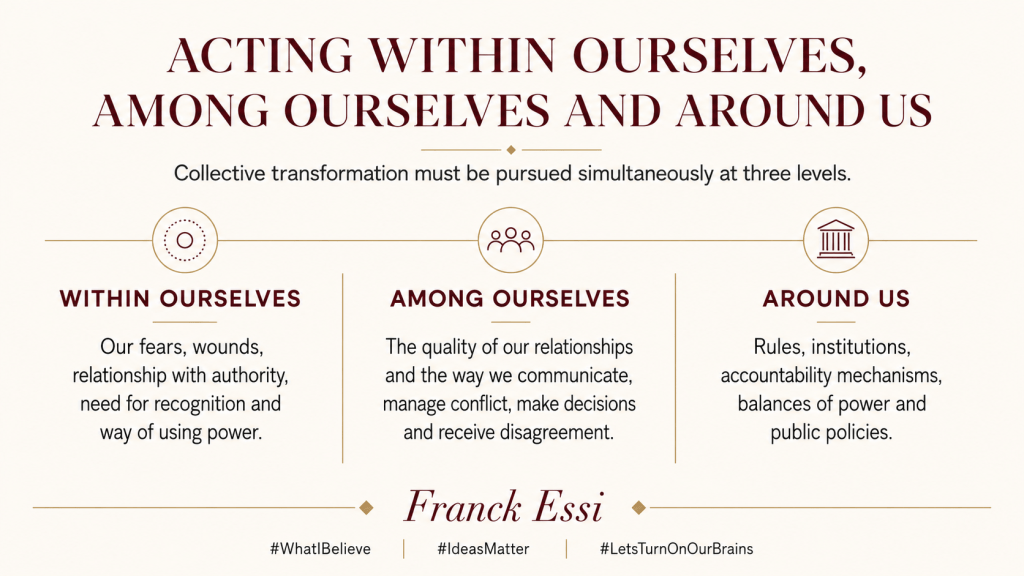
ACTING WITHIN OURSELVES, AMONG OURSELVES AND AROUND US
Collective transformation must be pursued simultaneously at three levels.
The first concerns what happens within us: our fears, wounds, relationship with authority, need for recognition and way of using power.
The second concerns what happens among us: the quality of our relationships and the way we communicate, manage conflict, make decisions and receive disagreement.
The third concerns what happens around us: rules, institutions, accountability mechanisms, balances of power and public policies.
Consider an organisation that wants to become more democratic.
At the inner level, each leader must examine their fear of losing control, their need to be right and their difficulty accepting dissent.
At the relational level, the organisation must establish rules governing discussion, delegation, decision-making and conflict resolution.
At the institutional level, it must enshrine those rules in its governing documents, limit terms of office, create appeal mechanisms and make accountability mandatory.
Inner work transforms how we exercise power. Relational work transforms how we function together. Institutional work ensures that everything does not depend on the goodwill of one person.
These three dimensions are not opposed to one another. They complement one another.
A transformation limited to individuals risks remaining powerless against systems. A transformation limited to institutions risks gradually being emptied of its meaning by the conduct of those who lead them.
Beginning with ourselves does not mean ending with ourselves. It means accepting our share of responsibility in a transformation that must also become collective, organisational and institutional.
OUR ORGANISATIONS SHOULD BE LABORATORIES FOR THE NEW WORLD
Associations, citizen movements and political parties are not merely instruments for securing rights, influencing public policies or gaining political power.
They are also spaces in which we learn how to live together.
If we want to build democratic societies, our organisations must begin by practising democracy.
This requires, among other things:
- rules that are known and apply to everyone;
- transparent circulation of information;
- regular accountability mechanisms;
- a genuine right to dissent;
- effective delegation of responsibility;
- non-violent conflict management;
- a clear distinction between the interests of the cause and those of its leaders;
- genuine preparation for leadership succession.
The quality of internal relationships is not a secondary matter. It directly affects the credibility, effectiveness and sustainability of a movement.
An organisation that publicly defends democracy while operating internally through fear, opacity and the personalisation of power will struggle to prepare the ground for a democratic society.
More importantly, it risks reproducing, on a smaller scale, the very system it claims to want to replace.
Our organisations should therefore embody, in their everyday practices, something of the new world they claim to be building.
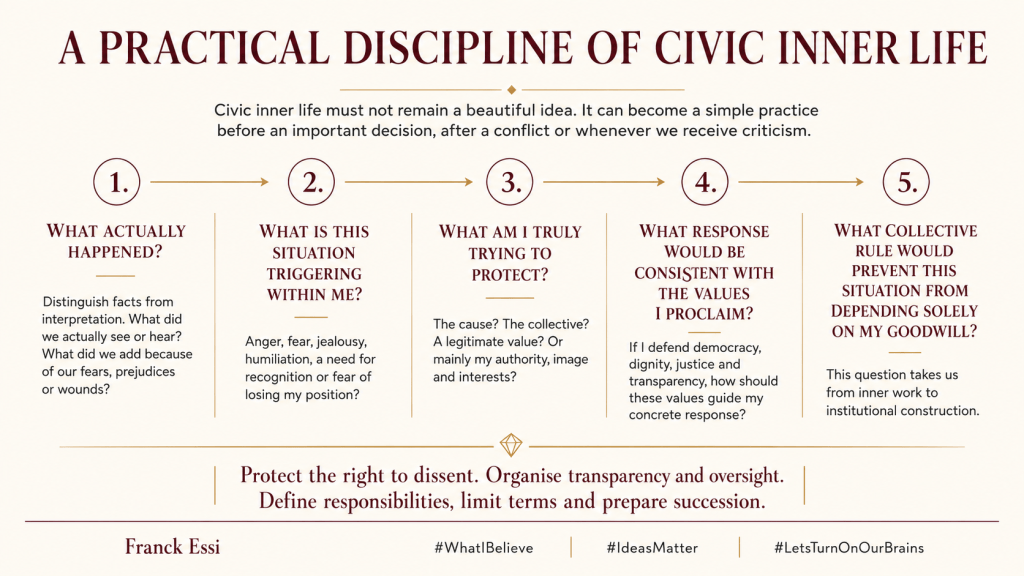
A PRACTICAL DISCIPLINE OF CIVIC INNER LIFE
Civic inner life must not remain a beautiful idea. It can become a simple practice before an important decision, after a conflict or whenever we receive criticism.
We can then ask ourselves five questions.
First: What actually happened?
This means distinguishing facts from our interpretation. What did we actually see or hear? What did we add to the situation because of our fears, prejudices or wounds?
Second: What is this situation triggering within me?
Is it anger, fear, jealousy, a sense of humiliation, a need for recognition or the fear of losing my position?
Third: What am I truly trying to protect?
The cause? The collective? A legitimate value? Or mainly my authority, image and interests?
Fourth: What response would be consistent with the values I proclaim?
If I defend democracy, dignity, justice and transparency, how should these values guide my concrete response?
Fifth: What collective rule would prevent this situation from depending solely on my goodwill?
This final question is decisive. It takes us from inner work to institutional construction.
It is not enough for a leader to be personally tolerant. The right to dissent must be protected. It is not enough for a person in authority to be honest. Transparency and oversight must be organised. It is not enough for a founder to delegate spontaneously. Responsibilities must be defined, terms limited and succession prepared.
Personal virtue is necessary. But institutions must ensure that respect for principles does not depend solely on the virtue of individuals.
A CHALLENGE THAT ALSO APPLIES TO ME
This reflection is not addressed only to others. It also challenges me personally.
It compels me to examine the way I lead, listen, speak, decide and handle disagreement. It invites me to identify the moments when I, too, may confuse firmness with rigidity, conviction with absolute certainty, authority with control, and commitment with a need for recognition.
None of us is perfectly consistent. No activist, leader or citizen is entirely free from ego, fear and contradiction.
The objective is therefore not to wait until we are beyond reproach before acting. Such an expectation would become another form of inaction.
The challenge is to accept a permanent discipline of lucidity, truth and transformation.
After making a difficult decision, do we have the courage to examine our true motivations?
After a conflict, are we able to acknowledge our share of responsibility?
Can the people who work with us tell us the truth without fearing that they will be marginalised?
When we make a mistake, is our first instinct to learn from it or to protect our image?
Do our daily practices already embody something of the society we want to build?
These are not merely personal questions.
They are profoundly political questions.
THE NEW SOCIETY ALSO BEGINS IN THE WAY WE BUILD IT
Our African societies need stronger institutions, better-organised citizens, responsible leaders, effective checks and balances, and genuine transformation projects.
They also need women and men capable of exercising differently the power they seek.
Denouncing what is wrong remains essential. But denunciation does not automatically make us better than those we denounce. The accuracy of our analyses guarantees neither the maturity of our conduct nor the quality of our leadership.
We must fight unjust systems without allowing their logic to govern our own organisations.
We must transform institutions while also transforming everything within us and among us that could reproduce authoritarianism, exclusion, opacity and domination.
We must learn to defend democracy when we are challenged, transparency when we are required to account for our actions, justice when those close to us are involved, and political alternation when our own time in power comes to an end.
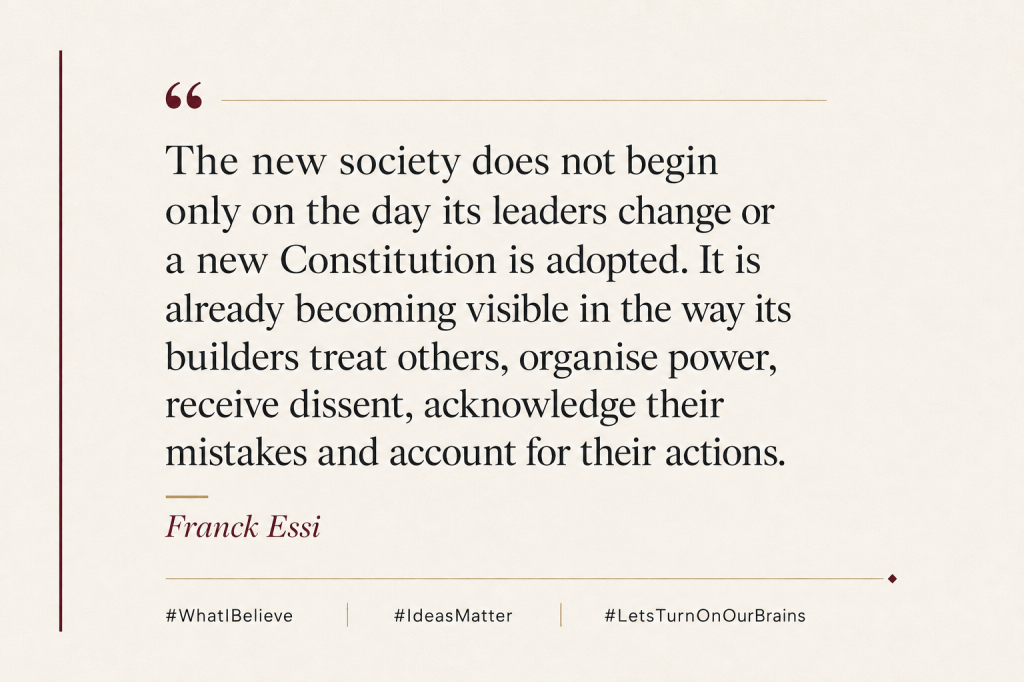
The new society does not begin only on the day its leaders change or a new Constitution is adopted. It is already becoming visible in the way its builders treat others, organise power, receive dissent, acknowledge their mistakes and account for their actions.
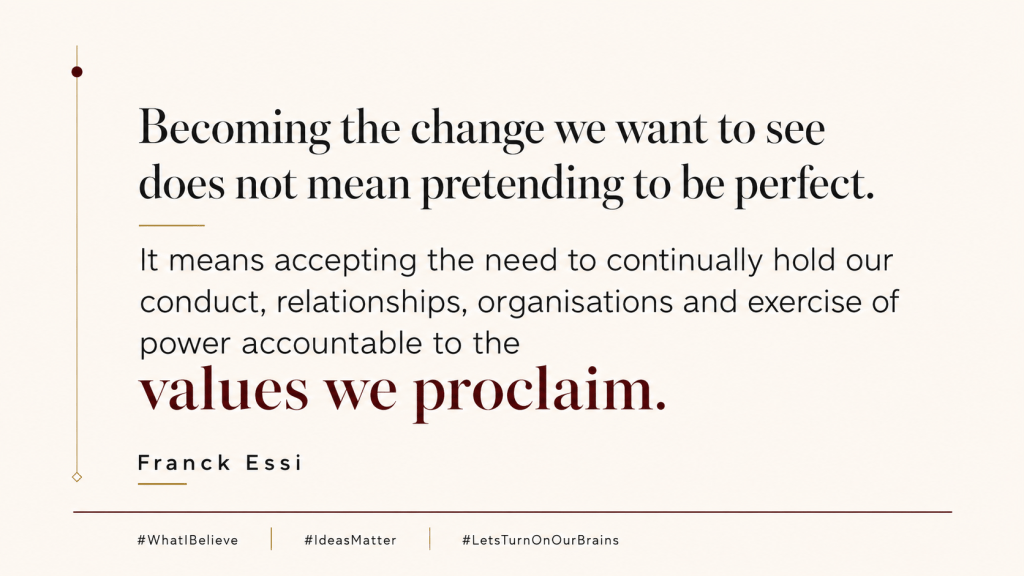
Becoming the change we want to see does not mean pretending to be perfect. It means accepting the need to continually hold our conduct, relationships, organisations and exercise of power accountable to the values we proclaim.
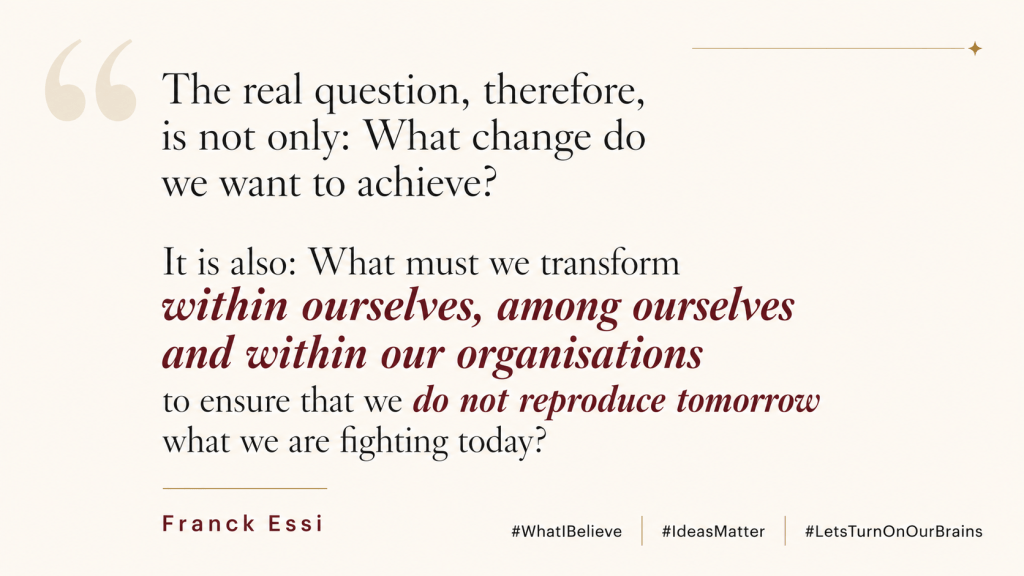
The real question, therefore, is not only: What change do we want to achieve?
It is also: What must we transform within ourselves, among ourselves and within our organisations to ensure that we do not reproduce tomorrow what we are fighting today?
Franck Essi
#WhatIBelieve
#IdeasMatter
#LetsTurnOnOurBrains